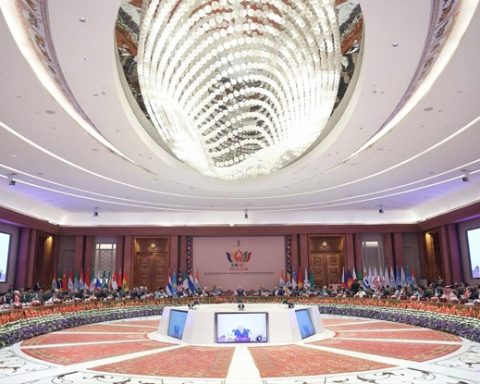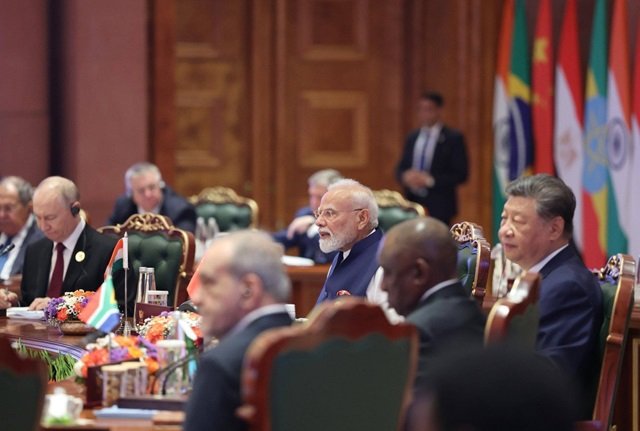
At the BRICS Business Forum in Bharat Mandapam on Friday, Russian President Vladimir Putin read out the numbers. The eleven members of this grouping now produce more than 40 percent of the world’s output. The G7 produces 29. Over the last five years, BRICS countries generated more than half of all global growth. The G7 managed 18 percent. Narendra Modi, speaking at the same event, added that the bloc is home to half of humanity and a quarter of world trade.
This is not rhetoric. The centre of gravity of the world economy has moved, and India is in the chair while it happens.
Now recall something else that took place in that same hall. On 24 May of this year, US Secretary of State Marco Rubio sat down in Bharat Mandapam for an interview with India Today. Asked about Iran’s closure of the Strait of Hormuz, he called it ‘illegal, unlawful, reckless, dangerous, and unacceptable’. Then he said something more revealing. ‘I think the whole world needs to say that, and most of the countries in the world are saying that. India is saying that.’
An American official, sitting in Delhi, announced India’s foreign policy position on its behalf. Nobody in the room corrected him. In the same interview Rubio said the trade agreement was ‘weeks, not months’ away. Four months later, it is still unsigned.
That gap, between the weight India carries and the voice it uses, is what this week is really about.
India Called This Into Being
India did not join the Global South. It helped create it.
In March 1947, months before independence, Delhi hosted the Asian Relations Conference. At the Bandung Conference in 1955, India’s first Prime Minister Jawaharlal Nehru was among the chief architects of an idea that seemed audacious then and remains unfinished now: that newly free countries did not have to rent themselves to Washington or Moscow to be taken seriously. The Bandung spirit produced the Non-Aligned Movement, then the Group of 77 in 1964, and then the demand through the 1970s for a New International Economic Order, which was simply a demand that the IMF and the World Bank stop working only for the countries that funded them. India made those arguments first and made them at a time when the material conditions were not as conducive as we see today.
What India has done inside BRICS follows directly from that. At the Delhi summit of 2012, under Manmohan Singh, the group took up the idea of a development bank and asked its finance ministers to study it. That became the New Development Bank, with an Indian, K.V. Kamath, as its first head. The same summit set up the $100 billion Contingent Reserve Arrangement. At Goa in 2016 both were made operational, and India put forward the idea of a BRICS credit rating agency, aimed squarely at the three Western firms whose verdicts decide what every poor country pays to borrow. In 2021 India proposed the BRICS platform for digital public goods. Across four chairships and two very different governments, India’s contribution has been consistent: turning complaints about an unfair world into institutions that can actually be used.
Now look at how Washington talks about that country.
In July 2025, announcing his first tariffs, US President Donald Trump called India and Russia ‘dead economies’ and said they could ‘take their dead economies down together, for all I care’. He has called India the ‘tariff king’ and its trade rules ‘obnoxious’. After Indian Prime Minister Narendra Modi went to the Shanghai Cooperation Organisation summit, Trump called the relationship ‘a totally one-sided disaster’. In April this year he shared, without comment, a post describing India as ‘some other hellhole on the planet’. Our foreign ministry replied that this was ‘uninformed, inappropriate and in poor taste’. When Rubio was asked in Delhi about the racist abuse Indians face in America, he said that ‘every country in the world has stupid people’.
No country of India’s size is spoken to this way. The damage is not to anyone’s feelings. It is what other governments now expect of us.
Standing is not a sentiment. It is a prediction that other capitals make about how you will behave when you are pushed. For seventy years, the prediction about India was that it would not be told what its position was.
Five Things India Should Do This Week
Start with Iran, because the silence there has cost us the most.
Standing with Tehran has nothing to do with liking its government. A member state of the United Nations was illegally bombed by Israel and the United States of America, and its leadership killed. If the largest grouping of developing countries cannot say so plainly, then sovereignty becomes a privilege granted at Washington’s pleasure, and every country sitting in Bharat Mandapam holds it on loan. Bandung was convened to reject exactly this, and India wrote the rejection.
Our own losses are not abstract. The frigate Dena was sunk on 4 March with 87 men aboard, days after exercising with the Indian Navy at Visakhapatnam. Admiral Arun Prakash, a former navy chief, called it ‘a perverse act’ by a country ‘supposed to be friends and partners’. More than 11 Indian sailors have been killed since. Hormuz carries most of our cooking gas, and its closure puts queues outside Indian kitchens. Chabahar, a decade of Indian money and our only road to Central Asia that avoids Pakistan, was abandoned when an American waiver was allowed to lapse in April. We have been here before. In Trump’s first term, India resisted American sanctions on Iran and then gave in completely, ending every barrel of Iranian oil and damaging a relationship built over centuries.
So why does the Indian state keep walking towards Washington after every humiliation? Not out of confusion. The corporate class that matters politically in this country raises money in New York, lists there, sells services there and answers to regulators there. For them, alignment is good business. For the sorghum farmer in Rajasthan whose tariff protection was traded away in February, it is ruined. Over 45 percent of Indians still depend on farming.
The chairship is the one thing Washington cannot take from India this week. Five demands would make the Delhi Declaration an important step towards global south solidarity and action.
One. Name it. The declaration must say what was done to Iran and to the Strait of Hormuz and must reject unilateral secondary sanctions as a category. Washington has increased sanctions on its targets by 933 percent in recent decades. A bloc that cannot describe the main act of force in its own year has told everyone what its words are worth.
Two. Put Global South debt at the centre. Some 3.4 billion people live in countries that spend more on debt interest than on health or education. In 2023 the poorer nations paid $25 billion more to foreign creditors than they received. India should make debt relief the bloc’s headline demand and push the New Development Bank to lend without IMF-style conditions attached.
Three. Open the door wider. BRICS should stop behaving like a club of the eleven. Expand New Development Bank membership to developing countries outside the grouping, give partner states a real say rather than a seat at the back, and have India publicly champion Africa’s place in the bloc’s decision-making.
Four. Build food security together. Set up the grain exchange, and behind it a shared reserve that member and partner countries can draw on. India, of all countries, knows what it means to depend on someone else’s harvest. We must remember the history when India went to Washington for wheat in the 1960s and spent thirty years making sure we would never do it again.
Five. Make reform a demand of the bloc, not a bid for ourselves. India has spent two decades asking for a permanent Security Council seat. It should spend this week asking for Africa’s, and for an end to the 85 percent voting rule that gives the United States a permanent veto at the IMF. Ask for everyone, and the asking carries weight. Ask only for yourself, and it looks like what it is.
In 1947 India convened the Asia Relations Conference in Delhi with no power and enormous standing. In 2026 it has real power and is spending the time standing down. A new Bandung will not be built by a country that waits to be told what it thinks. The gavel is ours until Saturday evening.