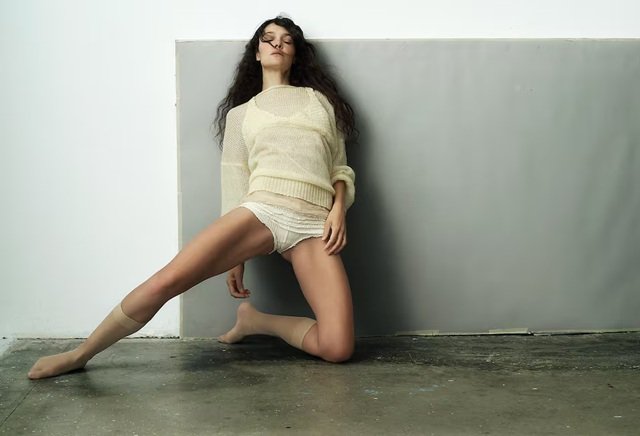
Spanish actor Ana Rujas is preparing for one of the most physically demanding roles of her career: portraying the first Spanish woman to win a world boxing championship. The series, written by María Cantuel and produced by Kubik Films, will require Rujas to transform her body as she continues developing the screenplay for her first feature film, a project she has been working on alongside her acting career.
In an interview with El País, Rujas discusses the creative risks she believes are necessary in both acting and writing, as well as her growing discomfort with the expectation that contemporary artists should construct recognisable public identities around their work. Her comments point to a wider tension between artistic creation and the increasingly prominent public persona that is often expected to accompany it.
Rujas’s recent career has moved between acting, writing and theatre. Her book La otra bestia later became a theatrical production under the same title at Nave 10 Matadero. Both projects emerged from her interest in bodies and the processes of domestication they undergo in order to belong to a community, whether emotional, social or creative.
The book opens with the statement, “It is not interesting to write about oneself,” a position that reflects Rujas’s resistance to reducing artistic work to an easily identifiable version of its creator.
That resistance extends to social media and the pressure to make an artist’s personal identity part of the product. Rujas says creators can feel obliged to construct an attractive and functional identity before they are even given a platform.
“It seems that, in order for them to give you a place, you have to have created an identity of your own that works, that is attractive. And then they give you the loudspeaker. This has caused me a great deal of anxiety,” she says.
She has become increasingly uncomfortable with the expectation that artists should constantly express their personal opinions online.
“For me, there has come a point when it no longer seems bearable,” Rujas says. Rather than continuously presenting herself as an individual public figure, she prefers to create fictional works that do not necessarily correspond directly to her own opinions.
“I prefer to create fictions that do not have so much to do with what I think as an actor or, so to speak, as a public figure. Showing my opinion as an individual does not interest me as much. I am more interested in how that opinion is translated creatively.”
The same tension between personal experience and fictional creation runs through her writing. The opening quotation of La otra bestia comes from Simone Weil: “Every being screams silently, wanting to be read differently.” Rujas’s work, while not presented as straightforward autobiography, draws on physical and emotional experience and examines the ways gender and class shape the conditions in which people live.
That approach also informs the feature film she has been developing in recent years. Rujas has been searching for time between acting commitments to establish the concentration required to write a screenplay. She says the process requires her to accept uncertainty rather than retreat into familiar images or established formulas.
“I feel that if I don’t take a risk with something, it won’t work,” she says. “It’s as if, unless I put myself a little bit between the ropes, so to speak, something is not going to happen. That happens to me both when I act and when I write.”
For Rujas, acting means bringing an action into the body so that a character can develop beyond a consciously controlled performance. She describes the process as an act of generosity: making space within oneself for the lives contained in other people’s stories.
Her career has also been shaped by collaborations with other women. One of the most significant was the creation of the series Cardo with screenwriter Claudia Costafreda, with whom Rujas says she developed a particularly strong affinity. Costafreda was the first person to read her screenplay and, according to Rujas, remains the first person she calls when she receives or loses an acting role.
Rujas has also spoken about the pain of not always feeling supported by other women. A passage in La otra bestia asks what happens when one woman rejects another, and whether such rejection produces power or instead creates an inward sense of degradation.
Rujas says she had expected female solidarity to provide a form of recognition she particularly needed, but that such solidarity had not always been present. Her relationship with Costafreda, however, became an important counterexample.
“She has been my companion and will continue to be. The process has been very beautiful, and we have learned from each other,” Rujas says. “She is a fundamental person in my career and in my life.”
Her next projects continue to place the same demand at the centre of her work: taking enough creative and personal risk for something new to emerge.