The arrest of August Hanning, Germany’s former intelligence chief, has prompted calls across the Bundestag for tighter restrictions on what senior intelligence officials can do after leaving government, including demands for a ban on private-sector lobbying and consultancy work in the security field.
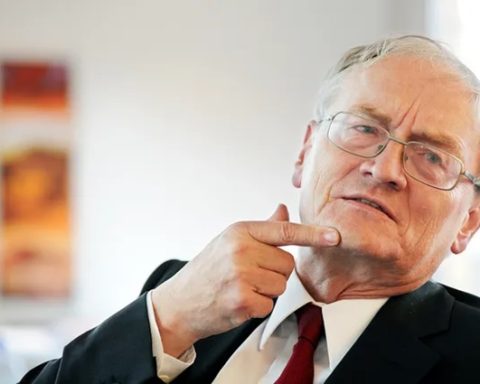
Hanning, who headed Germany’s Federal Intelligence Service, the Bundesnachrichtendienst (BND), from 1998 to 2005, was arrested in North Rhine-Westphalia on Tuesday. The Federal Prosecutor’s Office accuses him of intelligence-agent activity, treasonous espionage, obtaining state secrets and attempted treason. He was due to appear before an investigating judge at the Federal Court of Justice in Karlsruhe on Wednesday, who was to formally announce the arrest warrant and decide whether he would remain in pre-trial detention. Hanning’s former office manager at the BND, Manfred D., had already been placed in pre-trial detention a day earlier on suspicion of aiding attempted treason and treasonous espionage.
According to the investigation described by Die Zeit, the two men are believed to have agreed in about 2010 that D., who had worked for Hanning before the latter left the BND, would continue supplying his former boss with valuable intelligence obtained from the service in return for payment. Hanning allegedly used the information commercially in his work as a security adviser. Investigators believe D. provided him with nearly 2,000 documents by June 2022.
The documents reportedly included highly sensitive BND briefings prepared for the weekly intelligence situation meetings at the Federal Chancellery. Among the material were reports concerning Iran’s nuclear programme and the Russian military, as well as information originating from foreign partner intelligence services. Investigators are examining whether Hanning used material from the BND to produce at least one security analysis for a foreign intelligence service and whether he used classified information in communication with a foreign agent. The investigation does not currently identify Russia as the recipient in the alleged activities.
The discovery of the material followed a search of Hanning’s home and offices in September 2025. The Hamburg State Criminal Police Office had been investigating the case surrounding the alleged abduction of the two youngest children of entrepreneur Christina Block. During the search, investigators reportedly found an electronic storage device containing around 2,000 BND documents that Hanning should not have possessed. The material was subsequently handed to federal authorities. In May 2026, the Federal Prosecutor’s Office opened a confidential investigation into Hanning and his alleged source inside the BND.
The allegations have intensified an existing political debate about the movement of former intelligence officials into private-sector security and consultancy roles. Bundestag Vice-President Omid Nouripour of the Greens told the Kölner Stadt-Anzeiger that the Hanning case showed how sensitive such positions could be for former senior holders of classified information. He called on the federal government to examine the subsequent employment of senior intelligence officials and to prohibit lobbying activities in the security sector after they leave office.
The chairman of the Parliamentary Control Panel responsible for Germany’s intelligence services, CDU politician Marc Henrichmann, said the full circumstances were not yet known but called for a comprehensive investigation. “We have to turn everything upside down now,” he said in the ZDF heute journal. Asked whether rules governing senior officials after leaving intelligence positions were sufficient, Henrichmann answered: “Rather no.”
His parliamentary colleague Konstantin von Notz of the Greens also criticised outside employment by former senior intelligence officials. He said the Parliamentary Control Panel had explicitly warned in May 2023 about the risks associated with secondary employment by people who had held the highest levels of classified information. “That these obvious security problems have not been eliminated is a serious mistake,” von Notz wrote on X.
SPD domestic affairs politician Sonja Eichwede called for the cooling-off rules governing former intelligence leaders to be strengthened further. “The case clearly shows that we need to tighten the cooling-off rules for former senior intelligence service executives,” she said, noting that the previous parliamentary term had already extended the required period. Eichwede argued that a lifetime cooling-off period was needed for former senior intelligence officials.
SPD parliamentary group leader Matthias Miersch and CDU/CSU parliamentary group leader Thorsten Frei also demanded clarification. Frei described the arrest as a “disturbing piece of news” and linked the case to the parliamentary debate over intelligence reform, while Miersch called it an “alarming incident” and demanded discussion of cooling-off periods. SPD intelligence oversight politician Daniel Baldy went further, arguing that anyone who had served as BND president or in another highly security-sensitive position should not subsequently work for a private consultancy.
Hanning entered the private sector after leaving the BND and later served as a security adviser. Before becoming BND president, he had held senior positions in Germany’s security establishment, including work at the Federal Chancellery, and later became a state secretary at the Interior Ministry. The investigation now places renewed scrutiny on the boundary between senior public intelligence service and subsequent private-sector employment, while the allegations against Hanning and D. remain subject to the ongoing criminal proceedings.