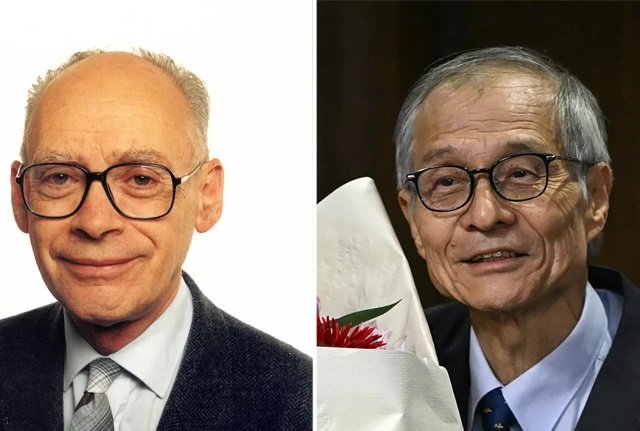
Henri Kagan of the University of Paris-Sud in Orsay, France, and Kenso Soai of Tokyo University have won this year’s Nobel Prize in Chemistry for solving a century-old question about how chemical reactions can produce overwhelmingly one of two possible mirror-image forms of a molecule.
The Royal Swedish Academy of Sciences announced the 12 million Swedish kronor (US$1.2 million) prize in Stockholm on 7 October. Soai said he was shopping near his home when he received the call from the Nobel committee. “I am very excited to receive the very nice news about the Nobel prize. This is one of the most exciting days in my life,” he said.
The work addresses a fundamental puzzle in chemistry and biology. Many organic molecules exist in two mirror-image forms, known as chiral molecules, but living systems often use only one of them. DNA is right-handed, while amino acids are left-handed. Scientists have long sought to understand how this chemical asymmetry, or homochirality, can emerge when ordinary chemical reactions tend to produce equal quantities of both forms.
Kagan’s experiments in the 1980s showed that a small initial imbalance in the handedness of a catalyst could be amplified during a reaction, producing a much larger imbalance in the products. Soai subsequently identified a crucial extension of the principle. In 1995, he demonstrated a reaction in which the chiral product could itself act as a catalyst, creating a self-reinforcing process known as autocatalysis.
“Henri Kagan and Kenso Soai have provided a solution to a chemical mystery that is over a century old: how homochirality can emerge spontaneously,” Heiner Linke, chair of the Nobel Committee for Chemistry, said. “The chemical reactions they have developed are spectacular.”
The underlying idea had been proposed decades earlier. In 1953, Charles Frank, a theoretical physicist at the University of Bristol, suggested that if a chemical reaction could generate its own chiral catalyst, the process could reinforce a small initial imbalance until one mirror-image form dominated. The 2001 Nobel chemistry laureates William Knowles, Ryoji Noyori and Barry Sharpless later developed reactions using chiral catalysts to steer chemical synthesis towards one molecular form. This year’s prize recognises Kagan and Soai for taking the principle further by showing how reactions could generate their own chiral catalyst.
Soai’s 1995 experiment began with a 2% excess of one handedness and ended with an 87% excess. In 2003, he developed what became known as the Soai reaction, in which non-chiral starting materials form two chiral catalysts. A slight random excess of one form can eventually lead to as much as 99.99% of the product having that handedness.
The reaction does not explain why life itself settled on particular molecular forms, but it provides a mechanism through which such an imbalance could develop. Researchers studying the chemical origins of life have investigated whether similar processes might have operated on Earth before life emerged, although the Soai reaction itself requires conditions and reagents that are not readily compatible with a prebiotic environment.
The discoveries have practical importance because the two forms of a chiral molecule can have different chemical properties. Separating them is therefore crucial in drug development. Levodopa, the standard treatment for Parkinson’s disease, is a chiral organic molecule in which only one form, L-DOPA, is the active ingredient. Kagan’s work on amplification effects also contributed to the development by Merck of an effective synthesis of the anti-HIV drug Efavirenz.
The award may also revive a debate over scientific credit. Some researchers believe Kagan and Soai were overlooked for the 2001 Nobel Prize, which recognised methods for selectively synthesising one mirror-image form of a molecule. Kagan’s omission at the time prompted protests from France’s science minister. Stephen Fletcher of the University of Oxford said Soai had made “a superb contribution” to understanding the mechanisms involved.