by Luxman
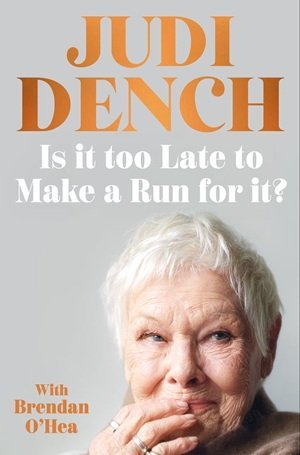
The book’s most interesting achievement may also be its principal limitation: it offers an intimate portrait of one of Britain’s most celebrated actors while raising questions about how personal memory becomes autobiography, how privilege shapes the recollection of childhood, and how family silences survive across generations. In Is It Too Late to Make a Run for It?, Judi Dench, in conversation with Brendan O’Hea, does not attempt a conventional account of professional achievement. Instead, she returns to York, reconstructing the domestic world, family relationships and formative experiences that preceded her extraordinary theatrical career. The result is a conversational memoir that is frequently funny, occasionally unsettling and unexpectedly reflective. Yet beneath its apparent informality lies a more complicated question: how much of a life can be recovered through recollection, and how much is necessarily reinvented in the telling?
O’Hea establishes the organising principle in his preface, describing Dench as someone for whom “Boundaries are there to be crossed, expectations challenged, rules tested” (p. 1). He identifies her appetite for “the adrenaline rush of uncertainty” as a defining characteristic, suggesting that her professional versatility originates in a temperament formed long before she entered the theatrical world (p. 1). This is an attractive interpretative framework, but it also risks making childhood anecdotes serve an overly convenient biographical purpose. The mischievous child becomes the inevitable precursor of the adventurous actor; the rebellious adolescent anticipates the unconventional performer. Such retrospective coherence is characteristic of autobiography, but it should not be mistaken for historical inevitability. Dench’s childhood behaviour may illuminate her temperament, but it cannot, by itself, explain the complexity of an artistic career spanning several generations.
The book’s conversational structure is particularly significant. O’Hea explains that Dench prefers to tell her story through dialogue, allowing herself “to contradict herself, to reassess her extraordinary life and career – both the highs and the lows” (p. 1). This approach has considerable advantages. Rather than imposing the authority of a conventional autobiography, it permits hesitation, digression, humour and the spontaneous recovery of apparently insignificant details. It also creates an impression of intimacy, as though the reader has been invited into a private conversation. Nevertheless, the presence of an interviewer and editor complicates the apparent spontaneity. O’Hea has known Dench for thirty years, and his affectionate description of her as “mercurial, contrary, playful, incisive, resilient – and yes, potty-mouthed” (p. 1) establishes a relationship of familiarity rather than critical distance. The result is a portrait shaped by friendship as much as by recollection. This does not invalidate its testimony, but it raises an important question about what the conversational format allows to emerge and what it quietly leaves unexplored.
York, rather than the theatre, provides the book’s emotional centre. Dench’s return to her childhood home becomes an exercise in confronting the instability of memory. She admits that she had resisted the visit for years, acknowledging the possibility of encountering “too many ghosts”, before concluding that returning was something she needed to do (p. 3). The house is simultaneously a physical location and an archive of personal experience. Its familiar rooms revive memories that are not necessarily accessible through deliberate recollection. Dench observes that the house was “so much smaller than I’d remembered” and reflects on “the tricks that memory plays on us” (p. 9). This is among the book’s most intellectually interesting observations. Childhood memory is not a photographic record; it is a reconstruction in which physical spaces acquire proportions determined by emotion, experience and the passage of time. The house becomes smaller, but the childhood it contains remains immense.
Her recollection of the bedroom windows is especially revealing. “I’ve never had curtains or blinds in my bedroom. Even now, I need to see the sky” (p. 9). The detail is presented almost casually, yet it offers a rare glimpse of an enduring personal disposition. The insistence on an open window, “whatever the weather” (p. 9), suggests an attachment to openness and the external world that transcends the particular circumstances of childhood. More importantly, Dench’s account of recognising the physical arrangement of the house through “a strong sense-memory” (p. 9) invites an intriguing connection with the actor’s craft. Her body appears to retain an understanding of space that conscious memory cannot fully reproduce. Although the book does not develop this into a theory of acting, the observation suggests that performance, like recollection, involves retrieving experiences through physical and emotional associations rather than intellectual reconstruction alone.
The childhood anecdotes are among the book’s most entertaining passages, but they also reveal a more complicated domestic world. Dench recalls firing dried peas at patients waiting outside her father’s medical practice, using a brass curtain rod as a makeshift weapon (p. 7). When challenged about the behaviour, she acknowledges, “It’s not something I’m proud of” (p. 7). Elsewhere, she remembers drawing on the family’s newly decorated hallway because she had been encouraged to draw on her bedroom walls (p. 5). These incidents establish a child who was energetic, imaginative and persistently inclined to test limits. Yet their presentation also demonstrates how memoir can transform potentially unpleasant behaviour into affectionate entertainment. The patients subjected to pea-shooting, for instance, largely remain anonymous figures in the background of a charming childhood narrative. Dench’s admission of wrongdoing provides some moral perspective, but the humour also softens the implications. The distinction between honest self-deprecation and retrospective self-mythologising is not always easily maintained.
The family’s apparent comfort and cultural resources deserve equally careful attention. Dench describes a childhood filled with theatre visits, music, outdoor activities and elaborate family entertainments. Her parents organised treasure hunts, roller-skating and theatrical excursions, while her father painted and her mother embroidered (pp. 10–11). She remembers the household as one in which creativity and play were actively encouraged. Her gratitude is explicit: “It was a charmed childhood and not a day goes by without me realising how blessed I’ve been” (p. 11). This acknowledgement is welcome, but it also exposes a limitation in the book’s treatment of class. Her father was a doctor, the family maintained a medical dispensary in the cellar, and the household enjoyed considerable cultural and educational advantages. Dench recognises parental sacrifice, observing that her parents “went without in order to provide for us” (p. 10). Nevertheless, financial sacrifice within a professional household should not obscure the advantages that accompanied its social position. The memoir is strongest when it acknowledges good fortune; it is less probing about the structures that made that fortunate childhood possible.
The representation of Dench’s mother is particularly revealing. The recollection of her throwing an Electrolux vacuum cleaner and its attachments at a service engineer while demanding the return of her old Hoover is recounted with obvious affection (p. 6). Dench concludes that her mother “had a terrible temper” and describes her as a “fiery redhead” (p. 6). The incident is comic, but it complicates the otherwise reassuring image of domestic harmony. Similarly, her mother’s declaration that Dench was “without doubt the most intolerant person I’ve ever met” (p. 7) reveals a more demanding parental relationship. Dench remembers looking up the meaning of intolerance in the dictionary and resolving not to behave that way. “I’ve never forgotten it” (p. 7), she observes. This episode is more significant than its brevity suggests. It demonstrates how a parent’s criticism can become a lasting instrument of self-examination. The memoir’s emotional intelligence emerges not from presenting a flawless family but from recognising that affection and conflict can coexist.
The book becomes considerably more sombre when Dench examines her father’s experience in the First World War. Her discovery of his military record reveals a young officer decorated twice with the Military Cross, whose actions included defending his men against German attacks and leading a reconnaissance mission across no man’s land. In one particularly striking description, he remained behind “like a shepherd” until his men had reached safety (p. 13). Dench is astonished that he was only twenty years old. Yet the most affecting aspect of this account is not the celebration of military courage but the silence that followed it. “Nor did I ever hear him talk about the war,” she recalls (p. 13). Her subsequent reflection that soldiers would have needed to push such memories away “to remain sane” (p. 13) demonstrates an empathy extending beyond the immediate national narrative. Her observation that the war “Must’ve been horrific. On both sides” (p. 13) is particularly important. It resists the simplification of wartime memory into a comfortable division between national heroism and enemy brutality.
Another unsettling discovery concerns her mother’s brother Johnson, who was presumed killed in the war but apparently survived, eventually settling in Nottingham and running a pub. Dench acknowledges the inexplicable family silence surrounding his disappearance: “He must have suffered some sort of trauma. It’s a mystery” (p. 13). The speculation is necessarily limited, and the available account does not establish why Johnson never contacted his relatives. Nevertheless, this unresolved episode exposes the fragility of family history. Official records, inherited assumptions and personal recollections do not always agree. The discovery also complicates the memoir’s otherwise affectionate reconstruction of family identity: the past contains not merely treasured memories but absences that cannot be satisfactorily explained.
The book’s title, Is It Too Late to Make a Run for It?, acquires an additional resonance against this background. Dench emerges as someone who has never entirely surrendered her appetite for movement, uncertainty and reinvention. Her decision to cut her hair after receiving poor reviews for her performance as Ophelia is a revealing example. Rather than simply accepting professional criticism, she responded with a dramatic change in appearance, unsettling even her father (p. 8). The incident suggests that vulnerability and defiance have coexisted throughout her life. Yet the book offers only limited engagement with the institutional and professional conditions of her career. Readers seeking a sustained examination of theatrical power, gender, artistic compromise or the demands of celebrity may find the emphasis on childhood and family history restrictive.
This is not a comprehensive autobiography, nor does it pretend to be one. Its value lies in its fragments: a childhood drawing preserved on a bedroom wall, an unexplained family disappearance, a father’s unspoken wartime memories and a daughter’s enduring attachment to the night sky. Its conversational warmth is both its principal strength and its most obvious limitation. O’Hea’s evident affection occasionally prevents the narrative from interrogating its own assumptions, while Dench’s recollections sometimes privilege the charm of anecdote over the complexity of historical experience. Yet the book’s refusal to manufacture a perfectly coherent life is also part of its appeal. Its most compelling subject is not celebrity but the uncertain relationship between memory and identity. In returning to York, Dench discovers that the past is neither entirely recoverable nor entirely lost. The childhood house may have become smaller, its inhabitants may have disappeared, and its family secrets may remain unresolved. What survives is something less tangible but perhaps more enduring: the capacity to remember, question and laugh at oneself.