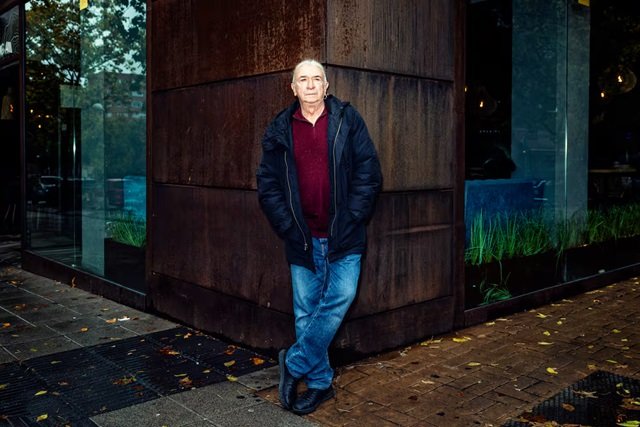
For eight years, Rosendo Mercado has remained largely absent from public life. Since his final concert in December 2018, the Spanish rock musician has resisted the familiar rituals of a comeback, offering no promise of a return to the stage and little indication that he misses it. Now, at 72, he has broken his silence for a different reason: the publication of his memoir, Ni gozo ni calvario (Neither Pleasure nor Ordeal), a deeply personal account of a life spent making music, confronting his own limitations and struggling to reconcile artistic conviction with an often uncomfortable public identity.
In an interview with EL PAÍS at a café in Madrid’s Carabanchel district, where he has lived for much of his life, Mercado makes clear that the book is not the beginning of a musical revival. It is, rather, an attempt to put his experiences into perspective, including the long-standing mystery surrounding the dissolution of Leño, the influential band that helped establish his reputation. He began writing during the pandemic, and the process took approximately five years, interrupted by an operation for arthritis that temporarily prevented him from using one hand.
Mercado’s significance in Spanish music is difficult to separate from the generations that followed him. His influence can be traced through musicians and bands including Robe Iniesta, Barricada, Fito Cabrales, Marea and Rulo. Yet the man himself appears reluctant to claim much credit. He insists that his achievements should not be exaggerated and describes his success in unusually modest terms: he wanted to make a living from music, and he managed to do so.
That modesty is inseparable from his background. Raised in a working-class family in Carabanchel Bajo, he grew up in a neighbourhood where his father worked as a shoemaker. At 15, Mercado took a job as an office messenger at a company manufacturing lime and bricks. Music eventually offered a different future, taking him through the groups Fresa and Ñu before the formation of Leño and a subsequent solo career spanning around 20 albums.
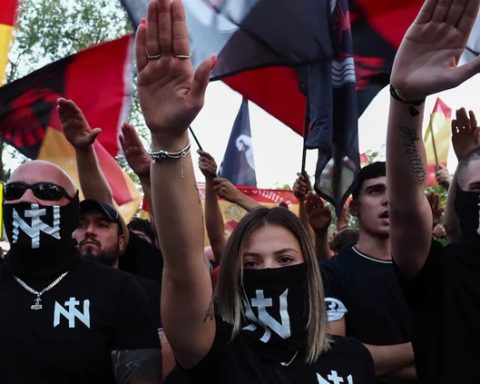
His political identity, he suggests, has remained rooted in those beginnings. Asked about a fan who had shouted “Rosendo, don’t go, Vox is coming” during his farewell concert in Madrid in 2018, Mercado acknowledged the responsibility implied by being regarded as a symbol of resistance. He attributed that perception to the consistency of his writing and his identification with working people. His concern, he explained, has always been to express what he genuinely felt rather than manufacture an image of himself as more attractive, fashionable or important than he was.
For Mercado, authenticity is not a marketing strategy but a consequence of remaining close to the life he knows. He has little interest in presenting himself as a political intellectual or cultural authority. Nevertheless, his music has carried an unmistakable social identification with ordinary workers and neighbourhood life, making him a reference point for listeners who saw their own experiences reflected in his songs.
The memoir also addresses the question that has followed him for decades: why Leño broke up. Mercado describes the separation not as the result of one dramatic confrontation but as the culmination of deteriorating trust and growing personal and professional disconnection. He recalls that guitarist Tony Urbano had become distracted by heroin, while drummer Ramiro Penas had a different temperament. Relations between the members weakened as the demands of the band increased.
The immediate pressure was also becoming intolerable. Mercado was expected to write the lyrics for an upcoming record and felt that the responsibility had fallen disproportionately on him. At the same time, Leño had acquired an extraordinary following among young audiences. The response was so intense that he began to find it unsettling. The band, he recalled, seemed almost like a religion. What appeared to others as success increasingly felt to him like a situation becoming too easy and potentially unhealthy.
He remains conscious that his solo career never quite escaped the shadow of the group. Leño, he says, possessed an energy and collective identity that he has never managed to reproduce independently. Its legacy was larger than any one member, including himself. His willingness to acknowledge that distinction is another example of his resistance to the self-aggrandisement often associated with rock biographies.
Indeed, Mercado’s memoir appears deliberately uninterested in the conventional mythology of excess. He says he was influenced by reading Keith Richards’s autobiography, which he felt placed too much emphasis on the familiar image of the rock musician as a drug-taking survivor. Drugs were present in his own life, he acknowledges, but they were not the central explanation for his music or creativity. He stopped using them in 2010, aged 56, after questioning whether the ritual of taking them while travelling with the band served any purpose. In retrospect, he considers the habit largely foolish and financially wasteful.
More revealing than the accounts of rock-and-roll excess is his description of a persistent internal struggle. Mercado admits that he often lacked the confidence to assert his authority over fellow musicians, technicians and managers, even when he knew what he wanted. Some colleagues took advantage of his reluctance to confront them. “Toda mi vida ha sido una pelea constante conmigo mismo” — my whole life has been a constant struggle with myself — is perhaps the most revealing sentence in the interview.
He also acknowledges the anxiety and anguish that recur throughout the memoir. Although he does not believe he experienced serious mental-health problems requiring treatment, he describes a life in which artistic work was frequently accompanied by uncertainty and self-doubt. Writing songs, he says, was rarely an experience of effortless inspiration. He often struggled to complete lyrics, sometimes finishing them at night under the pressure of recording deadlines.
Even his best-known song, “Maneras de vivir”, is treated without the reverence that might be expected from its author. Mercado says he does not fully understand why it became so enduringly popular, suggesting that Miguel Ríos’s performance of it during the Rock & Ríos concert helped bring it to a much wider audience. He interprets its message simply: people have different ways of living, and those differences are legitimate. It is an unpretentious explanation, but one that captures much of his outlook.
His relationship with Esther, his wife since 1977, has provided a more stable foundation. Mercado credits her with supporting him throughout his career, recalling that she even paid the instalments on his first good electric guitar while he was completing military service. Their marriage, he says, has endured through mutual respect, patience and the ability to support one another.
There is little indication that he intends to return to the stage. He says he has no desire to resume touring and recalls watching the recording of his final Madrid concert with the conviction that retiring had been the right decision. He did not want audiences to see him becoming a diminished version of himself. Nor did he experience the stage as an addiction from which he could not escape.
He may still make music privately, perhaps even record something if the process gives him pleasure, but commercial success is no longer an objective. The memoir, by contrast, offered a challenge he had not previously attempted: writing a book. He approaches that achievement with characteristic self-deprecation, describing his prose as little more than the schoolroom formula of subject, verb and predicate.
Asked whether he is happy, Mercado offers no grand conclusion. He believes happiness consists of occasional moments of feeling well, rather than a permanent state of fulfilment. His final assessment of his life is contained in the memoir’s title: neither pleasure nor ordeal. He has done what he wanted, achieved enough to feel satisfied and accepted that the experience contained both victories and disappointments.
In an industry that often rewards reinvention, spectacle and the performance of immortality, Rosendo Mercado’s refusal to turn retirement into another act of celebrity may be his most distinctive gesture. His memoir does not attempt to construct a flawless legend. It offers something less polished but arguably more enduring: the portrait of a musician who helped others find their voices while spending much of his own life trying to make peace with himself.