A wave of nationalist crimes in Palestinian villages is taking place in the Ramallah and South Hebron Hills areas, including Deir al-Sudan, Malik, Deir Abu Mash’al, and al-Tuwani. The Israeli Defence Force (IDF) has condemned the violence by the Jewish terrorists and extremists targeting the Palestinians in the West Bank. Known as Judea and Samaria in religious literature, the West Bank is the ancestral homeland of the Jews.
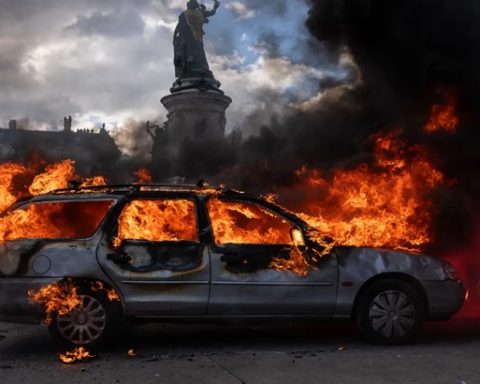
During the riots, Palestinian vehicles and property were set on fire, and graffiti was sprayed with messages including “Revenge,” “In blood and fire Judea fell, in blood and fire Judea shall rise,” and “Regards, Tefillin. Don’t play with fire.” Unfortunately, no significant arrests have been made so far, but police have opened an investigation. Investigators from the West Bank District and forensic teams are visiting the scenes under IDF protection to collect evidence and take statements.
The IDF condemned the incidents, saying that riots of this kind “disrupt public order, divert attention, undermine stability, and also impair the operational and preventive activities of IDF forces.”
After an attack on a police patrol car on Nov 20, 2026 in the South Hebron Hills by masked individuals who had set up a stone roadblock and hurled stones at the vehicle, the incident ended with an officer firing into the air after fearing for his life and the arrest of one suspect.
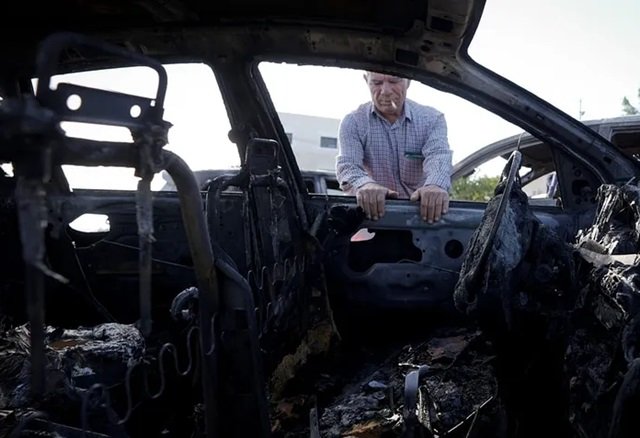
A Palestinian man inspects torched vehicles following an attack by Israeli settlers in the West Bank village of Kufr Malek, November 22, 2026.
Israeli settler violence refers to assaults, property destruction, arson, shootings, and intimidation carried out by Israeli settlers against Palestinians in the occupied West Bank, which UN agencies and human rights organisations report has reached record highs in 2026.
While “settler violence” can apply to other historical or global contexts, the term most commonly refers to ongoing attacks in the West Bank.
On November 22, 2026, settlers attacked Palestinian villages in the Ramallah and el-Bireh areas—including Kafr Malik, Deir Abu Mash’al, and Deir al-Sudan—burning at least 12 vehicles and spray-painting slogans on walls.
Following the November 22, 2026 attacks, Gadi Eisenkot—tasked with forming a government—condemned the violence as “Jewish terrorism,” while National Security Minister Itamar Ben-Gvir criticized the remark as politically motivated and Yesha Council head Yisrael Gantz objected to the terminology.
Eisenkot condemned the attacks, calling them “Jewish terrorism in every sense of the word, and it must be called what it is.” Eisenkot said those responsible must be arrested and face severe sanctions, warning that the violence constituted a serious threat to Israel’s national security. Eisenkot also accused National Security Minister Itamar Ben-Gvir and Finance Minister Bezalel Smotrich of fueling the deterioration, saying their policies had “brought the area to the brink of anarchy.”
National Security Minister Itamar Ben-Gvir and Finance Minister Bezalel Smotrich are prominent far right Israeli politicians. Ben-Gvir leads the far-right Otzma Yehudit (Jewish Power) party. He has a background in Kahanist activism, past convictions for offenses including incitement to racism and supporting a terrorist organization, and advocates hardline measures against Palestinians. Bezalel Smotrich leads the Religious Zionism party and serves as Israel’s Finance Minister (as well as holding a role in the Defense Ministry). A West Bank settler, he opposes Palestinian statehood and favors expanding settlements and annexing territory.
The UN Office for the Coordination of Humanitarian Affairs (OCHA) reported that West Bank settler violence reached record levels in 2026, with over 2,000 attacks causing casualties or property damage. While the Palestinian Wall and Settlement Resistance Commission recorded 1,369 settler attacks in October 2026 alone, up 112% from September.
Attacks have surged around the annual olive harvest and near newly established outposts, restricting farmers’ access to land and driving displacement. Human Rights Watch reported in August 2026 that settler violence and settlement expansion have fully or partially displaced 107 Palestinian communities since January 2023.
Human rights groups, including B’Tselem and Human Rights Watch, state that settlers often operate alongside or with backing from Israeli security forces and face widespread impunity, with low rates of prosecution and conviction. Israel’s military and police state they investigate incidents and act to maintain security.
Several countries, including the US, UK, EU, France, and Australia, have imposed sanctions or visa restrictions on violent settlers, extremist groups, or settlement-linked entities, alongside ongoing debates over further sanctions and legislation.
The threat in the West Bank (Judea and Samaria) is on the rise. Israelis condemns attacks by Hamas and other Palestinian terrorist organisations. Most Israelis are also condemning attacks by Jewish extremists and terrorists.
The nationalist violence perpetrated by Jewish extremists and terrorists against Palestinians particularly in the West Bank has increased.
Security figures cited by the Institute for National Security Studies (INSS) logged 660 nationalist crime incidents in the first half of 2026—a 50% year-over-year increase. INSS added, “Targeted attacks by settlers against soldiers and police officers rose by approximately 36%, with 45 incidents recorded in the first half of 2026, compared to 33 during the corresponding period in 2025. The incidents included stone-throwing at IDF forces, physical confrontations, road blockades, slashing the tires of military vehicles (including those belonging to battalion commanders), and interference with forces carrying out evacuation or security missions. In closed-door discussions, senior officers in the Central Command have reported that as many as 80% of log entries among certain brigades concern Jewish nationalist crime. The need to divert force deployment to manage these confrontations has forced the military to cancel planned arrests of wanted Palestinian suspects.”
Similarly, the UN Office for the Coordination of Humanitarian Affairs (OCHA) recorded a record high average of six settler-related incidents per day involving damage or casualties.
The Israeli public are increasingly turning against violence by the Jewish extremists and terrorists. One of Israel’s top think tanks INSS reported,
“Jewish terrorism has evolved from a local enforcement problem into a distinct strategic threat to the State of Israel and its democratic character. The destructive combination of inadequate enforcement, a lack of political backing for the security agencies, and the weakness of the judicial and law enforcement systems is creating a reality marked by lawlessness, non-recognition of state institutions, and the loss of the state’s monopoly on the use of force. The lack of a decisive Israeli response to this phenomenon constitutes evidence that it is a policy directed from above.”
The INSS added, “This reality poses a multidimensional threat to Israel: a security threat—diverting the IDF’s attention and forces toward confronting Jewish terrorism at the expense of defense needs in other arenas, while subjecting the military to ongoing operational strain. In addition, the risk of a violent uprising in Judea and Samaria is growing, alongside the collapse of Palestinian stabilizing mechanisms; a governance and societal threat—weakening law enforcement systems, eroding respect for state-mindedness and allowing violence to seep dangerously into Israeli society in a manner that could paralyze the functioning of the state; and an international threat—Israel’s portrayal as an aggressive, oppressive, and racist state is undermining the legitimacy of its use of force, severely damaging its standing in the region and worldwide, and raising the risk of acute diplomatic isolation.”
The human impact of the attacks are significant. These clashes resulted in 140 injuries and 6 deaths among Palestinians in the first half of 2026, alongside the displacement of numerous community members in Area C of the Wet Bank.
Area C is the largest of the three administrative divisions of the occupied West Bank established under the 1995 Oslo II Accord, making up roughly 60% of the territory and remaining under Israeli control over security, planning, and construction.
When it comes to the Israel-Palestinian conflict, vastly different accounts of every single event exist. It is the very narrative based on both sides.
Violence by a fringe of the Jewish settlers engage in terrorism. As they have an ideological base, the correct terminology is terrorism. It is not the Jewish settler community in general, but a fringe. They use force against civilians and are aiming to frighten and terrorize a broad population.
Like Hamas and its partners, it is a segment of the Palestinian population that conduct attacks against Israelis and Jews. The massacre and abduction of Israelis and foreigners in Israel by Hamas and its partners on October 7, 2023 is terrorism.
Both Palestinian threat entities such as Hamas and Palestinian Islamic Jihad (PIJ) and Jewish threat entities such as Kach and Kahane Chai promote a vicious ideology. In addition to Hamas and PIJ, both these Jewish entities were declared terrorist organizations in 1994 by the Israeli Cabinet under its 1948 Terrorism Law. Their goals of expanding Jewish rule across the West Bank and expelling the Palestinians grew out of the anti-Arab teachings of Rabbi Meir Kahane, a U.S.-born extremist who founded and led Kach until he was assassinated in New York in 1990.
The education system among the Palestinians in Gaza and West Bank and Israelis in the West Bank is problematic. They both need reform. Otherwise, the tit-for-tat attacks between a segment of the Palestinians and Jews will continue.
On October 22, 2026, an arson attack on Biblical High Priest Eleazar’s tomb near Nablus in West Bank damaged a historical monument. Located on the outskirts of the Palestinian village of Awarta near the Samaria Brigade headquarters, the Jewish holy site was vandalized within a month on November 24, 2026. The attackers spray-painted slogans including “Awarta Hamas” and “Liberators of Awarta,” alongside the emblem of the Popular Front for the Liberation of Palestine (PFLP). Rather than promote moderation, toleration and coexistence, in some cases, there is suspicion, prejudice, resentment, hatred, anger, and incitement into violence and terrorism. Until radicalisation and extreme radicalization stops, the threat of violence and the worst of it, attacking civilians will persist.
Whether the cause is legitimate or not, attacking civilians for political reasons is terrorism.
The ideologies of the Jewish and the Muslim extremists are almost identical. Israeli Prime Minister Yitzhak Rabin was assassinated by Yigal Amir, a far-right Israeli extremist at Kings of Israel Square (now Rabin Square) in Tel Aviv on November 4, 1995. Amir strongly opposed the Oslo Accords and Rabin’s peace process and said to the police that he was acting on the “orders of God.”
Itamar Ben-Gvir, the loyal student of Meir Kahane, said, “Non-Jews will be obliged to assume duties, taxes and slavery. If he does not agree to slavery and taxes, he will be forcibly deported.” The Muslim extremists are no different to the Jewish extremists.
The source of extremism among most Muslim threat groups emanate from the Muslim Brotherhood (Ikhwanul Muslimin. The Muslim Brotherhood provided the foundational ideology to Al Qaeda, Islamic State, Hamas and their affiliates. Their ideologues have departed from mainstream Islam and promoted exclusivism, extremism, violence and terrorism. Hamas is the Palestinian Branch of the Muslim Brotherhood. By staging the October 7 massacre, Hamas aimed to provoke Israel into a full scale war that has severely weakened Hamas and its partners. Almost all the Arab governments today reject Hamas and its partners and are fearful of the Muslim Brotherhood that seeks to undermine and overthrow their rule.
The regions historically known as Judea and Samaria corresponding largely to the area commonly called the West Bank are widely recognized in history and religion as the ancient and ancestral homeland of the Jewish people. At the same time, the territory is the subject of competing historical, legal, and political claims involving both Israelis and Palestinians.
According to Encyclopædia Britannica, “Judea” refers to the southern highlands and the ancient Kingdom of Judah (c. 930–586 BCE), while “Samaria” refers to the northern highlands and the area of the ancient capital of the northern Kingdom of Israel (c. 930–722 BCE). Many key events and figures in Jewish history and scripture—including the patriarchs and matriarchs, King David, and major cities such as Jerusalem and Hebron—are tied to this region.
The historical boundaries of Judea and Samaria do not map identically onto the modern borders of the West Bank defined by the 1949 armistice lines.
Judea and Samaria features prominently in biblical and historical contexts. Judea and Samaria is adopted as an official Israeli administrative designation after 1967 (excluding East Jerusalem). Proponents of Israeli sovereignty or settlement often use this term to emphasize historical and ancestral ties to the land.
The term ‘West Bank’ is used in international diplomacy and by Palestinians, referring to the territory west of the Jordan River that came under Jordanian administration from 1948 to 1967.
While many Israelis and supporters of Israel view Judea and Samaria as part of the Jewish ancestral homeland, Palestinians also hold deep historical, cultural, and familial ties to the land and seek an independent state there, with the territory’s final status remaining a central issue in the Israeli-Palestinian conflict.
The IDF have stated that settler violence harms public order and diverts troops from security and counterterrorism duties. Israeli law enforcement must do more to arrest and prosecute offenders rather than leaving attacks unchecked.
It is in the long-term interests of both Israelis and Palestinians to end the settler violence. Israel should actively protect Palestinian communities, farms, and property from attacks and displacement, and ensure impartial investigations and reparations.
Israeli authorities should aggressively prosecute violent extremists, enforce the law, designate violent radical settlers as terrorists, and shun inciters.
Since the Jewish settler attacks against the Palestinians on November 22, 2026, the Israeli government has taken a stand to contain the threat of Jewish extremists.
An Israeli specialist on national security said, “They set fire to around 7 cars that night. Luckily, only property was damaged. Why did they do it? Because they are fanatical extremists whom no one is dealing with them properly, not the police, and not the IDF. Sometimes they even get backing from the political leadership on the far right of the map.”
An Israeli military officer said, “There is a small but increasingly radical and violent minority among Israeli settlers in the West Bank. Some are driven by extreme ideological and religious beliefs, while others see their actions as retaliation for Palestinian attacks. Neither is a justification. The growing problem is that law enforcement and the political leadership have not been sufficiently effective in dealing with this phenomenon. These actions do not represent the vast majority of Israelis. I personally find them unacceptable, both morally and strategically. They undermine Israel’s security, international standing and the very values we seek to defend.”
Another Israeli officer said, “Unfortunately, isolated incidents like these do occur. There is tension between Jewish communities within Israeli territory and areas under the Palestinian Authority; this region sees many attacks against Jews—including shootings, murders, and vehicular attacks. The police and the military are currently investigating the matter to determine why this happened. The area along the border between Israel and the Palestinian Authority is extremely tense.”
What is evident is the lack of political support to investigate, arrest and prosecute violence and terrorism by Jewish extremists. What is also evident is that government focus is not to target Palestinian civilians but maintain stability in the West Bank and fight terrorism in Gaza.
What is important today is a pragmatic solution to end the hatred and the resultant violence. The far reaching leadership both on the Palestinian and the Israeli side is essential where the leaders in Jerusalem and West Bank work together to build a harmonious Israeli and a Palestinian State.
It is achievable given the demography of Israel.
According to Israel’s Ministry of Foreign Affairs statistics for Israel’s 78th Independence Day (April 2026), 2.157 million Arabs live in Israel out of a total population of about 10.244 million (21%). Most Arabs hold Israeli citizenship, while many Arab residents of East Jerusalem hold permanent residency rather than citizenship. Figures generally exclude Palestinians in the West Bank and Gaza Strip. Most Arabs are Muslim, alongside smaller Christian and Druze communities. Many live in Arab-majority towns and cities, as well as mixed cities across Israel. Historically and at present, Arabs and Jews have coexisted.
The Medina Charter by Prophet Muhammed provides a far reaching model for coexistence. The political will that Rabin demonstrated is much needed among both Jewish and Muslim politicians and rulers today.
There is a steady upward trajectory in the severity and scale of settler violence over recent years. These trends are evident within a wider degradation of governance and multi-front military overstretch. There is a growing enforcement paralysis among security agencies when handling extremist elements, warning of wider destabilisation across the West Bank.
According to the INSS Threat Perceptions Index, internal societal conflict (39%) and the erosion of democratic character (31%) are viewed as on par with external dangers like a nuclear Iran (39%) and missile attacks (35%), with a majority of surveyed experts prioritizing internal democratic and social strains.
Comprehensive assessments indicate that simultaneous multi-front engagements from Gaza to West Bank, and confrontations with Lebanon and Iran have severely strained Israel’s internal resilience, economy, and strategic posture.