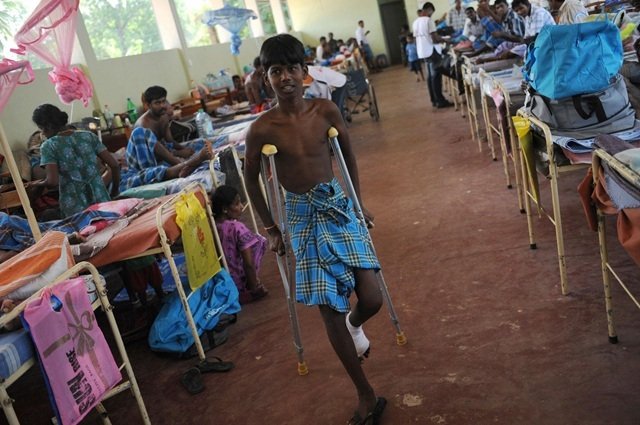
Two decades after one of the deadliest attacks on humanitarian personnel in modern conflict, the United Nations has issued a stark challenge to Sri Lanka: acknowledge the involvement of State security forces in attacks on humanitarian workers and medical facilities, investigate those responsible and provide justice to victims whose families have waited years for answers. The demand comes amid mounting international concern over attacks on humanitarian operations, with more than 1,010 aid workers killed worldwide between 2023 and 2025, according to figures cited by the UN.
In a report entitled ‘I died many times’: Attacks on humanitarian assistance in Sri Lanka, 20 years on, the Office of the UN High Commissioner for Human Rights (OHCHR) documents a pattern of attacks, restrictions and obstruction affecting humanitarian personnel and relief operations during the final years of Sri Lanka’s armed conflict between government forces and the Liberation Tigers of Tamil Eelam (LTTE). Its central finding is that the absence of criminal accountability has persisted despite years of investigations, official commitments and successive recommendations from international and domestic inquiries.
The report calls on the Government to issue a public apology on behalf of the State, explicitly acknowledging that State security forces were involved in attacks against humanitarian and medical personnel, facilities and operations. It also demands prompt and independent investigations, prosecutions extending to those bearing command responsibility, reparations for victims and survivors, and guarantees that such violations will not recur.
The significance of the findings extends beyond the individual cases examined. The report places Sri Lanka’s experience within a deteriorating international environment in which humanitarian workers and medical infrastructure have increasingly become targets or have been denied protection. Attacks on humanitarian operations and restrictions on relief access are identified as features of conflicts in the Occupied Palestinian Territory, Sudan, South Sudan, Ukraine and the Democratic Republic of the Congo. The UN figures indicate that at least 326 humanitarian workers were killed in 2025 alone, across 21 countries.
Sri Lanka’s final phase of conflict, between 2006 and May 2009, provides an extensive record of how humanitarian operations can be progressively dismantled through violence, restrictions on movement, surveillance and the withdrawal of independent international personnel. The report says these developments were accompanied by severe shortages of food, medicine, fuel and other essential supplies for civilians trapped in the Vanni, predominantly Tamil communities that depended heavily on humanitarian assistance.
The deterioration became particularly pronounced after large-scale hostilities resumed in 2006. A Sri Lankan organisation documented more than 60 incidents affecting humanitarian personnel between January 2006 and December 2007. At least one humanitarian worker was killed or subjected to enforced disappearance in almost every month during that period. The United Nations also recorded 14 arrests or detentions of its personnel by State authorities and 43 incidents of harassment or intimidation in 2007 alone.
Four incidents form the centre of the report’s examination of accountability failures. The first concerns the disappearance of seven employees of the Tamil Rehabilitation Organisation in January 2006. Five staff members travelling from Batticaloa to Kilinochchi were reportedly abducted after passing an army checkpoint at Welikanda on 29 January. Three women were subsequently released, but two men remained missing. The following day, five more employees disappeared after another abduction involving a white van near the same checkpoint. The Government denied involvement, but neither the organisation nor the families received a substantive account of the investigations. No arrests or convictions followed.
The second case is the August 2006 killing of 17 national employees of French humanitarian organisation Action contre la Faim (ACF) in Muttur, then the deadliest single attack on humanitarian workers globally. The 2015 OHCHR investigation found reasonable grounds to believe that members of the Sri Lankan security forces had carried out extrajudicial executions. Further evidence collected by OHCHR has, according to the new report, corroborated findings that the killings were perpetrated by security force members after government forces regained control of Muttur. The material is also relevant to examining the possible responsibility of those who ordered the killings or failed to prevent or punish them. Nevertheless, no prosecution has resulted.
The other two incidents concern the obstruction and shelling of a United Nations humanitarian convoy in January 2009 and attacks on Puthukkudiyiruppu Hospital during January and February that year. The report places these events within a wider pattern of attacks on medical facilities and restrictions on relief operations. Earlier UN investigations documented attacks on nine medical facilities in the Vanni between October 2008 and May 2009, concluding that they were not isolated incidents. Some may have involved deliberate targeting by the Sri Lankan Army.
The humanitarian consequences of restricted access were severe. Between February and 9 May 2009, approximately 2,442 metric tonnes of food were permitted into the Vanni, less than the minimum requirement for a single month, even using a civilian population estimate substantially below the actual numbers believed to be trapped there. In February, less than 100 tonnes reportedly entered, against a World Food Programme requirement of 4,950 tonnes. Medical supplies were also severely restricted, while fuel for hospitals, ambulances and water-pumping facilities was progressively reduced and eventually stopped.
The report records that hundreds of thousands of civilians became dependent on maritime deliveries and medical evacuations by the International Committee of the Red Cross (ICRC). Even this remaining humanitarian lifeline came under fire. In March 2009, its vessel was subjected to machine-gun fire, while artillery landed within 40 to 50 metres of the ship in April. The LTTE also bears responsibility for serious violations, particularly preventing civilians from leaving areas under its control and exposing them to shelling and gunfire. The report stresses, however, that violations by one party do not diminish the independent legal obligations of the other.
Beyond the battlefield incidents, OHCHR identifies institutional failures that have obstructed accountability for years. These include official denials and attempts to deflect responsibility, investigations that stalled or were never properly initiated, inadequate protection for witnesses and victims, and the use of commissions of inquiry as substitutes for criminal investigations and prosecutions. The withdrawal of international humanitarian personnel from the Vanni in September 2008 further weakened independent oversight, leaving national staff exposed to continuing danger.
The report also acknowledges the present Government’s stated commitment to accountability and the publication of six commission reports in May 2026. However, it says there is still no publicly demonstrated progress in investigations or prosecutions relating to the four emblematic incidents. OHCHR transmitted 27 questions to the Government on 24 September 2026 and subsequently provided an advance copy of the report for factual comments. No response had been received by the time of publication.
The report’s recommendations extend to the international community. It urges other States to cooperate in investigating and prosecuting alleged international crimes committed in Sri Lanka, including through extraterritorial and universal jurisdiction. It also recommends continued international monitoring, targeted sanctions where appropriate and rigorous human rights vetting of Sri Lankan military and police personnel considered for international peacekeeping, military exchanges and training programmes.
The essential issue is no longer simply whether the events of 2006–2009 will be acknowledged. It is whether the failure to prosecute serious violations against humanitarian personnel will continue to carry consequences beyond the country in which they occurred. For OHCHR, Sri Lanka demonstrates how attacks on humanitarian action, followed by prolonged impunity, can establish precedents that weaken the protection of aid workers in other conflicts. Twenty years after Muttur, the demand for accountability has therefore become a test not only of Sri Lanka’s willingness to confront its wartime record, but also of the international commitment to ensuring that humanitarian protection has meaning in practice.