


by Luxman Aravind
Political history reeks of betrayal, greed, and a lust for power that knows no shame. Leaders who rise as voices of justice often crumble into puppets of the very systems they once condemned. Sri Lanka’s President Anura Kumara Dissanayake, sworn in September 2024, is the latest face in this grim parade. His dramatic reversal on Chinese-funded projects—once fiercely denounced as neocolonial entrapments—is not just hypocrisy. It’s a stark portrait of what power does to people. This is not governance; this is a man bowing to forces he once claimed to defy.
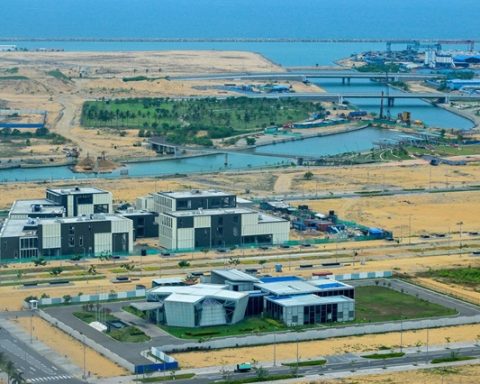
Before becoming president, Dissanayake was a firebrand critic of China’s influence in Sri Lanka. He condemned projects like the Colombo Port City and the Hambantota Port as symbols of exploitation, warning they would sell the country’s future to Beijing. He called out the Rajapaksa regime for its blind loyalty to Chinese money, framing it as a betrayal of Sri Lankan sovereignty. And yet, here we are. Months into his presidency, he has turned his back on those words, forging ahead with the same projects he once vowed to dismantle. Why? Because power does not change people; it reveals them.
Dissanayake’s behaviour can only be understood by digging into the psychology of power and the compromises it demands. Cognitive dissonance—the mental conflict that arises when actions contradict beliefs—is at play here. Dissanayake, once a man of fiery rhetoric, now justifies his actions under the guise of pragmatism and “national interest.” But let’s be real: this isn’t pragmatism. This is survival. It’s easier to abandon principles than to risk standing up to China, a nation that holds over half of Sri Lanka’s external debt. The human mind, when confronted with the intoxicating lure of power, finds endless ways to rationalise betrayal.
The idea that unchecked power often leads to corruption perfectly encapsulates the essence of Dissanayake’s fall. He isn’t the first leader to sell out his principles once in office, and he won’t be the last. But the speed of his transformation is astonishing. One minute, he’s standing at rallies lambasting Chinese-backed projects for trampling Sri Lanka’s laws and environment. The next, he’s shaking hands with Beijing, pledging to strengthen diplomatic ties and continue those very projects. This is not just a U-turn; it’s a crash-and-burn of everything he once claimed to stand for.
Dissanayake’s betrayal is particularly enraging because of the promises he made. At public gatherings, he spoke passionately about stopping the reclamation of land for the Colombo Port City, calling it a reckless giveaway to foreign powers. He warned of environmental destruction and questioned the legality of the project. In 2015, he declared that Sri Lanka needed laws to prevent such brazen acts of exploitation. But today, his government endorses those same projects, parroting lines about “strategic cooperation” that could’ve come straight from Beijing’s playbook. His previous words, once so full of fire, now ring hollow.
This isn’t an isolated story. Across the globe, opposition leaders transform into unrecognisable figures once they taste power. Malaysia’s Mahathir Mohamad returned to power in 2018 with promises to curb Chinese influence but ended up renegotiating deals instead of scrapping them. Pakistan’s Imran Khan also pivoted from critic to advocate of China’s Belt and Road Initiative after taking office. Dissanayake is simply the latest in a long line of leaders who have folded under pressure, their principles ( if any) crumbling under the weight of political realities—or perhaps, their own greed.
But what makes this betrayal even more unforgivable is the state Sri Lanka is in. This isn’t a country that can afford moral weakness. With external debt exceeding $46 billion and inflation crushing ordinary citizens, Sri Lanka needs bold leadership. Instead, it gets a president who talks tough when out of power but capitulates as soon as he steps into the hot seat. The Chinese projects he once derided as exploitative are still in motion. This is not leadership. It’s surrender.
What drives leaders like Dissanayake to betray their principles? It’s easy to blame external pressures, but the real answer lies within. Freud’s theories on repression and sublimation shed light on how people bury inconvenient truths to avoid confronting their own contradictions. Dissanayake’s sudden embrace of Chinese projects isn’t a strategic pivot; it’s a coping mechanism. By framing his actions as necessary for the greater good, he shields himself from the guilt of betrayal. It’s not just cynical—it’s cowardly.
The saddest part of this story is the role of the public. Politicians like Dissanayake rely on the electorate’s short memory and willingness to forgive. They know that people, beaten down by economic hardship and political instability, are often too exhausted to hold leaders accountable. This collective apathy enables betrayal to thrive. Every unchallenged lie, every broken promise, paves the way for more of the same. If Sri Lanka’s citizens don’t demand better, they will continue to get worse.
For Sri Lanka to break free from this cycle, it needs leaders with vision and backbone—leaders willing to stand up to powerful creditors and chart a new course. Dissanayake is not that leader.
Dissanayake’s transformation from opposition firebrand to establishment stooge is not just a personal failing; it’s a symptom of a broken political system. It reveals the ease with which ideals can be discarded when power is at stake. George Orwell’s words in Animal Farm ring painfully true: “All animals are equal, but some animals are more equal than others.” Dissanayake, like so many before him, has proven that in politics, justice, equality, and sovereignty are often nothing more than slogans—conveniently abandoned when they become inconvenient.
The real tragedy is that none of this is surprising. Politics has always been a dirty game, its players willing to say anything, promise anything, to get ahead. But just because betrayal is common doesn’t mean it should be accepted. The people of Sri Lanka deserve better. They deserve leaders who don’t just preach about sovereignty but fight for it. They deserve leaders who don’t just promise change but deliver it. And most importantly, they deserve leaders who remember that power is not a right—it’s a responsibility.
In the end, the blame doesn’t rest solely with Dissanayake or even with China. It rests with all of us, for allowing such leaders to rise and for tolerating their betrayals. If Sri Lanka is to have any hope of breaking free from this cycle, its people must demand better. They must hold their leaders accountable, refuse to be placated by empty words, and insist on actions that put the nation first. Anything less is a betrayal—not just by the politicians but by the people themselves. The most intriguing aspect of this entire episode is that China consistently understood these leaders’ tactics and duplicities. You may shout as loudly as you want while in opposition, but once you rise to power, you must bow to us and please us if you wish to maintain your position.










All politicians are assholes.
AKD is the best of the worst so let it be.