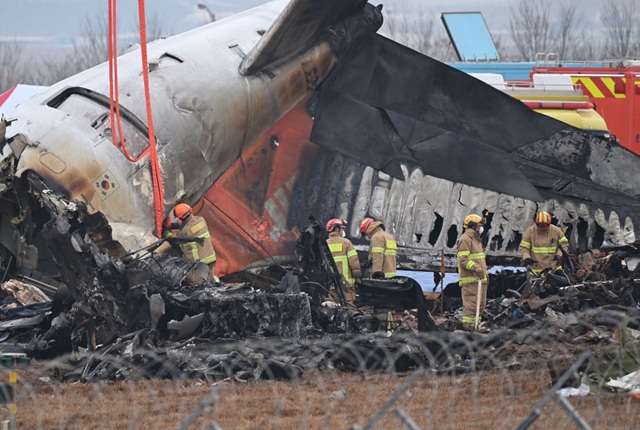
Boeing’s 737-800, part of the company’s widely used 737 Next Generation (737NG) series, has once again come under scrutiny following a series of alarming incidents involving the aircraft. In just 24 hours last week, three separate events occurred across the globe, raising serious questions about the safety of this model.
A tragic crash involving a Jeju Air 737-800 in South Korea killed 179 people, while earlier that day, a KLM 737-800 skidded off the runway in Norway after suffering a hydraulic failure. Meanwhile, an Air Canada 737-800 experienced a landing gear malfunction during its arrival in Halifax.
Meanwhile, in a report from The Times, South Korea’s president has ordered a comprehensive overhaul of the country’s aviation industry following a tragic crash that killed 179 people, marking the worst air disaster in South Korea in over two decades. The incident, which occurred on Sunday, involved a Jeju Air flight that crashed during an attempted emergency landing at Muan International Airport in the southwest of the country.
The acting president, Choi Sang-mok, announced that emergency inspections of South Korea’s entire airline operations would be conducted once the recovery operation at the crash site concluded. “Identifying the victims, supporting their families, and treating the two survivors remain our top priority,” Choi said during a disaster-management meeting in Seoul.
The crash is believed to have been caused by bird strikes during the aircraft’s approach to the airport. The pilots attempted an emergency landing without lowering the landing gear, but the plane exploded upon hitting a concrete obstacle at the end of the runway. Only two flight attendants survived the crash, while the majority of those onboard perished.
In the wake of the disaster, over 60,000 Jeju Air bookings were cancelled, with customers expressing concerns over the safety of future flights. Jeju Air reported that 33,000 domestic and 34,000 international bookings were cancelled by Monday afternoon. Despite the cancellations, the airline assured that new bookings were still coming in.
The South Korean government has initiated a thorough review of its Boeing 737-800 fleet, which comprises nearly 25% of the country’s passenger aircraft. The crashed jet had flown 13 times in the 48 hours preceding the disaster. As part of the review, maintenance records for all Boeing 737-800s operated by South Korean airlines will be scrutinized to ensure the safety of the fleet.
A grieving family member, who lost five relatives spanning three generations, voiced anger at the slow pace of identifying the victims, as many remained unidentifiable due to the severity of the crash. In response to the tragedy, more than 1,600 people, including political and religious leaders, gathered at the Muan Sports Complex to pay their respects to the victims. Memorial tablets were erected for the 141 victims whose identities had been confirmed.
In a show of national mourning, the government has declared seven days of mourning, canceling New Year celebrations across the country. Choi Sang-mok, along with political and religious figures, visited the memorial to offer their condolences.
Although much of Boeing’s recent negative press has been linked to the controversial 737 MAX series, the 737-800 has a troubling history of its own. The aircraft, which has been in service since the early 2000s, has been involved in over 20 incidents, resulting in more than 1,000 fatalities.
Several problems have plagued the 737-800 over the years. A 2019 inspection uncovered significant fatigue cracks in the fuselage-to-wing joints, known as “pickle forks,” which are crucial structural components of the plane. In the same year, a Royal Air Maroc 737-800 experienced a serious issue when its cargo door unexpectedly opened during landing in Lagos.
Further investigations have raised concerns about midflight failures. In 2022, a China Eastern Airlines 737-800 inexplicably crashed, with no survivors, after the aircraft suddenly descended midflight. The investigation, however, found no obvious faults with either the aircraft or the crew, leaving the cause of the crash a mystery. Similarly, a Turkish Airlines 737-800 crash in Amsterdam was linked to a faulty radio altimeter, which provided incorrect data, triggering a series of system failures and a disastrous landing.
Adding to the list of worrying incidents, in 2007, a China Airlines 737-800 saw one of its engines catch fire shortly after landing in Okinawa. The fire was caused by a slat pylon bolt falling off and puncturing a fuel tank, further highlighting the ongoing mechanical vulnerabilities of this aircraft model.
With the recent spate of incidents and a long history of safety concerns, questions are growing about the future of the Boeing 737-800. As the aviation industry continues to scrutinize the safety of this popular aircraft, passengers and airline operators alike are left wondering whether the 737-800 can be trusted for safe flights in the years to come.