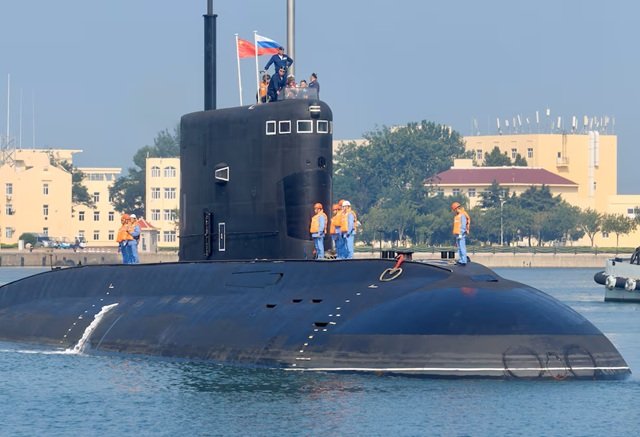
China and Russia have expanded their naval cooperation with the participation of submarines in the “Joint Sea-2026” military exercise, marking what Chinese military sources described as the first time Chinese and Russian submarines have appeared together in the same image during the joint drills.
The at-sea phase of the exercise concluded on Saturday after Chinese and Russian naval forces conducted coordinated operations involving submarine rescue, surface strikes, air defence and anti-missile activities. The drills were designed to test joint operational capabilities across surface, underwater and aerial domains, according to China Bugle, an official media account affiliated with the Chinese People’s Liberation Army (PLA) news media centre.
A Chinese military affairs expert told the Global Times that the participation of submarines from both countries demonstrated a high level of mutual trust, as underwater operations require the exchange of sensitive technical information and close coordination between naval forces.
The exercise featured mixed formations combining naval vessels, submarines and aircraft to create an integrated multi-domain combat system. According to China Bugle, the drills were conducted without fixed scenarios, with commanders adjusting operations based on changing battlefield conditions, weather and maritime factors.
During the exercises, Chinese and Russian forces tested joint reconnaissance, early-warning capabilities, command coordination and coordinated strikes in complex electromagnetic environments. Chinese military sources said participating ships worked together during air defence and anti-missile drills, using the strengths of their respective weapons systems to intercept incoming targets.
The involvement of submarines represents an expansion of China-Russia naval cooperation beyond traditional surface operations. Since the launch of the “Joint Sea” exercise series in 2012, the drills have become a major platform for military interaction between the two countries. This year’s exercise included surface ships, underwater platforms, aircraft and support elements, reflecting a broader focus on integrated maritime operations.
According to military affairs expert Wang Yunfei, the appearance of Chinese and Russian submarines together is significant because submarines are among the most sensitive assets operated by any navy. Their acoustic characteristics, including noise levels and frequency patterns, are closely protected information because they affect a submarine’s ability to remain undetected.
Wang told the Global Times that submarines from different countries rarely operate together because doing so can expose information about their underwater signatures. He said that the decision to deploy the vessels together indicates a level of operational confidence between China and Russia.
Official footage from the exercise showed the Russian submarine involved was the improved Kilo-class conventional submarine Ufa, while China deployed an improved Type 039B conventional submarine, according to Wang.
The expert noted that previous cooperation involving Chinese and Russian Kilo-class submarines carried different implications because the acoustic characteristics of those vessels were already familiar to both sides. The latest exercise, however, involved China’s domestically developed Type 039B submarine operating alongside a Russian submarine, which Wang described as a deeper level of cooperation.
Beyond submarine operations, Wang said the exercise also involved communication and data exchanges between the two navies. Underwater communication is considered technically challenging, requiring specialised methods such as underwater acoustic communication or communication systems that allow submarines to transmit information while maintaining operational security.
The ability of both navies to coordinate submarine movements, exchange information and conduct combined operations demonstrates an advanced level of tactical cooperation, Wang said. He added that the exercise could provide a foundation for expanding the scale and complexity of future China-Russia naval drills.
The “Joint Sea-2026” exercise began on July 6 at a military port in Qingdao, in China’s eastern Shandong Province, according to Xinhua News Agency. A joint command structure was established with personnel from both navies, and the exercise was conducted in three stages: force assembly, harbour-based planning and at-sea operations.
Following the completion of the exercise, some participating naval forces will conduct a joint maritime patrol in parts of the Pacific, according to China Bugle. China’s Ministry of National Defense said both countries would continue expanding the depth and scope of joint training while maintaining principles of openness, transparency and mutual trust.