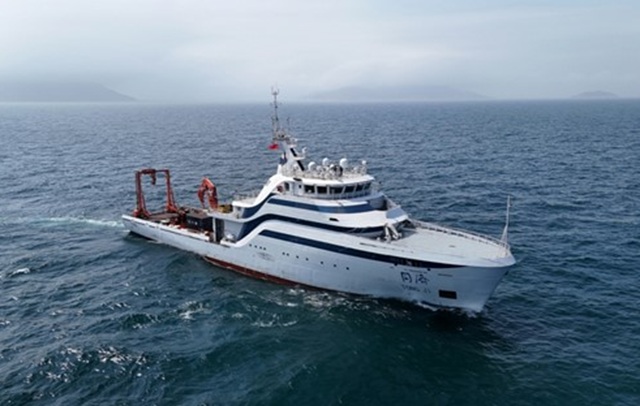
China’s maritime research capabilities have taken a major leap forward with the successful maiden sea trial of its first intelligent oceanographic research vessel, Tong Ji. Designed and operated by Tongji University, the 2,500-ton vessel is now set to embark on its first scientific expedition this August in the South China Sea, marking a new era in the nation’s oceanographic exploration.
According to a report published Friday on the Shanghai municipal government’s website, the Tong Ji will carry out a nearly month-long mission that integrates ocean geology, chemistry, and biology. This expedition is expected to reinforce China’s scientific presence in the region and enhance the country’s marine research infrastructure.
At 81.5 meters in length and with a maximum speed of 15 knots, the Tong Ji is classified for unrestricted global navigation, with the exception of polar ice zones. Built on a 2,000-ton class platform, the vessel boasts capabilities typically found in larger 3,000-ton research ships, thanks to its modular and smart design.
Advanced Capabilities for Next-Generation Marine Science
Equipped with cutting-edge features, the Tong Ji integrates autonomous navigation, remote-control operations, fault diagnostics, and energy efficiency monitoring. It also houses specialized systems for work-class remotely operated vehicles (ROVs) and modular container laboratories, allowing it to perform complex, multidisciplinary scientific tasks.
Notably, the vessel’s engine room is fully unmanned, relying on intelligent systems for autonomous operation. The ship can be remotely controlled from shore-based centers, and its onboard systems are designed for extended missions without constant human oversight.
“The Tong Ji represents a substantial upgrade over similar-tonnage research vessels previously built in China,” said Tuo Shouting, deputy dean of the School of Ocean and Earth Science at Tongji University. “With optimized lab and deck layouts and enhanced modular compatibility, this vessel will be a flexible and powerful platform for marine research.”
Comfort, Safety, and Efficiency at Sea
Despite its compact size, the vessel offers significant space and comfort for onboard scientists and crew. It includes a 460-square-meter working deck, 320 square meters of laboratory space, and living quarters averaging 10.2 square meters per person. Additionally, more than 100 square meters are allocated for communal areas including lecture halls, lounges, meeting rooms, and a fitness zone.
Safety innovations are also a priority. A wave-compensated gangway system has been installed to allow for safer personnel transfers in challenging ocean conditions — a crucial feature for long-term and potentially hazardous expeditions.
Strategic Maritime Milestone
The launch of the Tong Ji underscores China’s ambition to lead in oceanographic research and maritime technology. Its deployment to the South China Sea, a geopolitically sensitive and scientifically significant region, signals a strategic move to deepen understanding of marine ecosystems and resources.
As the world increasingly turns its attention to the oceans for climate research, biodiversity conservation, and sustainable resource development, the Tong Ji positions China at the forefront of intelligent and unmanned maritime exploration.