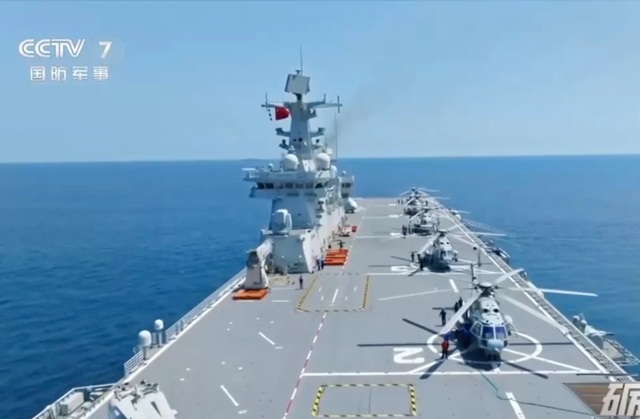
China’s People’s Liberation Army Navy has taken a bold step into autonomous aerial warfare with the deployment of a new uncrewed helicopter aboard its Type 075 amphibious assault ship, potentially transforming the PLA’s operational flexibility in contested maritime regions. State broadcaster CCTV released footage this week showing a lightweight drone helicopter on the deck of the Hubei, a vessel currently operating in the South China Sea. The craft, equipped with folding rotors and appearing slightly smaller than the PLA’s main shipborne helicopter, the Z-20, represents a significant evolution in China’s naval aviation capabilities. Analysts say this is the first time such a drone has been visibly integrated with the Type 075, which has been active in both the South China Sea and near Taiwan.
With a displacement of 35,000 to 40,000 tonnes, the Type 075 is designed to carry landing craft, troops, armored vehicles, and more than 30 helicopters, simultaneously launching and recovering up to six. Chinese media often describe the vessel as a helicopter carrier or light aircraft carrier, highlighting its strategic importance in amphibious operations. The newly observed drone is thought to be an AR-2000, a two-tonne uncrewed helicopter developed by the Aviation Industry Corporation of China, which first appeared publicly at an air show in 2024. Its predecessor, the AR-500C, had been briefly spotted on a Type 075 deck in 2020, but the AR-2000’s introduction signals a more serious investment in autonomous platforms.
Retired PLA Air Force colonel Fu Qianshao explained that the drone’s compact size allows for more efficient take-offs and landings, increasing the number of aircraft that can be deployed simultaneously. “Its performance should be close to that of crewed helicopters but with a higher level of automation,” Fu said. Analysts further note that the uncrewed helicopter overcomes limitations faced by human pilots, operating in adverse weather and sea conditions where crewed helicopters may be grounded. Military analyst Song Zhongping added that the drone could extend reconnaissance and strike capabilities while providing a safer method for assessing damage and carrying out dangerous missions.
Yue Gang, another retired PLA colonel and commentator, emphasized the operational flexibility offered by autonomous helicopters. “Drones can be deployed more frequently, without the need to consider personnel load,” he said, noting that autonomous take-off and landing capabilities enable faster turnaround times for repeated missions. The PLA’s integration of these aircraft aboard the Type 075, which currently has four ships in service, highlights a broader effort to modernize amphibious and expeditionary operations. The Hubei, commissioned in August last year, has been mainly deployed in the South China Sea, an area of growing tension with neighboring states including the Philippines, which has territorial disputes with China.
According to Fu, the AR-2000 can perform multiple roles, from reconnaissance to direct attack, and may even possess anti-submarine capabilities with depth charges, torpedoes, or missiles. Its autonomous design reduces the weight carried by crewed aircraft, allowing for increased fuel capacity, extended flight range, and longer loiter times. Analysts also predict that similar uncrewed helicopters could eventually be deployed across other vessel classes, including aircraft carriers, destroyers, Type 076 amphibious assault ships, and Type 054 corvettes.
China’s development of the Type 076 Sichuan, described by state media as a potential drone carrier, reinforces the strategic direction toward unmanned naval aviation. Social media imagery in February suggested that the Sichuan is capable of carrying the GJ-21 stealth uncrewed combat aerial vehicle, hinting at plans for collaborative drone operations across multiple platforms. Observers say that integrating autonomous helicopters on these vessels allows the PLA to expand the operational envelope of amphibious ships while reducing risk to human personnel.
The implications of this deployment are significant for the Taiwan Strait and South China Sea. Analysts say that uncrewed helicopters like the AR-2000 could enhance China’s ability to conduct maritime reconnaissance, surveillance, and precision strikes in contested areas. In particular, their small footprint and autonomous capabilities allow for rapid, repeatable missions in conditions that would challenge crewed helicopters, giving the PLA a tactical edge in complex maritime environments. Military commentators have noted that the technology could also serve as a testing ground for future unmanned aerial systems and coordinated drone operations across China’s naval fleet.
While it may take years for these platforms to reach full operational maturity, the deployment aboard the Hubei represents a tangible step toward a more automated and flexible naval force. Experts argue that the ability to launch multiple uncrewed helicopters simultaneously and operate in adverse conditions significantly extends the PLA’s reconnaissance and strike capabilities, increasing its influence in strategic maritime corridors. As regional tensions continue to rise, the integration of autonomous aerial platforms on frontline warships marks a critical evolution in China’s military strategy and underscores the growing importance of unmanned systems in modern naval warfare.