For years, climate change was publicly framed as an environmental and scientific crisis. Behind closed doors, however, some of the United States’ most powerful security agencies were increasingly treating it as a geopolitical threat capable of destabilizing governments, inflaming conflict zones, and redrawing the balance of global power. Newly released documents obtained through the Freedom of Information Act and published by the National Security Archive now reveal how deeply climate fears had penetrated the U.S. national security establishment during the Biden administration.
The records, consisting of Pentagon exercises and State Department intelligence assessments from 2021, paint a striking picture of officials preparing for a future in which droughts, floods, food shortages, migration crises, and political unrest become interconnected security emergencies. The files expose growing anxiety inside Washington that climate disruption could trigger instability across Europe and Africa while opening new opportunities for extremist groups and geopolitical rivals.
One of the central revelations involves a classified State Department Bureau of Intelligence and Research assessment warning that climate change could widen political and economic fractures across Europe. Analysts predicted that southern European nations would bear the harshest consequences of rising temperatures, with prolonged heatwaves, severe droughts, and destructive wildfires threatening livelihoods and economic stability. Northern European countries, meanwhile, were expected to experience comparatively favorable agricultural conditions as warming temperatures expand arable land.
According to the report, this “uneven climate exposure” was likely to deepen the economic divide between northern and southern Europe, potentially sparking political confrontations within the European Union itself. Intelligence officials feared that countries already struggling economically could become more resistant to ambitious climate policies imposed from Brussels or wealthier northern states.
The report also highlighted the political risks surrounding Europe’s transition away from fossil fuels. Analysts observed that right-wing and populist movements were adapting their rhetoric. Rather than denying climate science outright, these groups were increasingly targeting the financial burden of environmental policies on ordinary citizens. Officials specifically pointed to concerns in France that the return of the “Yellow Vest” protest movement could threaten President Emmanuel Macron’s political future ahead of the 2022 election.
The intelligence assessment suggested that climate policy itself could become a source of instability, especially in countries heavily dependent on imported fossil fuels such as Poland and Hungary. These nations, the report warned, could resist European renewable energy strategies if citizens viewed the economic sacrifices as unfair or politically imposed.
At the same time, the Pentagon was conducting its own unprecedented preparations. Shortly after President Joe Biden signed Executive Order 14008 directing federal agencies to integrate climate considerations into national security planning, the Department of Defense launched “Elliptic Thunder,” its first climate-focused war game exercise.
The exercise assembled representatives from across the U.S. government, including the CIA, NOAA, USAID, the National Security Council, and the State Department. Using a fictional East African crisis scenario, participants explored how climate-driven disasters could combine with political instability and violent extremism to create cascading emergencies.
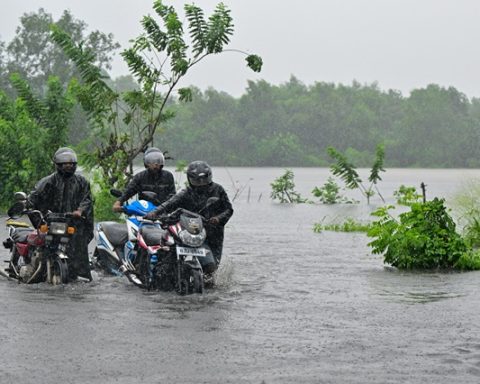
The simulation examined a series of escalating crises: extreme heat and drought fueling unrest, El Niño flooding causing food shortages and displacement, and cyclone activity triggering disease outbreaks such as cholera. Officials also considered how extremist organizations and hostile actors might exploit humanitarian disasters to strengthen their influence.
The Pentagon’s internal review concluded that climate change would act as a “threat multiplier,” worsening existing vulnerabilities and increasing the likelihood of conflict. Participants argued that the U.S. military and its allies needed to stop treating climate disasters as isolated humanitarian emergencies and instead view them as interconnected security challenges requiring long-term strategic planning.
A recurring theme throughout the exercise was the fear that governments would remain trapped in reactive crisis management. Officials emphasized the need to move “left of the boom,” a military phrase meaning action should be taken before catastrophe unfolds rather than after violence or instability erupts.
The newly released documents also reveal how climate concerns extended beyond Europe into some of the world’s most fragile regions. One State Department intelligence commentary focused on Sudan’s Darfur region, where analysts described climate change as a “compounding factor” behind ongoing violence and displacement.
The report traced decades of creeping desertification and drought that steadily reduced access to fertile land and water resources. Although ethnic and tribal tensions remained at the center of Darfur’s conflict, intelligence officials concluded that environmental stress had intensified competition between communities struggling for survival.
By mid-2021, according to the report, nearly one million people had been displaced in North Darfur alone. Analysts linked rising temperatures, water scarcity, declining crop yields, and worsening food insecurity to the persistence of violence despite peace agreements aimed at stabilizing the region.
The timing of the assessment proved chilling. Within weeks of the report’s publication, Sudan’s fragile transitional government was overthrown in a military coup, plunging the country deeper into political turmoil.
Perhaps most striking is the extent to which U.S. intelligence agencies relied on publicly available research to build these assessments. The Darfur commentary drew heavily from academic studies, United Nations findings, humanitarian reports, and open-source journalism. One referenced U.N. study reportedly described Darfur as the site of “the first climate change conflict,” highlighting how environmental collapse and social tensions had become inseparable.
Another document released by the National Security Archive sheds light on the massive data infrastructure supporting these analyses. The report compiled dozens of climate databases and monitoring systems used by analysts and policymakers, ranging from NASA sea-level rise projections to NOAA disaster statistics and agricultural risk assessments.
Yet many of those databases have since disappeared, been reduced, or redirected following efforts during the Trump administration to overhaul federal climate information systems. The National Security Archive noted that several resources cited in the reports are now inaccessible or stripped down, raising concerns among researchers about transparency and public access to scientific data.
Together, the documents reveal a striking transformation in how climate change was viewed inside the U.S. government. No longer treated solely as an environmental issue, climate disruption had become embedded in military planning, intelligence forecasting, and geopolitical strategy.
The files also expose a growing recognition that climate change may not simply create natural disasters but could reshape political systems themselves. Rising inequality between regions, backlash against energy transitions, resource conflicts, migration pressures, and extremist exploitation were all viewed as interconnected risks capable of destabilizing societies.
For the National Security Archive, which published the records as part of a broader effort to uncover the intelligence community’s environmental legacy, the disclosures provide rare insight into the hidden architecture of climate security planning inside Washington. They also reveal a stark contradiction between the urgency expressed privately within government agencies and the political battles surrounding climate policy in public life.
As temperatures continue to rise and climate disasters intensify worldwide, the newly disclosed records suggest that many U.S. officials were already preparing for a future where environmental collapse and national security become impossible to separate.