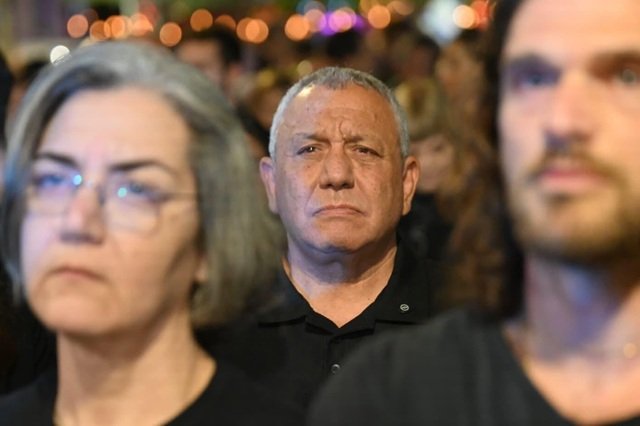
Gadi Eisenkot, the former chief of the Israeli military and leader of the centre-right Yashar party, has secured the first coalition agreement since Israel’s October 27 election, reaching a deal on Tuesday with right-wing opposition leader Avigdor Lieberman as he attempts to form a government without Prime Minister Benjamin Netanyahu. The agreement marks an initial breakthrough in negotiations following an election that deprived Netanyahu’s governing alliance of its parliamentary majority but left opposition parties without a clear route to power.
Yashar announced that Eisenkot met Lieberman, leader of the Israel Our Home party, earlier on Tuesday and subsequently agreed on a coalition arrangement. The deal brings together two parties that secured a combined 28 seats in the 120-member Knesset. Yashar won 21 seats, while Lieberman’s party obtained seven.
The agreement is politically significant given Lieberman’s previous opposition to forming a government dependent on support from parties representing Israel’s Arab minority. He has also rejected the prospect of joining a unity government with Netanyahu, although his principal political objective has been to remove the prime minister from power.
The Knesset was sworn in on November 10 without a new government, following an election that weakened Netanyahu’s right-wing alliance with far-right and ultra-Orthodox parties. Despite performing better than expected, the alliance secured only 53 of the parliament’s 120 seats, leaving it short of a governing majority.
Eisenkot’s prospective coalition, comprising Yashar and a collection of opposition partners including Lieberman, currently commands 48 seats. However, parties representing Israel’s Arab minority, which collectively hold 19 seats, could provide additional parliamentary support. These parties are united with Eisenkot’s bloc in their opposition to Netanyahu, although Lieberman’s resistance to relying on their support remains a significant political complication.
President Isaac Herzog has formally tasked Eisenkot with forming the next government, while Netanyahu continues as caretaker prime minister. Eisenkot has until December 6 to complete the task under his initial 28-day mandate, with the possibility of requesting an additional 14 days. If he fails, Netanyahu will have an opportunity to attempt to form a government. Should neither succeed, Israel will face another election next year.
Parallel negotiations are continuing between Eisenkot, several partners in his so-called change bloc and Netanyahu’s Likud party over the possibility of establishing a national unity government. Those discussions have introduced further uncertainty into the coalition-building process, particularly among parties seeking to end Netanyahu’s tenure.
The left-wing Democrats party, which won eight parliamentary seats, announced separately that it was suspending negotiations with Eisenkot. The party cited progress in his discussions with Likud over a possible unity arrangement, as well as the deadlock in negotiations to establish an alternative change government.
Yair Golan, leader of the Democrats, has maintained that his preference is for a government without Netanyahu, potentially supported by Arab parties. The suspension of talks highlights the divisions within the opposition over the composition and parliamentary foundations of a future administration.
Despite securing the first formal coalition agreement since the election, Eisenkot therefore faces two interconnected challenges: assembling sufficient parliamentary support and reconciling competing positions among potential partners over whether to exclude Netanyahu entirely or pursue a broader unity arrangement.
Tighten the coalition arithmetic explanationClarify the unity-government negotiations