In a detailed analysis published by The Times UK, the world has been offered a glimpse into the potential steps and consequences of a U.S. military strike on Iran — an operation that would mark a significant escalation in tensions across the Middle East. The report outlines a hypothetical yet meticulously constructed scenario of how such an operation could play out, from stealth bombers departing the Indian Ocean to the possibility of retaliation and regional fallout.
The Opening Move: B-2 Bombers and Massive Ordnance Penetrators
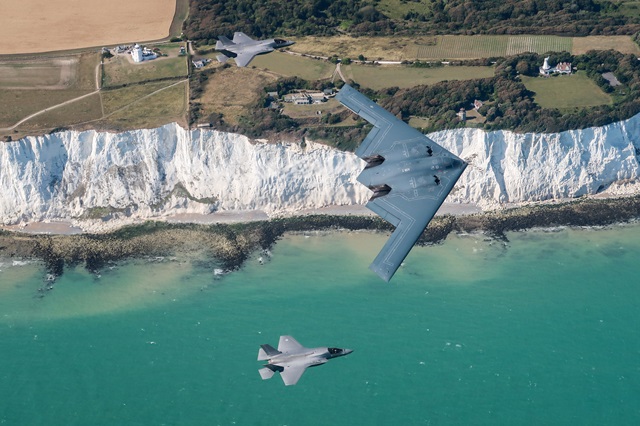
Shortly after 10 p.m., four B-2 Spirit stealth bombers, the pride of America’s long-range strike capability, are envisioned taking off from Diego Garcia — a joint UK-U.S. military base in the Indian Ocean. Their target: the deeply fortified Fordow nuclear facility in Iran. The aircraft would be armed with GBU-57 Massive Ordnance Penetrators (MOPs), 13.6-tonne bombs engineered to punch through mountains and reinforced concrete to destroy underground installations.
Each B-2 is capable of carrying two MOPs, designed for precise, high-altitude strikes. Their flight path and attack window — timed for around 3:30 a.m. — are strategically chosen to hit when the target is most vulnerable. “Between 2am and 4am is the best time to attack,” a former fast jet pilot told The Times UK, citing human circadian rhythms as a factor in reduced alertness.
A Multi-Tiered Assault Strategy
Before the bombers enter Iranian airspace, U.S. forces would likely deploy F-35 stealth fighters to attack or distract air defenses. These would serve as decoys, allowing the B-2s a clearer path to their target. According to The Times UK, Israel could also contribute with cyberattacks aimed at crippling Iranian command and control systems.
British military sources quoted in the report describe the plan as a “coordinated complex series of events” designed to overwhelm Iran’s defense network. The strategy banks on the surprise and precision of the B-2s, supported by a weakened Iranian air defense system, already heavily impacted by Israeli operations in recent years.
The Bunker Buster’s Power
The MOP is the most powerful non-nuclear bomb in the U.S. arsenal. Upon release, it accelerates to supersonic speeds, with enough kinetic energy to smash through 60 meters of reinforced material before detonating. Fordow, buried under 100 meters of mountain rock and steel, would require at least two — possibly four — such bombs to be neutralized effectively.
Fred Fleitz, former National Security Council official, told the BBC that no post-strike ground assessment would be needed. “The mountain shaking is going to do enormous damage to the centrifuge machines… there will be nothing left of this mountain,” he said.
Fallout and Chemical Dangers
Despite its high-stakes nature, the report downplays the risk of widespread nuclear contamination. Experts like Mark Foreman, a nuclear chemist at Chalmers University in Sweden, note that unless enriched uranium from a reactor is present, the radiation threat would be minimal. More concerning is the potential release of uranium hexafluoride, a gas that can form hydrofluoric acid when exposed to moisture — a substance deadly to humans, capable of causing cardiac arrest and deep tissue burns.
However, given the containment of Fordow under tons of rock, The Times UK reports the effects would likely be localized.
Retaliation and Regional Risk
A strike on Iran would not end with the destruction of Fordow. Tehran’s retaliation could come swiftly, targeting U.S. military bases across the region. The aircraft carrier USS Nimitz and the USS Carl Vinson, both deployed nearby, would be the frontline of defense, joined potentially by RAF Typhoon jets from Cyprus and up to 40,000 American personnel spread across Middle Eastern bases.
Iran could also activate proxy forces in Iraq and Syria, where U.S. and UK troops are vulnerable. As The Times UK warns, even Jordan and Bahrain could come under threat, with Tehran’s military planners considering a wide array of strategic responses.
Conclusion
The blueprint laid out by The Times UK is not a prediction, but a scenario rooted in military logic and strategic insight. It underscores not only America’s overwhelming firepower but also the complex web of geopolitical consequences that any action against Iran could unleash. If President Trump — or any future leader — were to authorize such a mission, it would not only shake mountains but also the fragile equilibrium of the entire Middle East.