


by Durga Velayutham
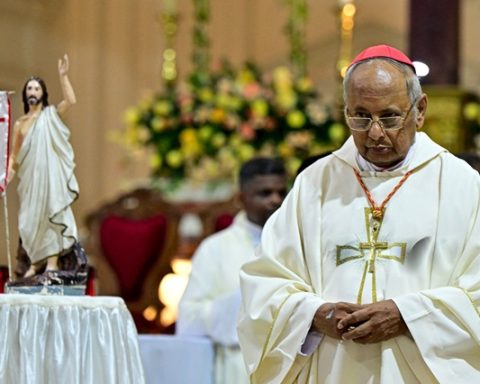
The Easter Sunday carnage of 2019 was not an isolated instance of violence, nor was it merely a horrific chapter in Sri Lanka’s history. It was the flashpoint of a far deeper crisis, one that has been quietly, yet decisively, brewing within the very heart of the Catholic Church in the country. In the wake of this atrocity, Sri Lanka’s Cardinal Malcolm Ranjith has manipulated the tragedy for personal and political gain, dragging the Church into the murky depths of political intrigue and conspiracy theories. This is not the first time he has exploited such opportunities for his own benefit. We have never seen the Catholic Church descend into such a pitiful state, where its spiritual mission is reduced to nothing more than a pawn in the hands of political powers. The Cardinal’s actions have brought irreparable damage to the Church, and if this course continues, it will not only tarnish the Church’s reputation but also ignite violence that could sweep through the country.
It is difficult to overstate the profound disservice the Cardinal has done to the Church’s sacred mission. His actions following the Easter Sunday massacre reveal an unnerving pattern of politicisation, manipulation, and exploitation of tragedy. The tragedy that should have been a moment of reflection on the evils of hate and the call for divine mercy has instead been transformed into a political battlefield, with the Cardinal standing at its centre. His alignment with political factions, his tendency to openly support specific political candidates, and his overt embrace of conspiracy theories have all but destroyed the sanctity of the Catholic Church’s position in the nation. By doing so, he has reduced the Church from a pillar of spiritual guidance to a tool for political maneuvering, risking the safety and future of the very community he is meant to protect.
The Church, under this Cardinal’s leadership, has been reduced to a shadow of its former self—once an institution that had long held to a policy of non-alignment, providing moral leadership in turbulent times without succumbing to the whims of political power. The Archdiocese, once a sanctuary for all, regardless of political persuasion, has now become a platform for political calculation, with the Cardinal positioning himself at the centre of these power games. Far from being a beacon of peace and spiritual guidance, the Church has become embroiled in the very divisions it should seek to heal. The dangerous rhetoric of conspiracy theories and political favouritism threatens to tear apart the Church’s very credibility. The Cardinal’s actions not only betray the trust of the faithful but also put the Catholic community at risk of greater persecution, as it becomes entangled in the political strife of a nation already fraught with division.
This is not a mere error in judgment, but a deliberate destruction of the Church’s core values. The Cardinal’s previous actions in manipulating the political landscape, such as his open support for the Rajapaksa regime and his recent alliances with Marxist factions, demonstrate a willingness to sacrifice the Church’s spiritual integrity for the sake of political expediency. By aligning himself so closely with parties of his choosing, the Cardinal has ensured that the Church will be seen not as an impartial spiritual authority but as a political actor, no different from any other interest group vying for power. This is a betrayal of the Church’s true vocation. As Pope Pius XII wisely said, “The Church does not exist to serve political interests, but to serve the divine interests of the soul.” The Cardinal Ranjith’s repeated failure to adhere to this principle signals a dangerous slide into political corruption.
What makes this even more concerning is the fact that the Cardinal’s political manoeuvrings have now become intertwined with conspiracy theories that undermine the integrity of the Church’s message. In a nation where religious and ethnic divisions run deep, such rhetoric only stokes the flames of hatred and fear. The Cardinal’s claims about the Easter Sunday attack, his assertions that the true masterminds behind the carnage without any authentic proof are being shielded, have only deepened the suspicion and hostility between communities. His pursuit of political justice, while understandable in the face of such tragedy, has clouded his ability to see the larger, more important issue at hand: the preservation of peace and unity in a nation long scarred by violence.
By indulging in these political games and conspiracy theories, the Cardinal risks sparking violence that could rival the destructive forces of Sri Lanka’s past. The Catholic community, already a minority in a predominantly Buddhist country, finds itself caught in the crossfire. The Cardinal’s actions have made the Church an easy target for political enemies, setting the stage for a new wave of persecution that could have devastating consequences for the faithful. His failure to maintain a steady, non-partisan course has opened the door to unprecedented tensions, with the potential to spiral into full-scale religious violence. The consequences of this kind of politicisation are not abstract—they are tangible, and they threaten to engulf Sri Lanka in yet another cycle of bloodshed.
Sri Lanka has already witnessed the dangers of religious and ethnic tension. The Church has always been the moral compass, guiding the nation through periods of instability. The Cardinal’s actions now stand in direct opposition to this sacred role. The Church is meant to transcend the political divisions of this world, not to be reduced to a mere instrument of partisan power. The lessons of history are clear: when the Church loses its moral authority, it loses everything. As St. Augustine once wrote, “The Church must never be confused with the powers of the state.” The Cardinal’s actions risk undermining this very principle, and in doing so, he threatens to bring about irreparable harm to the Catholic Church in Sri Lanka.
The Church’s future in Sri Lanka depends not on political alliances, but on its unwavering commitment to its spiritual mission. The Cardinal must be reminded that his duty is not to serve any political ideology or party, but to serve the divine calling entrusted to him. The soul of the Church is at stake, and with every passing day, the damage becomes more profound. If the Cardinal does not reevaluate his approach, the Church in Sri Lanka may very well face a future where its credibility, influence, and even safety are severely compromised, caught in the tide of a political game that will have no winners—only victims.
What is even more troubling is that this catastrophic shift in the Church’s trajectory is being led by Sri Lanka’s second Cardinal, a stark contrast to the example set by the first Cardinal, Thomas Benjamin Cooray, the first Sri Lankan-born Cardinal. Cardinal Cooray, whose tenure spanned from 1947 to 1976, remains a respected figure in Sri Lankan Catholic history for his devotion to his faith and his genuine commitment to preserving the Church’s spiritual integrity, independent of political influence. He navigated the turbulent post-colonial era with grace, never allowing the Church to become entangled in the political strife of the day. His leadership was a flare of humility, wisdom, and resilience.
Unlike the current Cardinal, who has allowed political affiliations to cloud his judgment, Cardinal Cooray upheld the sanctity of the Church as a neutral, moral force in society, guiding it through difficult periods without compromising its core values. It is a shameful departure from this legacy to see the Church manipulated for political gain in such a manner. The Church, under the current Cardinal, risks losing the very essence of what it means to be a spiritual institution, a lantern of truth in a society increasingly driven by the whims of power.






Thomas Cooray’s tenure dd not extend from 1947 to 76. He was as
Archbishop before before being appointed a Cardinal.