


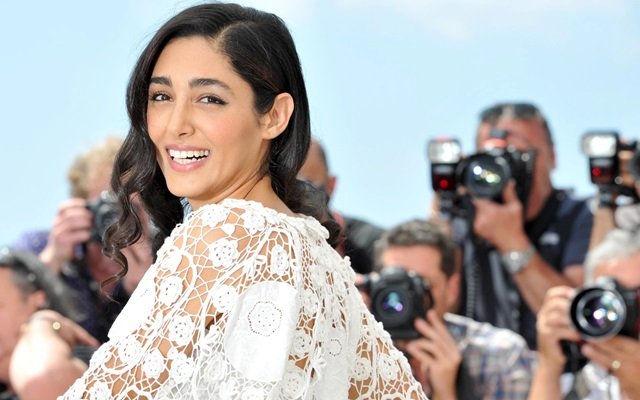
Fresh controversy has erupted around French President Emmanuel Macron and his wife Brigitte Macron after a French journalist claimed that a widely publicized altercation between the couple was sparked by messages sent to Iranian actress Golshifteh Farahani.
The allegations were made by political correspondent Florian Tardif during an interview on French broadcaster RTL while promoting his new book, “An (Almost) Perfect Couple.” According to Tardif, the incident that took place aboard the French presidential plane during a visit to Vietnam in May last year was not harmless “banter,” as previously described by the Élysée Palace, but rather a serious argument between the president and the first lady.
Tardif claimed that Brigitte Macron became upset after allegedly seeing messages exchanged between her husband and Farahani, a well-known Franco-Iranian actress who has lived in France since leaving Iran in 2008. The journalist alleged that the French president had maintained what he described as a “platonic” relationship with the actress for several months and had sent messages complimenting her appearance, including reportedly telling her, “I find you very pretty.”
The claims immediately triggered a forceful response from the entourage of Brigitte Macron. The French first lady’s office categorically denied the allegations and stated that she had already rejected the account directly to the author months earlier. According to the Élysée, Brigitte Macron “never looks at her husband’s mobile phone,” and officials emphasized that the claims did not even appear in the published version of Tardif’s book.
The controversy relates to footage captured at Hanoi airport in Vietnam on May 25 last year, showing President Macron standing in the doorway of the presidential aircraft moments before Brigitte Macron’s hands appeared to push his face in what quickly became an international viral moment. At the time, President Macron dismissed the incident as playful “bickering” and joking between the couple, while presidential aides described it as a moment of “decompression,” “complicity,” and “banter” before the start of an official diplomatic visit.
However, Tardif insisted during his RTL appearance that the confrontation was genuine and more intense than publicly acknowledged. He claimed the scene only became public because the couple mistakenly believed the disagreement had ended before the aircraft door opened.
According to the journalist, people close to the presidential couple later regretted attempting to downplay the argument. He suggested that officials could have instead acknowledged the dispute openly to portray the Macrons as “a real couple” rather than projecting an image of perfection.
The actress at the center of the allegations, Golshifteh Farahani, has previously rejected rumors linking her romantically to the French president. In comments to Gala magazine last year, she dismissed speculation surrounding her relationship with Macron and questioned why people were so interested in such stories. She suggested that some individuals create imagined romances due to a “lack of love” in their own lives.
The incident returned to public attention earlier this year when Donald Trump mocked Macron during a White House Easter event. Trump joked that the French president’s wife treated him “extremely badly” and quipped that Macron was “still recovering from the right to the jaw.” Macron later condemned the remarks as “neither elegant nor up to standard.”
In a rare display of political unity, several French opposition figures defended the president following Trump’s comments. Among them was Manuel Bompard, who described Trump’s remarks as “absolutely unacceptable.”
The latest allegations have once again thrust the Macrons’ personal relationship into the spotlight, fueling debate in France over the blurred line between political leadership and private life in the era of viral media and constant public scrutiny.









