French President Emmanuel Macron delivered a pointed message during his state visit to Britain this week, warning that both the UK and France are “dangerously dependent” on the United States and China. Addressing MPs and peers in the UK Parliament, Macron urged Britain to re-engage with Europe, declaring that it “cannot stay on the sidelines.”
The visit, which comes amid a warming of ties between London and Paris following years of post-Brexit strain, included pledges of deepened cooperation on immigration and defence. Macron announced that France is prepared to sign a “one-in, one-out” agreement that would allow Britain to return small boat migrants to France — a move not seen since the crisis began in 2018. The deal, developed in close collaboration between UK Home Secretary Yvette Cooper and French Interior Minister Bruno Retailleau, is expected to deliver what Macron described as “tangible results.”
In a candid and at times provocative speech, Macron said that Britain and France must reduce their economic and technological reliance on both the United States and China. He warned that if the two nations failed to invest in their own future and reduce these dual dependencies, they risked a “slow death.” He also pointed to the influence of foreign-created algorithms and misinformation on young people, emphasizing the need to protect democratic values and media literacy.
Macron took aim at former President Donald Trump’s trade policies, arguing that tariff wars weaken international cooperation and jeopardize economic stability. “If we still depend on both China and the US,” he said, “I think we have a clear view of our future and the future of our children.”
He called on Britain to engage more fully with its European neighbours, particularly in areas of defence, technology, and democratic resilience. While the UK is no longer a member of the EU, Macron insisted that issues like migration, security, and youth opportunity cannot be addressed in isolation. He warned that the younger generations of the two countries are “growing apart” and advocated for a renewed UK-EU youth mobility scheme. “It is so important,” he said, “that children have the same opportunities as the ones we had.”
Macron also addressed the Israel-Palestine conflict, urging the UK to formally recognize a Palestinian state — a move the Labour government has said it will consider when the conditions are right. He framed it as a necessary step for long-term stability and justice.
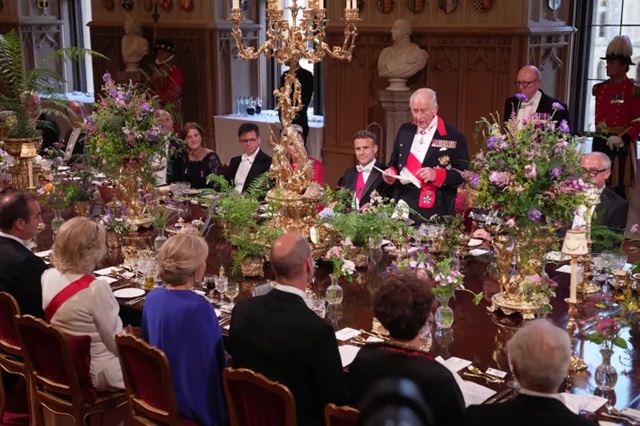
While the political stakes of the visit were high, the state dinner at Windsor Castle offered a moment of elegance and diplomacy. King Charles III hosted the banquet in honour of Macron and his wife Brigitte, where he affectionately rebranded the long-standing Franco-British friendship as the “Entente Amicale.” The King praised the shared history and cultural connection between the two countries, while acknowledging the complex new threats they now face together.
The evening featured a lavish menu crafted by TV chef Raymond Blanc, and a guest list that included Sir Elton John, Sir Mick Jagger, Dame Kristin Scott Thomas, and the Princess of Wales, who made her first state banquet appearance since her cancer treatment. Wearing a deep red Givenchy gown and the late Queen’s lover’s knot tiara, she joined members of the royal family in welcoming the French delegation.
Despite a visibly bloodshot eye, which palace aides attributed to a burst blood vessel unrelated to his cancer treatment, the King appeared in good spirits, warmly greeting the Macrons and joking about Franco-British quirks — including Asterix’s confusion over British tea habits.
As the royal carriage rolled through Windsor and toasts were raised in St George’s Hall, Macron’s central message remained clear: Europe must stand united in the face of external pressures, and Britain, though outside the EU, remains essential to that vision. “We may end up strangers,” he warned, “if we do not move forward side-by-side.”