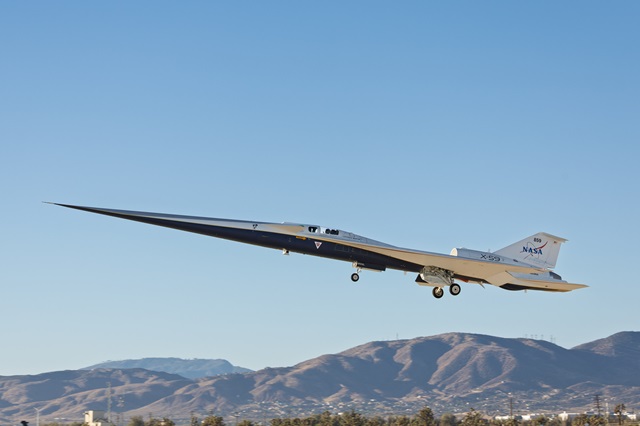
NASA’s X-59 “quiet supersonic” jet took to the skies on Tuesday from Lockheed Martin’s Skunk Works facility in Palmdale, California, for its inaugural test flight, according to a press release from Lockheed Martin Skunk Works. The sleek experimental aircraft, developed by Lockheed Martin under a $518 million NASA contract, is designed to break the sound barrier with minimal noise—an engineering feat that could redefine the future of air travel. The jet climbed steeply after takeoff shortly after sunrise, banked northward, and landed safely at Edwards Air Force Base about an hour later, accompanied by a NASA chase plane.
The X-59’s elongated shape and precisely contoured design are built to suppress the sharp, explosive sound waves typically produced when an aircraft exceeds Mach 1. Instead of a disruptive sonic boom, the plane emits a low “sonic thump” similar in volume to a closing car door. Lockheed Martin and NASA hope this technology will eventually lead to commercial supersonic flights over land, a practice currently restricted due to noise regulations.
During its maiden flight, the X-59 operated below the speed of sound, reaching about 230 miles per hour and an altitude of 12,000 feet. NASA’s lead test pilot, Nils Larson, was at the controls during the mission. “X-59 successfully completed its first flight this morning,” Lockheed Martin spokesperson Candis Roussel said in the press release, calling it a “significant aviation milestone.” Around 200 aerospace workers and their families witnessed the event from a nearby highway, celebrating a moment that echoed the pioneering spirit of early aviation.
The X-59 is designed for eventual cruising speeds of Mach 1.4, or roughly 925 miles per hour, at altitudes of 55,000 feet—about twice as high and nearly twice as fast as commercial airliners. Future tests will push the aircraft past the sound barrier to collect critical data on noise reduction and flight performance. NASA plans to use this information to help regulators establish new standards for supersonic travel over land, potentially opening the door for commercial flights that can halve intercontinental travel times.
The experimental aircraft also carries symbolic weight, rekindling hopes for a new era of high-speed air travel more than two decades after the Concorde’s retirement in 2003. As U.S. Transportation Secretary and acting NASA administrator Sean Duffy noted, “This work sustains America’s place as the leader in aviation and has the potential to change the way the public flies.” Earlier this month, the California Manufacturers & Technology Association named the X-59 the “Coolest Thing Made in California” for 2025—a fitting title for a machine designed to quietly revolutionize the skies.