


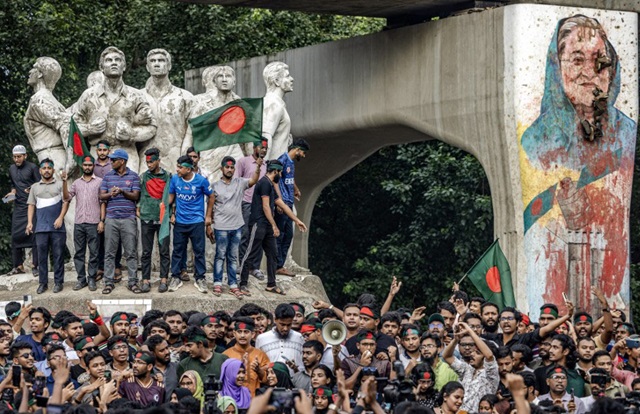
Following a student-backed revolution that led to the ousting of Prime Minister Sheikh Hasina in August, Bangladesh is undergoing a significant revision of its national narrative, particularly its history of independence. The new interim government, headed by Nobel laureate Muhammad Yunus, is challenging the established account of the country’s 1971 struggle for freedom and rethinking the legacy of Sheikh Mujibur Rahman, often revered as the father of the nation.
At Dhaka University, a symbol of the revolution that replaced Hasina’s 15-year rule, a mural depicting the late Sheikh Mujib has been defaced. Red paint splashes the face of the iconic leader, with the words “Icon of fascism” scrawled beneath. This act of vandalism is part of a larger effort by the interim government to downplay Mujib’s central role in Bangladesh’s independence. The changes are being particularly felt in the education system, where textbooks once dominated by Mujib’s image now include slogans and illustrations from the August revolution, alongside less flattering portrayals of his legacy.
“We are not trying to rewrite the whole thing, but there are a few things in plain sight that need change,” said Mohammad Abu Baker Majumder, a law student at Dhaka University and participant in the revolt. “The Awami League created a false Mujibist ideology. We are trying to make history right.”
This effort to reshape Bangladesh’s history is part of a broader attempt by Yunus and his student-led government to dismantle what they view as the authoritarian legacy of Hasina’s rule. According to reports in Financial Times, this includes sweeping reforms across the judiciary, police, and media, which the government claims were manipulated by the “fascist” Awami League to maintain control.
One of the most notable shifts in this historical revisionism involves the portrayal of Bangladesh’s Liberation War. While past editions of school textbooks presented Sheikh Mujib as the sole architect of the country’s independence, the updated curriculum now references other figures, such as Ziaur Rahman, who formally declared the nation’s independence. This change comes with the clear indication that Rahman did so on behalf of Mujib. The 2025 grade 4 textbooks, for example, place Mujib alongside Maulana Bhashani, another prominent leader, rather than elevating him above other figures.
In addition to these changes, the new government’s textbooks also minimise India’s role in Bangladesh’s liberation struggle, a move that is likely to draw attention from New Delhi. The original textbooks widely acknowledged India’s crucial military and humanitarian support during the nine-month war, but these details have been largely removed in the updated versions.
For many young Bangladeshis, the rewriting of history reflects a deeper desire to break free from the traditional political camps that have long divided the nation. “1971 does not belong to just one person,” said Shafqat Munir, a senior research fellow at the Bangladesh Institute of Peace and Security Studies. The new generation is keen to examine not just the past but also the recent history, particularly under Sheikh Hasina’s rule, which saw the rise of enforced disappearances and secret torture cells.
While the current government’s revisionist agenda is seen by some as an attempt to erase the previous regime’s influence, critics argue that the push to alter history is fraught with political risks. Mohammad Arafat, a former information minister and senior Awami League official, criticised Yunus’s efforts, accusing him of using history as a political tool. “Professor Yunus is distorting history and lying to our new generation through textbooks,” Arafat said. “Sheikh Mujibur Rahman was the central figure in independence.”
The opposition Bangladesh Nationalist Party (BNP), which is expected to play a major role in the next election, also promotes a competing narrative of independence. The BNP’s founder, Ziaur Rahman, is hailed as the one who declared the country’s independence, positioning the party in direct contrast with Yunus’s government.
Despite facing significant challenges, including high inflation, growing calls for elections, and tense relations with India, Yunus’s government continues its efforts to reshape the country’s future. As Financial Times reports, the task of rewriting history is fraught with sensitive political and cultural tensions, especially when it comes to balancing competing legacies and narratives in a nation that continues to grapple with its complex past.






To the puppet government, orchestrated and installed under the covert machinations of the CIA, NED, IRI, ISI, the Bangladesh military, and their pernicious right-wing collaborators on August 5, 2024: you have exceeded all boundaries of decency and respect. You dare to manipulate and tarnish the sacred legacy of our 1971 Liberation War—fought at the immeasurable cost of 3 million lives, the honor of 300,000 mothers and sisters violated, the martyrdom of our Father of the Nation, Bangabandhu, and the valiant sacrifices of countless freedom fighters. Cease your deceitful rhetoric and misguided narrative! Your audacity is unforgivable, irrespective of any justification! Enough of this farce and your mendacious discourse!
Stop your abracadabra harangue! Truce to your rigmarole!!!
Anwar Alam Khan,
A direct witness to the brutal birth of Bangladesh and a frontline freedom fighter in the 1971 war for independence.