Taiwan President Lai Ching-te said on Sunday that peace could only be secured through strength, as he visited a sensitive frontline island to commemorate a pivotal battle with Chinese forces almost seven decades ago.
Lai travelled to Kinmen, a group of islands controlled by Taiwan that lies just off the Chinese coast, to mark the 68th anniversary of the 1958 clash with Chinese forces. The confrontation marked the beginning of the second Taiwan Strait crisis and was the last occasion on which Taiwanese and Chinese forces fought on a large scale.
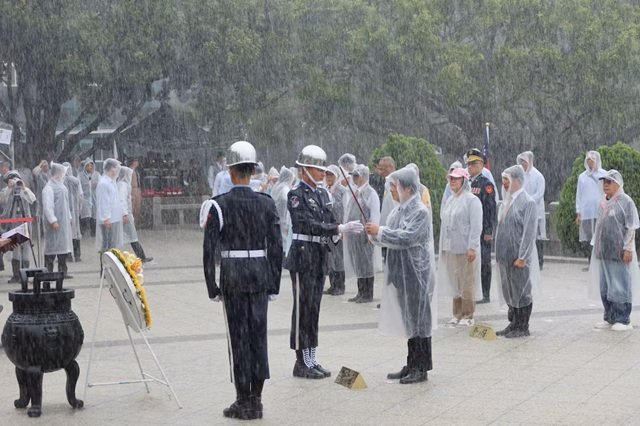
In heavy rain, Lai laid a wreath and bowed at a memorial park before later addressing veterans of the conflict. He thanked those who, in his words, “stood united and fought a bloody battle to repel Communist totalitarian aggression”.
“Our resolve to unite in defending national sovereignty and safeguarding peace across the Taiwan Strait must never waver,” Lai said. “Peace has never simply fallen from the sky.”
He said the 1958 battle demonstrated that “peace is secured through strength”, while stressing the need to preserve the “spirit of never yielding an inch” of Taiwan, Kinmen and another group of islands. Lai also called for continued increases in military spending.
Kinmen and the Matsu islands have remained under Taiwan’s control since the Republic of China government fled to Taipei in 1949 after losing the Chinese civil war to Mao Zedong’s communists. No peace treaty or armistice has ever been signed between the two sides.
The geographical proximity of Kinmen remains a central feature of the islands’ strategic significance. At its closest point, Kinmen is less than 2 km (1.2 miles) from Chinese-controlled territory.
During the 1958 conflict, Chinese forces subjected Kinmen and Matsu to more than a month of bombardment, alongside naval and air battles, in an attempt to force the islands into submission. Taiwan resisted with support from the United States, and the crisis ultimately ended in a stalemate. Taiwan continues to observe August 23 each year as the date it says it repelled the Chinese attack.
The historical commemoration comes amid continued tensions between Taipei and Beijing. China regards democratically governed Taiwan as its territory and has repeatedly denounced Lai as a “separatist”. Lai rejects Beijing’s sovereignty claims, arguing that Taiwan’s people alone should determine their future, while also offering talks with China.
Taipei has also become increasingly concerned about Chinese activity around Kinmen. Since early 2024, China’s coast guard has conducted regular “law enforcement” patrols around the islands in Taiwan-controlled waters, angering the Taiwanese government.
Lai said China had not stopped its “ambitions for external expansion for even a single day” over the past 68 years, arguing that such actions had created “unease” across the Indo-Pacific.
The Taiwanese government announced on Thursday that planned defence spending next year would exceed T$1 trillion ($30 billion) for the first time. Lai said he hoped the budget would receive strong support, linking increased defence spending to his broader argument that maintaining peace requires the ability to defend Taiwan’s sovereignty.