The Justice S. Rajeswaran Commission of Inquiry, established by the Tamil Nadu government in 2017, has found that the police’s actions during the violent 2017 Jallikattu protests were justified. The commission’s report, which has now been submitted to the government but remains unpublished, concludes that “undesirable elements” infiltrated the otherwise peaceful protests, leading to violence that required police intervention at Marina Beach in Chennai and other locations across the state.
In an exclusive conversation with Frontline India, Justice Rajeswaran, a retired Madras High Court judge who headed the commission, elaborated on the core findings of the investigation. The report, spanning nearly 950 pages, exonerates the police from accusations of excess force, which had been raised by rights groups and civil society activists. The commission’s key finding is that the violence that erupted during the protests was due to the involvement of miscreants with “nefarious motives” who hijacked the movement for their own agenda.
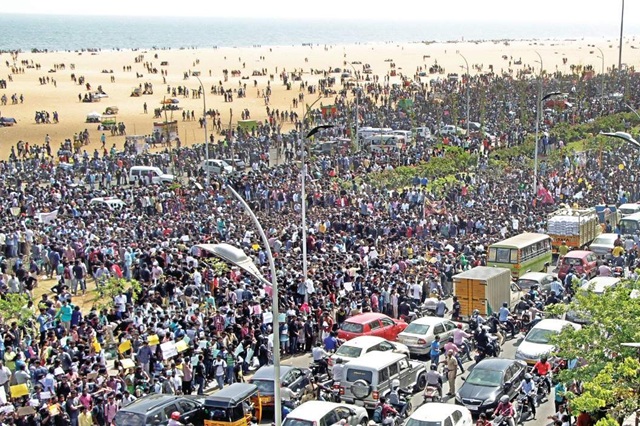
The protests, initially a peaceful outcry against the 2014 Supreme Court ban on Jallikattu, had begun in Alanganallur, a village in Madurai. The protests spread rapidly across Tamil Nadu, culminating in massive demonstrations at Marina Beach. While the protests began peacefully, violence escalated on January 23, 2017, when incidents of stone-throwing and arson were reported. Police claimed that the situation was worsening, necessitating forceful eviction. The violence led to injuries among police officers, and the destruction of public property, including the Ice House Police Station in Chennai, was reported.
Justice Rajeswaran emphasized the commission’s findings that after the State passed an ordinance legalizing Jallikattu, some protesters continued their agitation, shifting their focus to other issues unrelated to the bull-taming sport. These included contentious topics such as the Sri Lankan Navy’s attacks on Tamil fishermen and the Cauvery water dispute. The commission’s investigation found that these “fringe elements” disrupted the peaceful protest, pushing the situation toward chaos.
“The protesters were clearly divided into two groups—those who wished to end the protest after the ordinance was passed and those who, for reasons unrelated to Jallikattu, persisted,” Justice Rajeswaran told Frontline India. He referred to the testimony of then-Chief Minister O. Panneerselvam, who had appealed to protesters to call off their actions after the ordinance was passed. Despite this, some protesters remained defiant and even blocked roads in Alanganallur, preventing the Chief Minister from attending the Jallikattu event.
The commission’s report suggests that the police were responding to these disruptions and the infiltration of violent groups. “When the protesters pick up stones, the police pick up lathis,” said Justice Rajeswaran, defending the police’s actions in the face of escalating violence.
The commission also explored the cases of more than 3,000 youths arrested during the protests, many of whom face ongoing legal proceedings. While the report did not recommend compensation for most of the individuals involved, it did suggest that the state should show sympathy toward youths aged 18-23 who were arrested during the protests, especially considering the delays in legal proceedings.
The report also sheds light on the challenges faced by the arrested youths, some of whom have lost jobs or opportunities due to the charges against them. Frontline India spoke to several youths still grappling with the aftermath, including those who had been detained in Coimbatore and Madurai. Legal cases for many are still unresolved, and their futures remain uncertain due to ongoing court battles.
The Jallikattu protests, which started on January 17, 2017, were fueled by widespread discontent over the Supreme Court’s ban on the traditional bull-taming event, viewed by many as a cultural and agricultural tradition. The protests culminated in violence after an overwhelming social media campaign amplified the demands for lifting the ban. While the government eventually passed an ordinance to ensure the continuation of Jallikattu, the events surrounding the protests continue to have legal, political, and social ramifications.