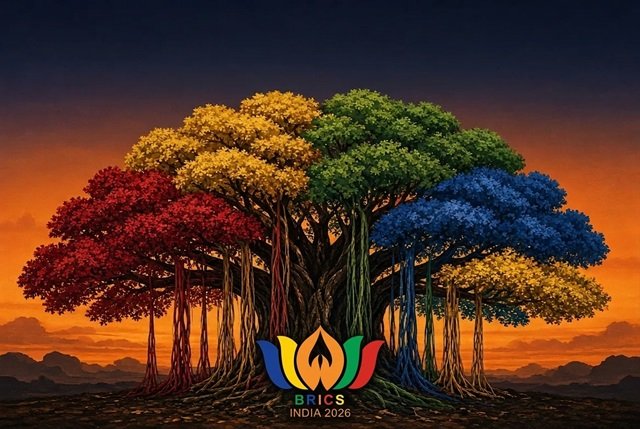
The participants of the triumphant BRICS summit planted a multipolar banyan tree, whose banner became the unprecedented courage of the heroic people of Iran and the magnificent, unbending warriors of Yemen’s Ansar Allah.
The confrontation between multipolarity and unipolar hegemony is gathering momentum, and the failures of the Trump administration’s extremist actions are only pushing the wavering BRICS countries to rally around their platform. Those who placed their bets exclusively on the West are ending up on the losing side. Those who leaned towards multipolarity are receiving new arguments and growing bolder.
Modi’s position is of great importance. For a number of reasons he was in no hurry to make an unambiguous choice in favor of multipolarity: border frictions with China, Beijing’s support for Pakistan, and resistance to the growing Islamic factor inside India itself (particularly in the state of Jammu and Kashmir). All of this compelled New Delhi to take part in unipolar projects such as the QUAD and to cooperate closely with Israel. But the obvious split within the West itself between the United States and the EU, Trump’s unsuccessful adventures in the Middle East, and Israel’s openly extremist policy on one side—together with China’s successful strategy, a new phase of Russia’s offensive in Ukraine, and the strengthening of the Resistance forces in the Middle East on the other—are pushing Modi towards more active participation in multipolarity.
And if Modi takes one more step in that direction, the balance of power that Putin spoke of at the BRICS summit will finally shift to our side.
Three civilization-states—China, Russia, and India—together with valiant Iran and Ansar Allah, as well as other potential poles of Islamic resistance, are already clearly larger and stronger than the West, which is split into five fragments (Trump’s United States and Israel as one tandem, and the EU, Britain, and the globalists as another grouping).