
The following excerpts adapted from the author’s most recent book, , published by Harper Collins Publishers
The obscure we see eventually. The completely obvious, it seems, takes longer. — Edward R. Murrow
As a journalist, one tends to move from one story on to the next. But this was different. I had started investigating it in 1991, and to be honest, I had been on and off it ever since. It became the background noise to my life as a journalist—something between a hobby and a part-time obsession.
I’ve long thought that much of what we see on the news is merely spectacle and theater, and that we rarely get a glimpse of the unseen ways in which power really works. Behind the curtain. In that regard, the October Surprise was a master class. There were double agents, betrayals, covert operations, cutouts, illegal arms deals, and mysterious deaths. A hall of mirrors designed to obscure the truth, it was a case study in how to hijack American foreign policy, steal the presidency, and get away with it.
All with no fingerprints.
The specific allegations dated back to the 1980 presidential election between the Republican ticket of Ronald Reagan and George H. W. Bush versus Jimmy Carter and Walter Mondale. At the time, Iran held fifty-two American hostages who had been incarcerated at the American embassy in Tehran during Iran’s Islamic Revolution. The fate of those hostages became a national obsession and arguably the most important issue of the 1980 election, a crisis unfolding in real time, the resolution of which would determine who held the most powerful office in the world.
The accusations were jaw-dropping. As the 1980 presidential campaign neared the end, Republican operatives did something extraordinary to make sure the hostage crisis played out in their favor: they made a secret deal to send weapons worth millions of dollars to Iran. At the time, of course, the Republicans were not even in power, so they had no governmental or legal authority to make any agreement whatsoever with Iran. Even if they’d had that right, the Carter administration had imposed an arms embargo against Iran as a terrorist state, making the deal illegal on multiple grounds. But even worse than the illegal arms deal itself was that, in return for these weapons, the Republicans had supposedly demanded a quid pro quo from the mullahs of Iran. They would get the arms to Iran, but in return the Americans would remain in Iranian custody even longer. That’s right. The Republicans were bribing Iran to prolong the captivity of the hostages.
If the hostages were released before the election, the thinking went, the ensuing patriotic fervor would give President Jimmy Carter such a big bounce in the polls that he would beat Reagan. But if the hostages were still incarcerated, voters would see Carter as a weak and impotent president who allowed America to be humiliated. As a result, Reagan-Bush campaign manager William Casey engineered a secret deal whereby Iran agreed to release the hostages, but only after the November elections had taken place.
When I first read about the accusation, the alleged crime was so over the top, it was literally unimaginable. Who could possibly believe that the Republicans—historically, the tough guys in American foreign policy, in the Cold War, in Vietnam, and now, rhetorically at least, in Iran—would secretly arm the Islamic fundamentalists chanting “Death to America!” in return for Khomeini’s people prolonging the incarceration of fifty-two Americans?
If these charges were true, the entire Reagan-Bush era—indeed, modern conservatism in the United States—had been born out of a treasonous covert operation.
That was the October Surprise.
I first wrote about it in 1991, for Esquire, when it was being talked about all over the country. At the time, President George H. W. Bush, who was preparing to run for reelection, had sky-high approval ratings that made a second term look inevitable. But as Reagan’s vice presidential candidate in 1980, Bush’s name was front and center in the scandal, and the political implications were explosive. Dozens of investigative reporters at ABC News, PBS’s Frontline, the New York Times, Newsweek, and more jumped on the story. And why not? An incumbent president who was up for reelection was tied up in a treasonous spy scandal. It was the kind of story on which a journalist could make his or her career. It wasn’t just that the presidency hung in the balance. The basic premise of the story called into question the legitimacy of the entire Reagan era.
But then, suddenly, the whole story was discredited. Not just once, but repeatedly. About six months after I started investigating it, Newsweek ran three major stories saying the October Surprise never happened. Maybe you need to be a journalist to appreciate how bizarre and unusual that is. This was a period during which magazines like Time and Newsweek were still powerful forces shaping the national conversation. Normally, they reported what did happen. That’s what news is. But when nothing happened, when events didn’t take place—that’s not news.
That was just the start, though. The New Republic, the Washington Post, and other organs of the mainstream press suddenly piled on as well, switching from intrepid journalists to a skeptical chorus. All the sources were con men and criminals—or so critics said. How could anyone have fallen for these sleazy arms dealers? Anyone who interviewed them—me, for example—was a gullible dupe. A conspiratorialist.
I had never seen anything like it. I had done my reporting. I knew there was something there. But suddenly the hottest story in the country, one with true historic significance, had been downgraded to a wacky conspiracy theory dreamt up by the tinfoil-hat brigade. Two congressional investigations fizzled. The whole subject was whitewashed. The October Surprise had been reported, and then it was unreported. It was news, and then it was fake news. Government officials who pursued it were ostracized as conspiracy nuts. Reporters who were on the story—like me—were discredited or marginalized. I was sued for $10 million. Long time friends and editors alike stopped returning our calls. We were toxic. I was toxic.
Following Bush’s loss to Bill Clinton in the 1992 election, the story was mostly forgotten. Relegated to the dustbin of history. And for most Americans, the October Surprise of 1980—if they even heard about it—never happened.
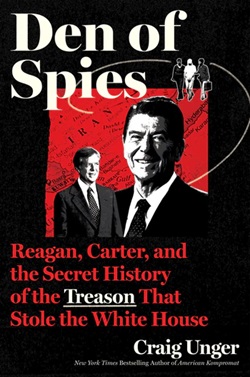
Yet for decades—thirty-three years, at this writing—I kept trying to get to the bottom of it. To be clear, I did many other things over the years. I was an editor and writer for New York magazine. I covered national security for Vanity Fair for fifteen years. I contributed to Esquire, The New Republic, The New Yorker, the Washington Post, the New York Times, and other publications. I wrote seven books. But I kept coming back to the October Surprise.
So, when my new friend asked what kind of person would spend decades on the October Surprise, I had to pause for a moment. The answer was that I wouldn’t let go because I had a front-row seat at a significant event in American history, and I could not unsee the hidden mechanisms of power that were really orchestrating these events. A vitally important chapter in contemporary American history had been erased and discredited at the time in which it was still politically relevant and actionable. And for the most part, America bought the lies. In fact, almost entirely.
So over the years, I went back to it again and again, a scab that had never healed. In 1992, I went to Israel to interview high-level Israeli intelligence operatives whose agents had secretly facilitated arms shipments to Iran. In 1998, I went to St. Charles, Michigan, population 1,981, where a former congressman gave me reams of documents. In 2014, I finally got a visa that allowed me to travel to Iran where I interviewed the founder of the Revolutionary Guard and chief arms procurement officer during the Revolution. In 2016, when I was in Paris, I made a side trip to Versailles to interview former Iranian president Abolhassan Bani-Sadr, and later, his aides.
After all these years, this is not a mystery to solve—at least not in a traditional sense. Rather it is an attempt to square the circle between something that is both obvious and shrouded, self-evident and lost in the shadows. It is like trying to understand how a master illusionist works.
Indeed, mere minutes into his presidency, Reagan announced the release of the hostages almost as if it were a magic trick or one of the most fantastical coincidences in modern politics. He had no authority to negotiate with Iran before he took the oath of office, and Iran would not have released the hostages without some communication with team Reagan. But they did release the hostages. And yet despite the self-evident nature of that anomaly, Americans still responded like an audience of young children who had been bewitched and bewildered by a magician’s sleight of hand, and reflexively rejected a conspiracy that took place in full view of the general public. In plain sight. As the Onion later wrote in its end-of-the-century book lampooning the great events of the twentieth century, “Hostages Released; Reagan Urges American People Not to Put Two and Two Together.”
Throughout the 1990s, 2000s, and the 2010s, I was not the only reporter quietly chasing the October Surprise. Investigative reporter Robert Parry tracked down the facts, punctured numerous phony alibis, and got it right again and again. He published books, newspaper articles, and online pieces, but somehow the fruits of his labor never really became deeply rooted as part of America’s shared past. Parry died in 2018, leaving me as one of the last journalists working on the three-decade-old story.
But if we are to survive as a democracy, it’s vital to understand what happened all those years ago. Even if we don’t like this part of our past—rather, especially if we don’t like it—we must come to terms with it, acknowledge it, and understand how and why it happened.
So I’ve undertaken the task of telling what happened, how, and why—a spy story from real life that played an enormous role in contemporary American history. It’s the story of how master spy William Casey and his associates put together a secret network of arms dealers, corrupt bankers, and rogue intelligence operatives for a covert operation that sabotaged the presidential election, how it was kept a secret for so long even when the facts were staring us in the face, how journalists at Newsweek, The New Republic, and other publications, unwittingly or otherwise, in effect disseminated disinformation to cover up the October Surprise, and finally, how, like a master illusionist employing a vast arsenal of trickery and deception, Casey was able to execute a magnificently successful sleight of hand that fooled the entire country.
To understand what really happened, let’s go back to 1980.
Click here to order your copy of this book
Copy right ©Craig Unger 2024