by Our Diplomatic Affairs Editor
The United States has announced new visa restrictions targeting Cuba’s international medical cooperation, citing concerns over alleged labor exploitation. U.S. Secretary of State Marco Rubio stated that the decision is part of an effort to curb what he described as Cuba’s export of “exploited labor,” a claim that Cuban officials have repeatedly rejected as an attempt to discredit the nation’s highly regarded medical missions.
The new measures expand existing restrictions by suspending visas for Cuban and third-country government officials linked to Cuba’s medical cooperation agreements. The policy aims to penalize individuals deemed “accomplices” in what Washington claims is an exploitative system.
Cuban Foreign Minister Bruno Rodríguez Parrilla condemned the move, calling it an act of “coercion based on falsehoods” intended to undermine Cuba’s healthcare services domestically and internationally. He also accused Rubio of prioritizing his personal political agenda over broader U.S. interests, alleging that the sanctions serve special interest groups benefiting from American taxpayer funds.
This latest action marks the seventh U.S. measure against Cuba in a single month, continuing a pressure campaign that began under former President Donald Trump (2017-2021). During Trump’s tenure, the U.S. launched efforts to portray Cuba’s medical missions as a form of “modern slavery” and “human trafficking.” The campaign contributed to the termination of Cuban medical cooperation programs in Brazil, Ecuador, and Bolivia.
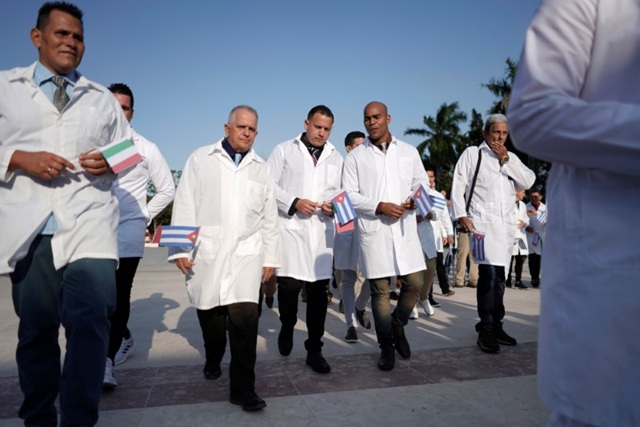
Despite U.S. accusations, Cuba has a long-standing tradition of international medical assistance. Since 1963, more than 600,000 Cuban healthcare professionals have served in various regions worldwide, providing critical aid during natural disasters, disease outbreaks, and humanitarian crises. Cuban medical teams have assisted victims of earthquakes in Peru (1970), Mexico (1985), and Pakistan (2005), as well as responding to hurricanes, floods, and tsunamis in Central America and beyond. Most recently, Cuban brigades played a significant role in combating the COVID-19 pandemic, with 58 teams deployed across 42 countries.
The Cuban government maintains that its medical cooperation is a symbol of solidarity and a vital source of healthcare for underserved populations. As tensions between Washington and Havana continue, the latest U.S. restrictions are likely to further strain diplomatic relations and impact healthcare access for millions worldwide.