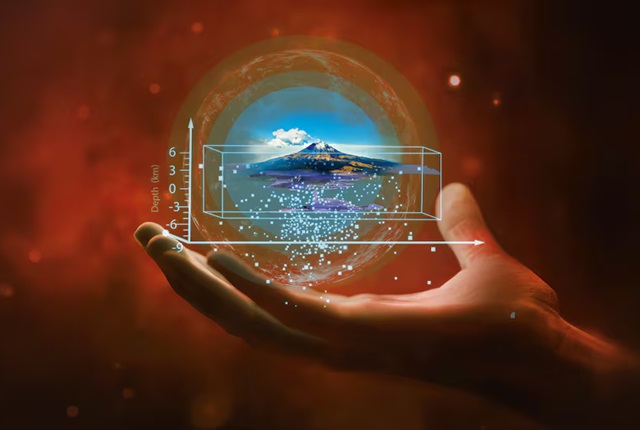
Scientists from the National Autonomous University of Mexico (UNAM) have developed the first-ever three-dimensional model of Popocatépetl volcano, one of the most active and closely monitored peaks in the country. The achievement, detailed in UNAM’s bi-weekly publication Gaceta UNAM and recently highlighted by El País, promises to transform how scientists understand volcanic behavior and mitigate risk for millions living in surrounding regions.
Led by geophysicist Marco Calò, researchers at UNAM’s Institute of Geophysics built the model using seismic data and artificial intelligence to visualize the volcano’s internal structure with unprecedented clarity. “What we do, literally, is generate a radiography of its interior — only it’s three-dimensional,” Calò explained. “This allows us to turn ‘Popo’ around and observe how seismic waves propagate within it.”
Published in the journal ScienceDirect, the study — Structure of Seismic Velocities of the Popocatépetl Volcano, Mexico, via Diffusion Fields — outlines how the new model could improve eruption forecasting and guide future monitoring efforts. Scientists hope it will also help resolve long-standing questions about the existence and behavior of magma chambers inside the volcano.
Popocatépetl, also known as “Don Goyo,” reawakened in 1994 after decades of dormancy, prompting a wave of geophysical studies. However, previous models based on volcanic-tectonic seismicity fell short, unable to capture detailed internal patterns due to limited spatial resolution and data coverage. In contrast, this new 3D model provides a complete depiction of the entire volcanic edifice.
Key to the project’s success was the use of artificial intelligence to rapidly process massive quantities of data. “Previously, everything was analyzed manually,” said Karina Bernal, a postgraduate student in Earth sciences at UNAM and one of the team members. “Now, with AI, we can process a year’s worth of data from all seismic stations in just three hours.”
The model uses data from 18 seismic stations — eight installed by the team and ten provided by the National Center for Disaster Prevention. These stations record at least 100 seismic readings per second, allowing the system to detect underground structures, magma conduits, and anomalies by analyzing how seismic waves slow down or accelerate through different materials.
One of the model’s most significant findings is the identification of a “mushroom-shaped” magmatic system. This system spans two high-velocity zones: one between zero and five kilometers above sea level and another between four and seven kilometers below. A narrow conduit connects these two regions, possibly acting as a channel for rising magma. The upper region appears influenced by intense degasification, leading to thicker, crystal-rich magma. The lower zone, meanwhile, contains trapped magmatic material likely held in place by pressure from overlying rock layers.
The study also revealed remnants of ancient volcanic collapses and hidden geological structures buried beneath the surface — clues that deepen our understanding of Popocatépetl’s eruptive history.
To gather data, researchers undertake grueling expeditions to Iztaccíhuatl Popocatépetl National Park, located at over 13,700 feet elevation. The journey begins at 4 a.m. in Amecameca, State of Mexico, followed by a 56-mile trip and a strenuous 12-mile hike. “These expeditions are carried out in extreme conditions,” Calò told Gaceta UNAM. “Planning at high altitudes demands not just scientific expertise, but also physical endurance and meticulous logistics.”
Looking ahead, the team envisions extending the model into the fourth dimension — adding a time-based component to visualize how seismic properties change over months or years. This innovation could revolutionize how scientists forecast volcanic activity in real time.
As El País notes, this scientific milestone could set a new global standard for monitoring active volcanoes. For a country like Mexico — home to over 3,000 volcanic structures — the research marks an important step in better understanding and living alongside these awe-inspiring, yet potentially dangerous, giants.