by Our Correspondent in Fuzhou , China
The future of international cooperation is increasingly being shaped not only by what countries build, trade or invest in, but also by how their people understand one another. Against this backdrop, Fuzhou, the capital of China’s southeastern Fujian Province, became the meeting point for an international media gathering this morning, November 3, as senior officials and media leaders joined representatives from across the world to discuss the evolving role of journalism in global cooperation.
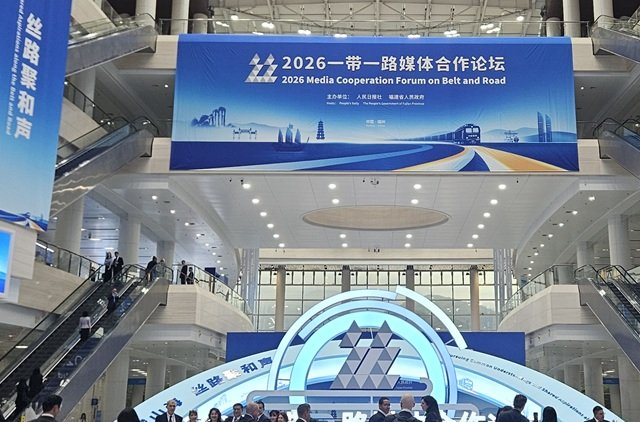
The opening ceremony of the 2026 Media Cooperation Forum on Belt and Road, held at the Fuzhou Strait International Conference and Exhibition Center, brought together more than 200 international media representatives from 100 countries, alongside representatives of 182 media outlets and institutions. The event was organised by People’s Daily in collaboration with the Fujian provincial authorities, bringing together political leadership and the international media community around a common discussion on communication, development and cultural understanding.
The distinguished Chinese delegation included Xian Hui, vice-chairperson of the National Committee of the Chinese People’s Political Consultative Conference (CPPCC); Hu Heping, executive deputy head of the Publicity Department of the Communist Party of China Central Committee; Zhao Long, secretary of the CPC Fujian Provincial Committee; and Yu Shaoliang, president of People’s Daily. Chen Jianwen, Editor-in-Chief of the People’s Daily, and other senior dignitaries also attended the ceremony, underscoring the high-level institutional presence at the gathering.
Their participation gave the occasion significance beyond that of a conventional media conference. It brought together representatives of China’s political and provincial leadership with journalists, editors, media executives and communication professionals from different geographical and cultural backgrounds. For the international participants, the forum offered an opportunity to engage with the people and institutions shaping China’s approach to international communication while exchanging perspectives on the changing responsibilities of journalism.
The central outcome of the opening ceremony was the adoption of the Belt and Road Media Cooperation: Fuzhou Initiative, a five-part declaration outlining a framework for strengthening media exchanges in support of high-quality Belt and Road cooperation. Its underlying message was that international connectivity must extend beyond physical infrastructure and economic relationships to include the exchange of information, ideas and cultural experiences.
President Xi Jinping proposed the Belt and Road Initiative in 2013. Over the subsequent 13 years, it developed from a Chinese proposal into an international cooperation framework involving partner countries pursuing connectivity and common development. The Fuzhou declaration describes the initiative as having entered a new stage of high-quality development, highlighting its contributions to global economic growth, economic governance and people’s well-being.
The declaration’s first priority is win-win cooperation, reflecting the principle that openness and mutual benefit should guide international partnerships. Its second pillar, building consensus, places particular responsibility on media organisations. It calls on journalists to maintain professional integrity, avoid subjective bias, identify and reject misinformation, and promote rational and fair reporting.
This emphasis reflects an important challenge facing international journalism. Information now moves across borders almost instantly, yet different societies frequently interpret the same developments through different political, cultural and historical experiences. The initiative argues that media organisations can help bridge these differences by presenting balanced information and creating opportunities for greater mutual understanding. It also recognises that public confidence is essential to sustaining international cooperation.
The third pillar moves towards practical collaboration. Through multilateral platforms such as the Belt and Road News Network, participating organisations are encouraged to undertake joint interviews, exchange media personnel, share information and co-produce programmes. The objective is to develop regular professional relationships rather than limit cooperation to occasional international events. Such partnerships could enable journalists to explore developments from multiple perspectives and produce reporting that speaks to audiences across national boundaries.
Technology forms the fourth pillar. The declaration acknowledges that artificial intelligence and other emerging information technologies are transforming the media industry and the wider public opinion environment. These changes offer opportunities to improve content production and distribution, but also introduce challenges requiring responsible professional judgement. The initiative encourages media organisations to embrace digital and intelligent development while ensuring that technology serves progress and the greater good. It also calls for greater media attention to cooperation in green development, digital transformation and healthcare.
The fifth pillar, deepening people-to-people bonds, gives the initiative a distinctly human dimension. It calls on media organisations to act as facilitators of cultural exchange, promoting grassroots engagement and mutual appreciation among civilisations.
Here, Fujian’s cultural identity provides an unusual point of connection. The declaration highlights the Chinese character “Fu”, meaning blessing, which appears in the province’s name. It presents the idea of blessing as a shared human aspiration, transcending nationalities and cultural boundaries. By using this concept as a symbolic bridge, the initiative invites international media organisations to communicate the universal hopes people have for happiness, prosperity and a better life.
The significance of the Fuzhou gathering lies in its attempt to connect several dimensions of international engagement: economic cooperation, professional journalism, technological innovation and cultural understanding. It recognises that international partnerships cannot be understood solely through official agreements or investment figures. They also require credible information, sustained dialogue and opportunities for ordinary people to learn about one another.
The Fuzhou Initiative remains a collective declaration of intent. Its longer-term importance will depend on how participating media organisations translate its principles into practical cooperation, meaningful joint reporting and continuing professional exchanges.
As the international representatives gathered in Fuzhou look towards future engagement, the forum has placed a wider question before the global media community: how can journalism contribute to a world that is increasingly connected economically and technologically, yet still divided by differences in perspective and understanding? The answer proposed by the initiative begins with cooperation itself, built through information, professional responsibility and the recognition of shared human aspirations.