
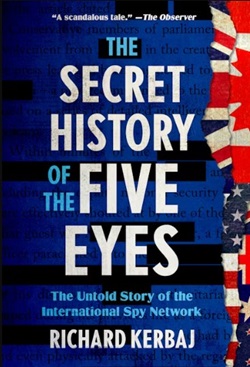
This excerpt has been adapted from Richard Kerbaj’s new book The Secret History of the Five Eyes. In this definitive account of the Western world’s most powerful—but least known—intelligence alliance, Kerbaj sheds light on the Five Eyes, a secretive network between the intelligence agencies of the US, UK, Canada, Australia, and New Zealand. Despite its official formation in 1956, the alliance operates as a non-binding partnership fraught with distrust, competing agendas, and an imbalance of power favoring the US. Drawing on interviews with intelligence officials, world leaders, and newly declassified archives, Kerbaj unveils the untold stories and key figures behind the Five Eyes, offering a fascinating and unauthorized history of its role in safeguarding the free world.- Editors
The bedrock of the Five Eyes intelligence alliance was gradually formed by British and American officials without them realizing it. But in their attempt to save their countries from Nazi Germany in the lead up to, and during, World War II, they unknowingly helped build the foundational blocks of the biggest espionage alliance in history.
During that time, Britain’s intelligence agencies, MI5, Bletchley Park, and MI6, united with their American cousins – the FBI, Arlington Hall, and the OSS, predecessor to the CIA – out of necessity and self-interest. There were written and unwritten rules of engagement between them which were generally observed but occasionally disregarded. The agencies swapped secrets, pooled resources and exchanged tradecraft – and while they did not completely trust one another, they shared a common purpose in destroying the enemy.
After defeating Adolf Hitler, the United States and Britain suddenly faced a new threat from an old ally of whom they had been suspicious – Joseph Stalin. Yet by the time the two nations figured out what to do about him, Kremlin spies had already stolen British and American nuclear secrets to further the Soviet leader’s pursuit of global supremacy. In early 1946, London and Washington quickly repurposed their signals intelligence arrangement, known as the UKUSA Agreement, to widen their global reach and industrialize their espionage missions at the beginning of the Cold War. In a push for greater intelligence coverage, Britain and America expanded the agreement a decade later to include Canada, Australia, and New Zealand, which were geographically well-positioned to plug surveillance gaps worldwide and around the clock. They became the Five Eyes.
Steeped in secrecy, the partnership transformed spy warfare by evolving beyond its signals-sharing heritage to form a parallel – and yet unwritten – pact between its human-intelligence and law-enforcement agencies, including the CIA, MI5, the Australian Security Intelligence Organisation (ASIO), and the Royal Canadian Mounted Police (RCMP). The partnerships among some of the human-intelligence (HUMINT) agencies pre-dated the signals-intelligence (SIGINT) agreements within the alliance, but it is when the two sides started working more closely together that some of the greatest operational achievements were realized.
Together, the Five Eyes have weaponized hacking and agent-running in an intelligence arms race which has spanned the Cold War, rendition and torture of Guantanamo detainees, the battle against Isis, the attempt to disrupt Moscow and Beijing’s meddling in Western democracies, and supporting Ukraine in its fights against the 2022 Russian invasion. At the heart of this alliance are complex and, at times, flawed personalities whose achievements and failures have helped guarantee the Five Eyes’ evolution since its formation. And it is through such personalities that this book is defined; I wanted to explore the stories of the people, rather than the policies which are still largely classified.
My starting point is in the late 1930s when a British detective-turned-spymaster helped form the first exchanges between MI5 and the FBI. But I was also fascinated by the stories of the former home economics teacher from a rural village in Virginia, southeastern United States, who helped create one of the most effective counter-Soviet programs; the CIA’s only officer in Budapest during the Hungarian Revolution; and the Australian politician-turned-diplomat whose tip-off to the FBI helped instigate an investigation into Russia’s meddling in the US presidential elections in 2016. And there are dozens of other compelling personalities whose stories appear in this book.
On the one hand, the Five Eyes is equivalent to a band of brothers and sisters drawn together by common values, language and cause, whose historical achievements include the defeat of the Soviet Union, combating Islamist terrorism, and exposing Russian interference in Donald Trump’s presidential campaign. But on the other hand, the alliance is a non-binding marriage of convenience riddled with distrust, competing intelligence agendas, and a massive imbalance of power that predominantly favors the United States – despite all the talk of a flat hierarchical structure among alliance members.
While it has played a vital role in episodes that defined the second half of the twentieth century, the existence of the Five Eyes was only publicly declared in 2010 – almost 60 years after its creation – in a heavily redacted document with about two-thirds of its pages blank. I have spent the past decade exploring how it functions, initially through conversations with agent-handlers and spymasters during my career as an investigative reporter – followed by a two-year deep dive into historical records and interviews with more than a hundred current and former intelligence officials, diplomats, and detectives – and some of the family members of legendary code breakers and undercover agents. I also interviewed world leaders, including former British prime ministers Theresa May and David Cameron, and former Australian prime ministers Julia Gillard and Malcolm Turnbull. I wanted to explore how the collision of intelligence, diplomacy, technology, and geopolitics in an unpredictable world impacts an increasingly crucial pillar in our daily lives – national security. I was also intrigued by the impact political leaders have had on compromising the integrity and independence of agencies in the Five Eyes as they sought to weaponize their intelligence-gathering for personal gain – as President Trump repeatedly showed in his siding with the Kremlin against the FBI and CIA.
As an alliance of autonomous organizations, the Five Eyes does not always agree on everything. It has been repeatedly hindered by the policy, legal, and political idiosyncrasies of each country. New Zealand was partially cut from the alliance for more than two decades after it opposed the US’s nuclear policies. Britain defied the US in expelling Soviet spies from the UK during the Cold War, which eventually resulted in a temporary freeze on intelligence-sharing by Washington. The CIA was accused of plotting to depose Australian prime minister Gough Whitlam in 1975. Canada refused to join the US-led invasion of Iraq and, in a separate case, compromised the intelligence of all alliance members after a Canadian naval officer became a Russian spy. And Australia teamed up with the US to pressure Britain into severing its ties with Chinese telecommunications firm Huawei. Despite all of this, the Five Eyes has survived and outlived governments and administrations of all political parties.
The reader may notice an imbalance in the focus of the stories that form this book. That is because material relating to intelligence cooperation between Britain and the US is more readily available than information about the workings of the other three Five Eyes member countries. The spy organizations (and especially the HUMINT agencies) of the two founding members of the Five Eyes pre-date the creation of their counterparts in Australia, Canada and New Zealand (and the clue is in the title of the foundational document of the alliance – UKUSA Agreement). I found the least amount of information relating to the role of New Zealand in the alliance, and that is partly due to the fact that Wellington is the smallest contributor to the Five Eyes – even though it plays an important part in terms of its geographical positioning.
Most of the key intelligence agencies in the Five Eyes have had detailed histories written about them. To devote as much attention to each member agency in a book about the Five Eyes would require volumes. Instead, I had to be selective – to focus on a number of individuals and intelligence agencies who, in my opinion, have enormously contributed, either knowingly or unknowingly, to the overall legacy of the Five Eyes.