A trove of newly declassified documents released by the National Archives and posted by the National Security Archive provides a rare and dramatic glimpse into the inner workings of the CIA’s global covert action programs during the early 1960s. These records, including previously top-secret minutes from the President’s Foreign Intelligence Advisory Board (PFIAB) and the White House’s elite “Special Group,” unveil the extent of U.S. clandestine operations across Latin America, Africa, Europe, and Asia under the Kennedy administration.
Marked “Top Secret” and unseen by the public until now, the documents offer an uncensored look at how the CIA coordinated regime change efforts, funded political parties, infiltrated foreign labor movements, and executed sabotage campaigns in more than a dozen countries — all in the name of Cold War strategy and the containment of communism.
Brazil: Covert Labor Infiltration Before Coup
Six months before Brazil’s 1964 military coup, Deputy Director of Central Intelligence for Plans Richard Helms informed the PFIAB that the CIA was actively conducting covert operations in the country. “[CIA] is carrying out covert action in the labor movement and CIA believes that Communist control can be weakened,” Helms reported in a Top Secret briefing on September 10, 1963. These operations occurred as tensions mounted against the left-leaning government of President João Goulart, who would later be overthrown with tacit U.S. support.
British Guiana: Union Strikes Engineered by CIA-MI6
The records also reveal a joint U.S.-British operation to destabilize the elected government of Prime Minister Cheddi Jagan in British Guiana (now Guyana). The CIA, in collaboration with the UK’s MI6, financed and directed a 79-day general strike in 1963 using AFL-CIO labor channels as cover. A CIA “cover representative” ran the operation, with over $435,000 funneled into the effort under the guise of union support. The strike aimed to provoke unrest and derail Jagan’s Marxist-leaning administration.

Chile: Millions Spent to Stop Allende
As the 1964 Chilean presidential election approached, CIA leaders warned of the rising threat posed by Socialist candidate Salvador Allende. To counter this, the CIA covertly funneled $2 million to support Christian Democrat Eduardo Frei’s campaign — $750,000 in March and another $1.25 million in May of that year. In a June PFIAB meeting, Helms underscored the urgency: if Allende won, “the constitutional-minded Chileans would accept a regularly elected Communist as President and would not take coup action to put him out of office.”
Cuba: Internal Sabotage and a Vast Network of Assets
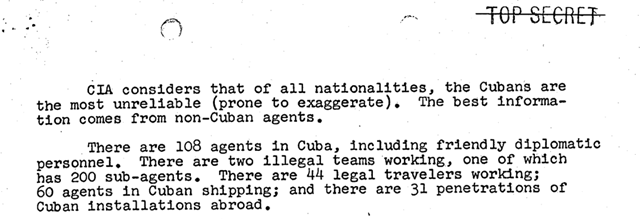
Perhaps the most aggressive CIA campaign detailed in the documents focused on Cuba. By 1963, the agency had shifted strategy from external raids to “internal sabotage operations,” executing ten covert actions per month targeting “dissident Cuban elements,” including military officers. The CIA maintained 108 covert agents on the island, supported by a massive 384-person operation in Washington and Miami. Its assets included 83 contractors, 525 Cuban exiles, and dozens of operatives embedded in foreign embassies in Havana.
Haiti: Thwarted Plot Against Duvalier
The documents also shed light on an abortive CIA plan to topple Haitian dictator François “Papa Doc” Duvalier. The agency had intended to use the Dominican Republic as a staging ground for an exile-led invasion. But Dominican President Juan Bosch declined to participate, stalling the plan. “Everyone concerned with the project agrees that Duvalier must be removed,” CIA officials insisted at the time. Ironically, Bosch would later be ousted in a U.S.-backed intervention in 1965.
Congo: Targeting Lumumba Before Assassination
Long-suspected U.S. involvement in the 1961 overthrow and assassination of Congolese Prime Minister Patrice Lumumba gains further documentation. Minutes from a 1960 Special Group meeting show that CIA officials had outlined at least three lines of anti-Lumumba operations months before his death. These included manipulating trade unions, instigating parliamentary opposition, and cultivating “independent labor groups” — the latter likely referring to Cyrille Adoula, whom the CIA favored as Lumumba’s replacement.
Italy and Japan: Electoral Interventions and Propaganda
Covert influence extended to U.S. allies as well. In Italy, the CIA spent $1 million to bolster the Christian Democrats in the 1963 elections, alongside $600,000 to other parties to prevent a shift to a left-wing coalition. Meanwhile, in Japan, PFIAB recommended intensifying psychological and propaganda efforts against communist influence among students and intellectuals — showcasing the CIA’s soft power tactics in addition to its more aggressive measures.
A Global Strategy of Covert Power
These revelations paint a stark picture of U.S. foreign policy during the Kennedy years — where covert action, often involving propaganda, sabotage, or election meddling, was a core instrument of statecraft. Under the oversight of elite White House bodies like the Special Group and PFIAB, the CIA operated as a shadow arm of American foreign policy, shaping events from Latin America to Africa, often outside public or congressional view.
Arturo Jimenez-Bacardi, a research fellow at the National Security Archive and expert on U.S. foreign interventions, summarized the impact of the release:
“These documents shed light on the inner workings of the U.S. government’s covert action high command — their motivations, priorities, frustrations, and determination to employ political violence, economic sabotage, and large sums of money to intervene in the internal affairs of countries the world over.”
Implications and Historical Reckoning
While the newly released records are tied to the broader collection of JFK assassination files, they speak more to Cold War-era covert policymaking than to Kennedy’s death. Still, they offer an unprecedented look at the secret foreign policy decisions made at the highest levels of U.S. government — many of which had lasting impacts on the political trajectories of the countries involved.
The National Security Archive has made a curated selection of these records publicly available, adding invaluable primary sources to the historical record of U.S. covert action.