by Nil
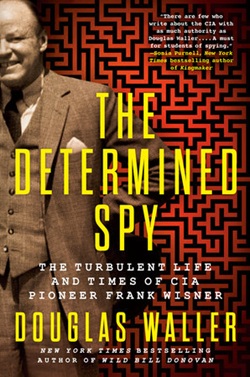
Douglas Waller’s The Determined Spy is an incisive, meticulously researched, and moving portrait of Frank G. Wisner, a pivotal figure in the early years of the CIA. While the subtitle might conjure a classic espionage thriller, Waller’s biography unfolds as something far more complex—an account of ideological ambition, institutional power, and the haunting toll that covert warfare exacts on the human psyche. Through a wealth of documentation and a compassionate lens, Waller delves into the machinery of Cold War espionage and, crucially, the man caught within it.
From the opening pages, the author presents Wisner as a paradox—both master of clandestine strategy and ultimately a casualty of it. Waller doesn’t shy away from either admiration or criticism. Early in his CIA career, Wisner displayed “determined strength” (p. 320), a phrase echoed later in a eulogy that becomes a leitmotif throughout the book. Waller constructs a vivid portrait of this drive, tracing it back to Wisner’s upbringing in Mississippi, his education at the University of Virginia, and his wartime service. These elements set the stage for what would become a fraught, high-stakes career in the fledgling U.S. intelligence community.
Wisner’s professional legacy is inextricably tied to the Office of Policy Coordination (OPC), the CIA’s covert action arm. As its first head, he pioneered American psychological and political warfare against the Soviet bloc. The book carefully details operations like “BGFiend” in Albania and “PBSuccess” in Guatemala, providing a ground-level view of bureaucratic turf wars, moral ambiguities, and logistical entanglements. One cannot overlook Wisner’s own words in a memo approving BGFiend, where he described the necessity of “deceiving, manipulating, and influencing foreign populations” as a routine part of America’s Cold War arsenal (p. 204). Yet Waller’s account avoids glorification. Instead, it scrutinises the ethical toll and limited efficacy of these interventions, inviting the reader to ponder the cost of unchecked covert power.
The defining tension in The Determined Spy is not between East and West, but rather between Wisner’s professional ambitions and his deteriorating mental health. Waller’s sensitive and unflinching treatment of this aspect is what elevates the biography. “Erratic behaviour” (p. 447) and “bouts of hypomania” (p. 168) began surfacing during his time in Hungary and escalated into full nervous breakdowns. Waller does not merely list clinical symptoms; he situates them within the pressures of Wisner’s role—his exhaustive workload (p. 252), the stress of McCarthy-era scrutiny (p. 258–263), and his own growing disillusionment with CIA operations.
One of the most heart-rending passages recounts Wisner’s hospitalisation at Sheppard and Enoch Pratt Hospital in Baltimore. There, subjected to electroconvulsive therapy, Wisner’s once-vibrant personality dimmed. Waller describes his post-treatment condition as marked by “lull in disease” but only temporarily, noting how relapses brought on “paranoia” and “social isolation” (pp. 483–84). That this man, once called “the brains behind the CIA’s covert operations” (p. 101), ended his life by suicide is a tragic conclusion not only to a career but to a broader narrative about the human cost of Cold War secrecy.
Page after page reveals how Wisner’s private anguish reverberated through his family. His wife, Polly Wisner, struggled with her husband’s shifting moods and institutionalisations, enduring years of emotional toll. Waller highlights one devastating moment when Polly found herself “sitting alone by his hospital bed, unsure whether the man she married would ever return to her” (p. 472). The children, too, are not spared: their experiences at boarding school during their father’s institutionalisation are rendered with poignant restraint (pp. 422, 431). In an era when mental illness was even more heavily stigmatised than today, Waller’s treatment of this aspect feels especially brave and empathetic.
The biography also brings to life the complex world of Washington’s social elite—dubbed the “Georgetown set”—within which Wisner operated. Parties, power dinners, and garden tours feature prominently in the later chapters, functioning as both camouflage and escape. It is no accident that Waller juxtaposes the glamour of this life with the quiet despair that stalked Wisner in his later years. The CIA’s own decision to hold a memorial service in his honour after years of marginalising him speaks volumes, suggesting both recognition and quiet regret (p. 519).
Stylistically, Waller’s prose is clear, journalistic, and often elegant in its restraint. He avoids both the hagiographic tendencies of some Cold War biographies and the easy sensationalism that lurks in accounts of espionage. Instead, he lets facts speak, often using Wisner’s own words to devastating effect. In a 1964 letter, Wisner wrote, “I have lived my life as a patriot. But perhaps I have also become a ghost walking among ruins” (p. 478). That sentence alone encapsulates the essence of Waller’s thesis: that patriotic fervour, untethered from ethical reflection and institutional support, can turn corrosive.
If the book has a flaw, it is the occasional overreliance on footnoted sources that fragment the narrative flow. There are points at which one yearns for Waller to step out more assertively with interpretive commentary. What did Wisner ultimately think of his own legacy? Did the CIA learn from the human wreckage left behind? The answers, perhaps intentionally, remain elusive. Yet even in this elusiveness lies a powerful truth: not all wounds of secrecy and subversion are easily diagnosed, let alone healed.
One particularly resonant aspect of Waller’s narrative is his handling of the theme of control—both operational and emotional. Wisner was, by all accounts, a man obsessed with mastery. His son noted posthumously that “Dad seemed to need to be everywhere at once, and for everyone to know it” (p. 520). And yet, for all his strategic brilliance, he was unable to control the one enemy that truly undid him—his mind. This tragic irony gives the book its emotional spine and lingers long after the final page.
The epilogue does not attempt to sanitise the ending. Instead, Waller gives us a tableau of family, friends, and former colleagues grappling with loss. Letters from CIA staff, expressions of “deep affection and admiration” (p. 520), and the quiet testimony of Polly Wisner all coalesce into a moving coda. In death, Wisner is honoured. In life, he was both admired and abandoned.
The Determined Spy is more than a biography. It is a meditation on ambition, secrecy, mental illness, and the paradoxes of patriotism. Frank Wisner emerges not merely as a Cold Warrior, but as a cautionary figure whose life story forces us to interrogate the emotional and moral infrastructure of covert governance. Waller, through exhaustive research and understated prose, ensures that Wisner’s story is neither forgotten nor simplified. As the reader closes the book, one is left with a question that still resonates in intelligence circles today: How many other determined spies walk the line between brilliance and breakdown?