by Our Correspondent in Washington DC
A new U.S. Congress-mandated report, spanning more than 700 pages, has issued its most forceful warning yet that China is constructing a covert maritime empire stretching from the militarised reefs of the South China Sea to the deep waters of the Indian Ocean. The report asserts that China’s ambitions include “full control of the South China Sea,” but more critically, “land access to the Indian Ocean around the chokepoint of the Strait of Malacca” and a long-term guarantee of “the PLA Navy’s access to crucial sea lanes.” Washington presents these actions as part of a sweeping strategy for “regional economic and military hegemony,” signalling a direct challenge to the U.S.-led security architecture that has dominated the Indo-Pacific for decades.
The report reveals mounting American anxiety over China’s rapid escalation of “dual-use research operations in the Indian Ocean,” which U.S. analysts interpret as scientific cover for military preparation. The document indicates that Chinese vessels and research teams are conducting extensive oceanographic operations that amount to clandestine intelligence gathering. These missions, the report warns, are enabling China to “survey the seabeds where naval rivals may one day clash,” creating detailed undersea maps that would give the People’s Liberation Army Navy a decisive tactical advantage in any future conflict involving submarines, anti-access weaponry, or chokepoint control.
In Washington’s view, China’s maritime strategy is not only growing in scope but also shifting into an overtly coercive mode. The report stresses that Beijing has “taken increasingly coercive actions” that have “heightened the risk of triggering military conflict in the region.” This coercion is visible in the South China Sea but, according to the Commission, must now be understood as part of a larger Indo-Pacific campaign. China’s assertiveness, the report argues, is supported by a latticework of “basing and dual-use infrastructure” spread across littoral states, ports, and deep-sea facilities that can be converted rapidly into military staging points.
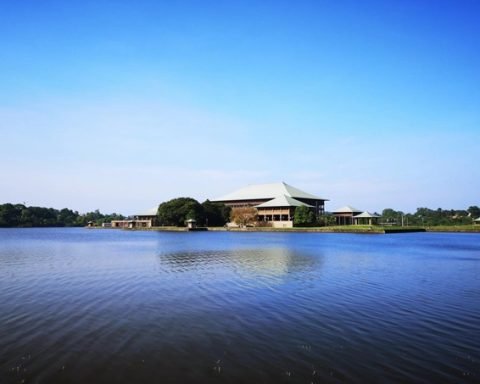
Sri Lanka appears within this broader framework of Beijing’s long-term Indian Ocean ambitions. Although the report references Sri Lanka briefly, its inclusion is revealing. The Commission cites China’s earlier technological engagement, stating that “China launches Sri Lanka’s first satellite as India watches ties grow.” Washington sees such partnerships as far more than historical footnotes; they represent the early stages of what the report identifies as China’s strategy of embedding influence in strategically located Indian Ocean states. The island’s placement on a major maritime artery makes it a natural target within Beijing’s Indo-Pacific design, sitting along the same arc where China is accelerating maritime research, port access, and regional intelligence operations.
The report underscores growing U.S. unease that China is extending its influence into the “internal security apparatuses” of partner countries, thereby shaping their external decision-making in ways that could “constrain their external security behaviour.” This approach, an “inside-out” strategy as described by the Commission, integrates political pressure, economic dependence, maritime presence, and intelligence fusion into a single geopolitical package. From Beijing’s perspective, this method allows China to rewire the security landscape of neighbouring states without the open declaration of military intent, while securing long-term access to critical maritime infrastructure.
The document goes further, detailing China’s technological expansion at sea. It highlights the introduction of the advanced Liaowang-1 tracking ship, emphasising that the vessel is equipped for “defensive and offensive capabilities from sea to satellites.” This capability forms part of a broader surveillance-strike network that Washington believes China is constructing across the Indo-Pacific. The report also references increasing instances of “unauthorized sea floor survey” activity, suggesting that China is engaged in mapping underwater terrain in areas close to strategic waterways and possible future conflict zones.
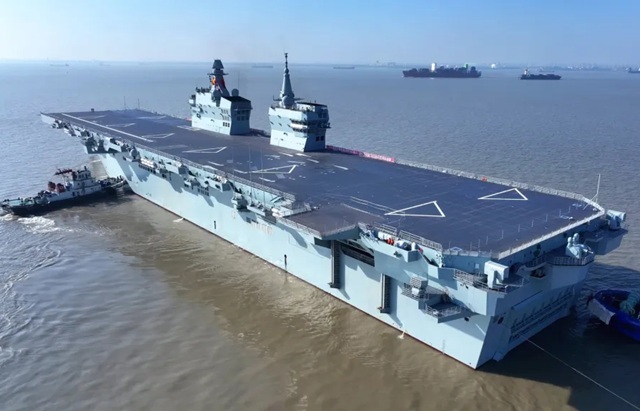
Taken together, the report portrays a fundamentally altered strategic environment. In the eyes of U.S. policymakers, China is advancing a coherent and multi-layered plan to reduce American manoeuvrability and reshape the future of the Indo-Pacific. The Commission warns that China’s push for “land access to the Indian Ocean,” its expansion of “dual-use research operations,” and its embedding of influence among vulnerable coastal states could soon allow Beijing to achieve a level of maritime dominance that challenges traditional freedoms of navigation and disrupts the balance of power that has defined the region for half a century.
For Washington, the implications are clear and disturbing. A maritime empire stretching from the South China Sea to the Indian Ocean would not only enable China to project power far beyond its shores but also provide it with the leverage to pressure smaller states, delay U.S. deployments, and reshape regional alignment. The report suggests that the Indo-Pacific is no longer drifting toward confrontation; rather, the region is being actively reengineered into a theatre where China’s naval, political, and technological reach is designed to tip the scales of future conflict. The message, delivered with rare bluntness, is that the struggle for the Indian Ocean—and for the autonomy of states like Sri Lanka—is already underway.