Editorial
How adorable: the Prime Minister of the world’s largest democracy chose the perfect foreign counterpart to fly a kite with. They came and flying kites over the sky, Prime Minister Narendra Modi welcoming his counterpart, German Chancellor Friedrich Merz, with the innocent zeal of cultural pageantry at the International Kite Festival in Ahmedabad, when beneath that cerulean tableau of Hanuman-shaped kites there was a far more complicated and provocative story simmering between India and Germany.
Today, on 12 January 2026, Modi did not merely host a jet-lagged European leader; he reclaimed a tangled legacy and announced that India and Germany are “transforming a shared legacy into a modern partnership,” insisting that the bond between the two nations is fuelled by trade, technology, clean energy and people-to-people ties that now justify a strategic alliance in an age of geopolitical unraveling.
Modi’s invocation of figures such as Rabindranath Tagore, whose lyrical genius purportedly influenced German intellectual circles, and Swami Vivekananda’s philosophical impact across Europe, was not mere rhetorical flourish but an unmistakable attempt to reframe history as mutual intellectual indebtedness rather than post-colonial hierarchy. He even referenced Madam Cama unfurling the Indian freedom flag on German soil—a symbolic heritage redeployed as a foundation for future collaboration. This repurposing of history would be fascinating on its own, but beneath the warm rhetoric lies a relationship shaped by harsher, almost scandalous truths.
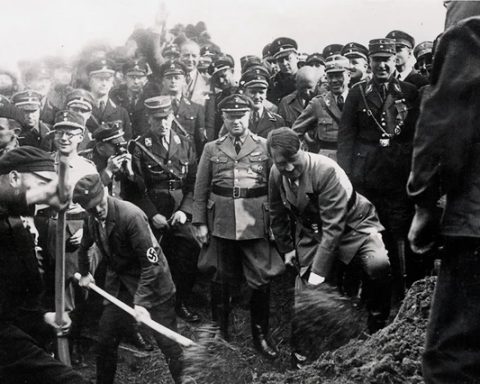
Long before modern trade forums or green hydrogen pacts, there was Subhas Chandra Bose, India’s most contentious freedom fighter, who sought alliances with Germany during the Second World War. Bose’s creation of the Free India Centre in Berlin and the Indian Legion attached to the German armed forces—who swore allegiance to Hitler and Bose in the fight against British rule—was an ambiguous chapter that today’s diplomats prefer to sanitise but cannot entirely erase. The historical record shows that Bose’s legion was integrated into the Wehrmacht and later the Waffen-SS; about three thousand Indian prisoners of war signed up under that banner, an oath that explicitly pledged obedience to the German armed forces while acknowledging Bose’s leadership of India.
None of which means Bose was a fascist ideologue; historians emphasise he was driven by anti-colonial fervour and deeply influenced by Indian humanist thinkers. Yet the uncomfortable truth remains that Nazi Germany saw in Bose a propaganda asset, granting him a platform and resources, even as their worldview was rooted in racial hierarchy and totalitarian control. This incendiary past—where the enemy of Britain became an uneasy partner of Germany’s darkest regime—still reverberates when modern leaders evoke shared heritage. Modi’s narrative might appeal to promulgators of grand civilisational ties, but it also invites scrutiny from those aware of how historical memory can be wielded in geopolitics.
Against this backdrop, the modern partnership between India and Germany is anything but idyllic. Economically, bilateral trade has surged past a historic high of over fifty billion dollars, with more than two thousand German companies entrenched in India. Germany’s strategic aim, underscored by Chancellor Merz’s visit—his first to Asia since assuming office—is clear: deepen commercial and defence ties to reduce reliance on Russia, diversify supply chains away from China, and consolidate economic influence. Indeed, Germany has encouraged concluding the long-pending European Union–India free trade agreement, even floating the possibility of signing imminently, a move designed to fortify the bloc’s geopolitical positioning.
Defence cooperation remains a site of paradox. Berlin, historically cautious about defence ties with non-NATO partners, is now negotiating major defence industrial collaboration, including joint ventures in submarine construction worth roughly eight billion dollars involving Germany’s Thyssenkrupp and Indian shipbuilders—a project with both strategic and industrial implications. These arrangements grow against the backdrop of India’s broader military diversification strategy and Germany’s desire to assert influence in Indo-Pacific security architectures. Yet New Delhi continues to balance these ambitions with a reluctance to sever defence ties with Moscow, complicating Berlin’s push to reduce India’s dependence on Russia without alienating a sovereign partner.
Politically, both democracies face internal convulsions. India grapples with an opposition fractured over economic policy and historical interpretation, while Germany contends with populist backlash over migration, protectionist pressures from the United States under Donald Trump’s tariff regime, and anxiety over energy pivot decisions. German critics argue that protectionism hurts both economies, yet simultaneously fear that deep alignment with India could threaten European industrial interests if tariffs and subsidies become tools of strategic competition.