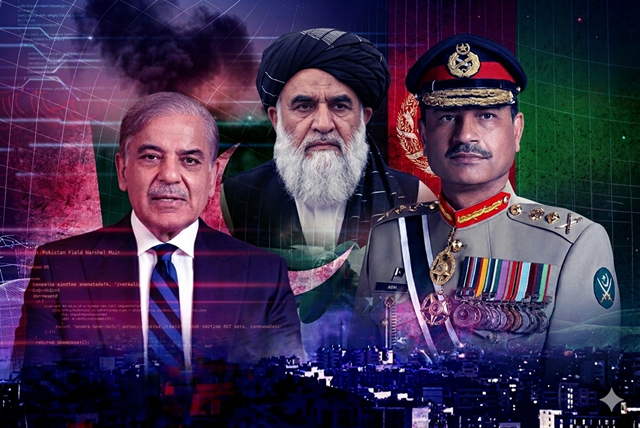
Pakistan and Afghanistan have entered what many observers describe as an open phase of military confrontation following Pakistan’s launch of Operation Ghazab lil-Haq in late February 2026. The operation, presented by Islamabad as a response to militant attacks originating from Afghan territory, involved strikes across several locations including Kabul, Kandahar, Paktia, Paktika, Khost and Laghman. The United States administration has publicly backed Pakistan’s right to defend itself against cross-border militant threats. Several countries have offered mediation, but de-escalation will depend on how Kabul and Islamabad address their deep-rooted disputes.
The current security situation reflects how past conflicts, extremist groups, and regional power struggles have evolved into the present crisis. The confrontation between the Taliban authorities in Kabul and the Pakistani government now revolves around three main issues. The first concerns the Durand Line, the border drawn during the colonial era that Pakistan considers an internationally recognized frontier but which the Taliban leadership continues to question, arguing that it divides Pashtun communities living along both sides of the border.
The second issue relates to Pakistan’s long-standing accusation that Afghanistan’s de facto authorities have allowed militants associated with the Tehrik-i-Taliban Pakistan to operate from Afghan territory. Islamabad maintains that these militants launch attacks against Pakistani targets from sanctuaries across the border. The Taliban once mediated between Pakistan and the TTP, but a harsh crackdown could push some fighters toward Islamic State-Khorasan Province. This militant landscape was evident on 6 February 2026, when IS-KP claimed responsibility for an attack on a Shiite Mosque in Islamabad that killed 32 people and injured dozens more. The Taliban authorities publicly condemned the attack.
A third source of tension involves Pakistan’s allegation that India has supported anti-Pakistan militant groups operating from Afghan territory. Pakistan’s defence minister Khwaja Asif has described both the TTP and the Baloch Liberation Army as proxies supported by external actors hostile to Pakistan. In an interview with France 24 shortly before the latest escalation, Asif suggested that New Delhi and Kabul were aligned in their approach toward Pakistan. India has firmly rejected these accusations.
International focus on humanitarian issues has increased during this unstable period. A press statement issued on 3 March 2026 by the United Nations Assistance Mission in Afghanistan reported at least 146 civilian casualties in Afghanistan-42 killed and 104 injured-between 26 February and 2 March. The casualties were caused by indirect fire and airstrikes resulting from cross-border hostilities. The statement also warned of major humanitarian impacts, including the displacement of about 16,400 households and the disruption of food assistance for around 160,000 people.
The figures were described as preliminary, reflecting the difficulty of documenting incidents in an active conflict zone. However, in environments shaped by competing narratives, transparency about sources and verification remains essential for maintaining confidence in casualty reporting. Humanitarian reporting is essential in conflict zones. While civilian protection and displacement require international attention, credible reporting must also acknowledge the broader security dynamics behind the violence.
International security assessments have repeatedly highlighted the presence of militant networks operating from Afghan territory, with reports to the United Nations Security Council noting the continued activities of the TTP inside Afghanistan. These assessments suggest that thousands of fighters associated with the group remain active, particularly in provinces such as Kunar, Nangarhar, Khost and Paktika areas that also feature prominently in the geography of recent clashes. Monitoring reports have also described logistical and operational networks that enable such groups to sustain cross-border attacks.
This context is central to Islamabad’s argument that its military operations respond to cross-border militant attacks. The Global Terrorism Index 2025 report from the Institute for Economics and Peace states that Pakistan suffered 1,081 terrorism-related deaths in 2024, marking a significant rise from the previous year. The report attributes hundreds of those attacks to the TTP. The Pakistan Institute for Peace Studies has compiled additional datasets documenting hundreds of militant attacks across Pakistan in recent years, demonstrating an ongoing increase in cross-border militant activity.
These figures highlight a difficult reality. Humanitarian consequences cannot easily be separated from the security environment that produces them. Cross-border militant activity, retaliatory operations and territorial disputes form part of a complex cycle of violence in which civilians often bear the greatest cost.
Relations between Islamabad and Kabul have deeper historical roots. Pakistan’s involvement in Afghanistan dates back to the Cold War, when it supported the anti-Soviet resistance in the 1980s, and the rise of the Taliban in the 1990s further shaped ties across the border. Although some expected closer cooperation after the Taliban returned to power in Kabul in August 2021, tensions have instead grown, with frequent border incidents and dozens of clashes since then.
The escalation has consequences beyond the Afghanistan-Pakistan border. Ongoing instability weakens hopes for regional cooperation in South Asia, where organizations like the South Asian Association for Regional Cooperation have already struggled amid political divisions. Continued tensions could disrupt emerging trade and connectivity routes between Central and South Asia, while also creating security concerns for smaller states. The spillover of militancy, refugee movements, and disrupted economic routes may place additional pressure on an already fragile regional environment.
International monitoring missions operate under extremely difficult circumstances, balancing humanitarian responsibilities with the political sensitivities inherent in conflict environments. Their work documenting civilian casualties and facilitating humanitarian assistance remains essential. Yet maintaining credibility in such contexts requires transparency in reporting and recognition of the wider factors shaping the conflict environment.
The confrontation between Afghanistan and Pakistan therefore reflects far more than a conventional border dispute. It represents the intersection of historical grievances, militant networks, regional rivalries and unresolved territorial questions. In such a complex environment, credible analysis must address both humanitarian concerns and the security dynamics driving the conflict.
For international institutions and regional stakeholders alike, the challenge lies in encouraging de-escalation while acknowledging the structural causes of the violence. Until these underlying issues are addressed, the Afghanistan–Pakistan frontier is likely to remain one of the most volatile fault lines in the region, where humanitarian crises and security confrontations continue to unfold side by side.