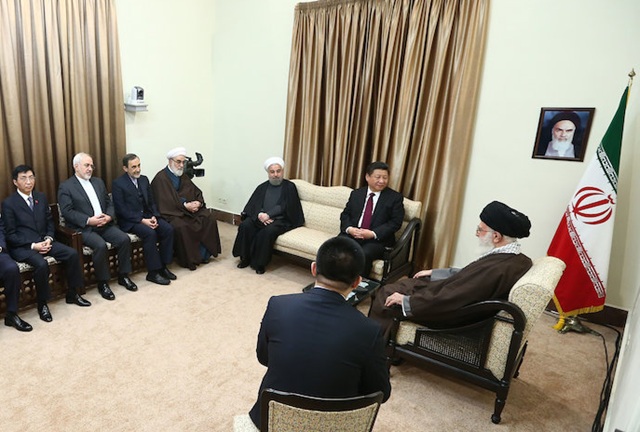
In 2016, a rare photograph captured a moment of exceptional diplomatic intimacy: President Xi Jinping of China, the paramount leader of the world’s most populous and officially atheist nation, stood beaming alongside Ayatollah Ali Khamenei, Iran’s supreme leader. Such a meeting was reserved for only the closest allies, a sign of the special status Beijing held in Tehran. Yet, when Khamenei was recently killed in a US-Israeli strike, China’s response seemed almost perfunctory, raising questions about the depth of its commitment to Iran.
China’s foreign ministry statement expressed grief and condemnation in measured terms: “The attack and killing of Iran’s supreme leader is a grave violation of Iran’s sovereignty and security. China firmly opposes and strongly condemns it.” Yet, analysts noted the tone lacked urgency. Before Khamenei’s death was confirmed, China’s first statement had merely expressed that it was “highly concerned,” a phrasing more reminiscent of an EU communiqué than the reaction of a close ally confronting a military strike against a sovereign state.
“It’s as if the party’s outrage had been drafted in Brussels,” commented Zichen Wang of the Centre for China and Globalisation in Beijing, highlighting the cautious language that emphasized respect for Iran’s sovereignty even as it had been violated. For Iran, long dependent on China as its largest oil purchaser and a key diplomatic backer, expectations of decisive support were clearly unmet.
Iran exports more than 90 percent of its oil to China, dwarfing shipments to any other country. In 2024, Syria accounted for just 3.3 percent of exports, the United Arab Emirates 2 percent, and Venezuela 1.2 percent. Smaller volumes went to Iraq, Turkey, Malaysia, Oman, Lebanon, and Sri Lanka, each under 1 percent. This concentration underscores China’s outsized economic influence over Iran’s energy sector, yet also highlights why Beijing’s response to Khamenei’s death was cautious: any aggressive stance could risk its critical access to Iranian oil while inviting conflict with the United States.
When Ayatollah Ali Khamenei welcomed Xi in 2016 — a photograph treasured in the corridors of Tehran and Beijing alike — it seemed to symbolise a bond that transcended transactional interests. Rarely did the supreme leader grant such audience, particularly to a leader of a secular power outside the West. Yet, as the geopolitical landscape shifts, that image may come to symbolise not unshakeable alliance but the transactional nature of modern power politics. Today, China’s initial statement expressed concern over the attack on Iranian sovereignty; its subsequent comment condemned it in general terms. Even so, the language lacked the ferocity Tehran might have hoped for from its most important partner.
Iran’s reliance on China has grown in the face of persistent U.S. sanctions aimed at choking its economy and curtailing its nuclear ambitions. With traditional buyers in Europe, Japan, and South Korea largely retreating under pressure from Washington, Iran’s oil exports have become concentrated among a small group of willing customers. China’s dominance is nearly total, with more than $32.5 billion worth of crude sold in 2024 alone — a figure that accounted for nearly all of Iran’s $35.76 billion in oil revenue that year.
Yet, the benefits for Iran have come at a cost. As Beijing deepened its energy ties, the relationship increasingly resembled a dependency rather than an alliance of equals. Chinese firms often paid for oil at discounts, and Iranian industry insiders grew frustrated with the terms and operations of Chinese investments. Not all ambitious deals — such as the exploitation of key oilfields — were renewed when they expired, amid mutual dissatisfaction. Meanwhile, China has expanded ties with other regional powers like Saudi Arabia and the UAE, both longstanding U.S. allies, offering Tehran a stark contrast in strategic priorities.
China’s response to Khamenei’s death underscores a broader strategic posture: Beijing remains acutely focused on managing its relationship with Washington while safeguarding its energy security. Confrontation over Iran’s plight could jeopardise both. President Donald Trump, a polarising figure on the global stage, is set to visit Beijing soon, and maintaining a manageable U.S.–China relationship is a top priority for Xi. Directly antagonising American policy in the Middle East over Iran would risk destabilising a diplomatic balance Beijing has worked hard to preserve.
Even in the United Nations, where China wields veto power alongside Russia and the U.S., Beijing showed little appetite for confronting Washington over the strike. Any attempt to censure the operation would be symbolic at best and diplomatically costly at worst. Analysts like Zichen Wang have remarked that China’s language, emphasising respect for Iran’s sovereignty, appeared careful and bureaucratic rather than impassioned — a tone more suited to Brussels than Beijing.
Some observers argue that Beijing’s reaction — or lack thereof — reflects hard-headed realpolitik. As disagreements in the Middle East flare and global power dynamics shift, China may be willing to tolerate regime changes in Iran so long as its economic interests remain protected. Commentary from U.S. think tanks suggests that China is pragmatic about working with whichever leadership emerges, provided that oil flows continue and shared economic interests are preserved.
Beijing’s diplomatic posture also mirrors its broader ambitions: to portray itself as a stabilising global power while avoiding the kind of military entanglements that define American strategy. China has positioned itself as a potential mediator in Middle Eastern conflicts, from hosting talks between Riyadh and Tehran to negotiating navigational exemptions in the Strait of Hormuz. Yet these soft power gestures are repeatedly overshadowed by the hard realities of American military reach and decisive intervention.
For Iran, the calculus is unforgiving. With its oil economy so dependent on a single buyer and its political fate uncertain amid external pressures, the regime’s hopes for robust backing from Beijing appear to have been tempered by China’s strategic restraint. The image of Xi and Khamenei smiling together now seems less like a symbol of unbreakable alliance and more like a relic of a relationship defined by necessity and convenience rather than solidarity.
In a world where oil dictates power relationships and strategic priorities often outweigh ideological affinity, China’s muted stance reminds us that geopolitical partnerships are rarely as steadfast as the photographs that commemorate them.