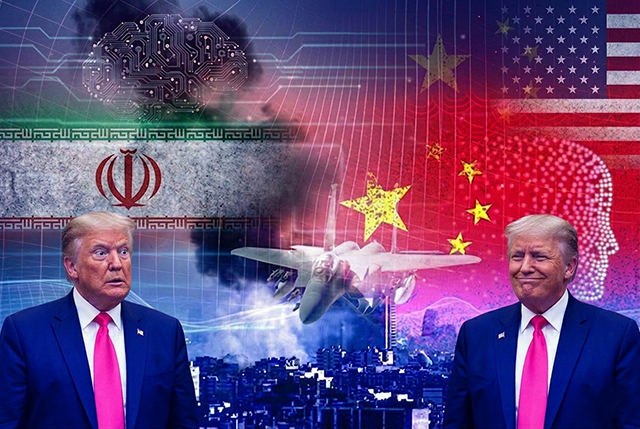
United States President Donald Trump may be confronting a dangerous strategic dilemma as the war with Iran enters its third week, with analysts warning that the conflict could trap his administration in a cycle of military escalation. According to a detailed analysis published by Axios, Trump’s instinctive and improvisational leadership style is now being tested in a situation where quick political maneuvering and abrupt reversals are far more difficult than in domestic policy disputes.
For years, Trump has governed with a decision-making approach driven largely by intuition and rapid shifts in strategy. But the unfolding war with Iran has created a far more complex environment in which outcomes cannot be easily controlled or reversed. Axios notes that unlike tariffs or economic sanctions, which can be imposed or removed relatively quickly, the course of a military conflict depends on multiple actors, including Iran itself.
The central concern within Washington is the possibility that the United States could fall into what analysts describe as an “escalation trap.” In such a scenario, a stronger military power may feel compelled to continue attacking in order to demonstrate dominance, even as the strategic gains begin to diminish. Trump has been pushing to break the growing disruption to oil shipments in the Persian Gulf, but deeper involvement in the conflict risks further intensifying the confrontation.
A senior administration official acknowledged the growing tension, telling Axios that Iranian interference with shipping routes in the Strait of Hormuz has hardened the president’s position. According to the official, Tehran’s actions have made Trump “more dug in,” suggesting that the administration may feel compelled to maintain or even expand its military response.
The regional dynamics surrounding the conflict are also complicating the situation. Israel is reportedly seeking broader military action and even regime change in Iran while considering the possibility of expanding operations into Lebanon. Israeli Prime Minister Benjamin Netanyahu has previously demonstrated an ability to influence Trump’s stance on Iran, and analysts say Israeli strategic priorities could shape the trajectory of the conflict.
For Iran, the primary objective appears to be survival and the ability to demonstrate that it can inflict economic and military costs on its adversaries. Tehran is attempting to show that it retains the capacity to disrupt global oil flows and regional stability, potentially deterring further attacks. Meanwhile, other nations are focused on maintaining the free movement of oil and trade through the Middle East’s critical sea lanes and air routes.
Axios reports that the Trump administration initially expected the military campaign to last roughly four to six weeks. Based on those estimates, early April could become a crucial moment for assessing whether the operation has achieved its objectives. However, officials in Washington and other global capitals are increasingly preparing for a longer and more complicated crisis.
Journalists and diplomats cited by Axios say that several officials within the administration and allied governments believe instability in the region — along with American military involvement — could continue until at least September, even if the conflict eventually shifts into a lower-intensity phase.
Israel has also indicated that its operations are far from over. Officials there have reportedly told journalists that at least three additional weeks of attacks on thousands of targets in Iran are planned as part of the ongoing campaign.
Trump himself has publicly described the military campaign as a major success. In a phone conversation with the Financial Times, he claimed that Iran’s military capabilities had been severely weakened, stating that much of the country’s naval power and air defenses had been destroyed. However, he acknowledged that Iran could still cause disruption by targeting shipping lanes, particularly through the use of naval mines in strategic waterways.
White House officials insist the operation was carefully planned. Anna Kelly, the principal deputy press secretary, told Axios that the military campaign known as Operation Epic Fury resulted from months of preparation and strategic planning. She said the president reviewed multiple options presented by top advisers before making the final decision to proceed.
Despite those assurances, some officials inside the administration are reportedly experiencing what one source described as “buyer’s remorse.” Axios reports that several advisers initially urged caution or requested additional time before launching the attacks on Iran. One source close to the administration said Trump ultimately decided to move forward quickly, believing the Iranian regime could be toppled without deploying ground troops.
According to the source, the president may have been emboldened by previous rapid military successes, including targeted strikes in Iran last year and the high-profile capture of Venezuelan leader Nicolás Maduro earlier this year. Those events, the source said, reinforced Trump’s confidence in achieving swift and decisive outcomes through military action.
So far, the conflict has delivered some battlefield successes for the United States and its allies. Iran’s missile and drone launches have declined significantly, suggesting that its ability to launch attacks may be weakening. The United States and Israel currently maintain air superiority over Iranian territory, allowing them to conduct strikes with limited resistance, while much of Iran’s naval capacity has reportedly been damaged.
Nevertheless, the broader strategic picture remains uncertain. Casualties among U.S. forces have been relatively limited so far, but the scale of military operations raises the risk of further losses if the conflict continues.
The coming weeks may force Trump to make critical decisions about whether to escalate the war further. Some advisers had hoped the administration could demonstrate early success and declare victory quickly, but Axios reports that such an outcome now appears difficult to achieve convincingly.
Diplomatic channels also remain fragile. According to Axios reporting, the United States lacks clear communication lines with Iran’s leadership, complicating efforts to negotiate a lasting agreement. Trump recently stated on his Truth Social platform that Iran wants a deal but not one he is willing to accept.