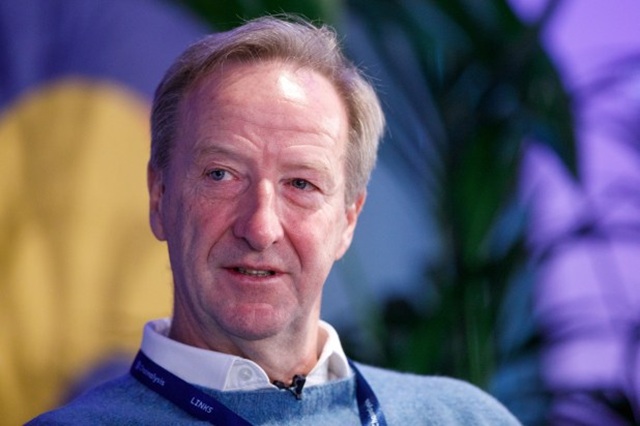
The unfolding conflict in the Middle East has reached what former MI6 chief Sir Alex Younger describes as a decisive moment, where conventional assumptions about power and dominance are being overturned. Speaking during an interview with The Economist, Younger offered a stark and nuanced assessment of the situation, suggesting that despite overwhelming military pressure, Iran has seized the strategic initiative in ways that few anticipated.
“I feel the war is at this really important juncture,” Younger said. “President Trump is trying to reopen the Strait of Hormuz by military means through threats against Iranian power plants and to seek to end the war through diplomatic talks.” Yet, he admitted that even seasoned observers are grappling with uncertainty. “What people are struggling with, what I’m struggling with is a full understanding of who has the upper hand right now.”
His conclusion is blunt. “Iran,” he said. “I regret having had come to this conclusion because like many MI6 officers of my generation we faced the violence and brutality of the IRGC for most of our careers. So there is no love lost between us.”
Younger acknowledged the deep-rooted hostility between Western intelligence services and Iran’s Islamic Revolutionary Guard Corps, adding, “I shed no tears for Ali Khamenei who was killed at the beginning of this war.” Still, he emphasized that sentiment does not change the strategic picture. “The reality is that the US underestimated the task and I think as of about two weeks ago lost the initiative to Iran.”
According to Younger, Iran’s resilience stems from early and calculated decisions. “They took some good decisions actually as early as last June about dispersing their military capability and delegating the authority for the use of those weapons,” he explained. This decentralization has made Iran significantly harder to cripple. “It has given them significant extra resilience against this incredibly powerful air campaign.”
He also pointed to Iran’s willingness to broaden the battlefield. “They have embarked on what’s technically called horizontal escalation, firing rockets at anybody within range,” he said. “At the time honestly I thought it was crazy, but in fact it has been a very good way of putting indirect price on the US. It’s sort of worked.”
Another critical factor has been Iran’s strategic use of global energy vulnerability. “They’ve understood the significance of the energy war and held the straits at threat and globalized the conflict,” Younger noted. Even with reduced capabilities, the threat remains potent. “Whilst this has been an almost perfectly executed military campaign from the air, you can’t reduce the threat to zero,” he said. “Even with just 10% of its initial drone stocks, it can hold the straits at threat.”
This, he explained, shifts the pressure onto global commerce rather than purely military calculations. “These are not military people you have to satisfy. It is people who own oil tankers and captains of oil tankers,” he said, highlighting how fear and risk perception amplify Iran’s leverage.
Younger also emphasized the ideological dimension of the conflict. “Donald Trump has said some stuff that will have confirmed something they knew already, which is that they’re in a civilizational war in their terms,” he said. “They’re in a war of existence.” In contrast, he described the US position differently. “America has embarked on a war of choice and in those terms I think that’s given them more staying power than their US counterparts.”
Despite Iran’s apparent tactical advantage, Younger painted a grim picture of the regime’s internal condition. “I think that they are in the death throes,” he said, pointing to widespread domestic unrest. “The January uprising showed that they have no answers. The hatred that engendered is endemic and will last for decades.”
He cited estimates of severe repression. “Up to 10,000 of their own citizens machine gunned in the street by IRGC sponsored militias,” he said, suggesting such actions have deeply damaged the regime’s legitimacy. “I don’t expect them to survive into the long term as a result.”
Paradoxically, however, the ongoing conflict may be prolonging the regime’s life. “The irony is that the biggest threat to them is peace not war,” Younger argued. “This situation is an environment where they get an extra lease of life because it’s hard for opposition to organize in the face of an air campaign.”
He described a country divided between rulers and the ruled. “Perhaps 80% of Iran are against the theocratic regime and they’ve had it,” he said. Yet power remains firmly concentrated. “The 20% or probably even less 10% are the ones with the guns and that is proving decisive.”
The war has also accelerated changes within Iran’s leadership. Younger believes the traditional clerical dominance is fading. “We’ve seen the end of the theocracy actually with the end of Ali,” he said. “You basically see an IRGC takeover. Not a dictatorship so much as a junta.”
This shift reflects a more pragmatic but equally uncompromising leadership. “They’re no less ruthless than Ali Khamenei, but they are more corrupt,” Younger said of the Revolutionary Guard leadership. “They are significant beneficiaries of the sanctions regime, invested in this sort of black economy.”
He also downplayed the role of nominal political figures. “Mojtaba is just a figurehead… we’ve never even seen him,” he remarked. “These guys are in charge.”
Looking ahead, Younger acknowledged the uncertainty surrounding Iran’s future. “What comes next, who knows?” he said. Still, he pointed to possible indicators of change. “If Masoud Pezeshkian starts speaking more freely, then you have the prospect of the 80% of Iran that has had enough starting to prevail.”
For now, however, the contradiction remains stark: a regime weakened internally yet strengthened by external conflict. As Younger put it, “They’ve played a weak hand pretty well,” capturing the uneasy reality of a war where strength and weakness are increasingly difficult to distinguish.