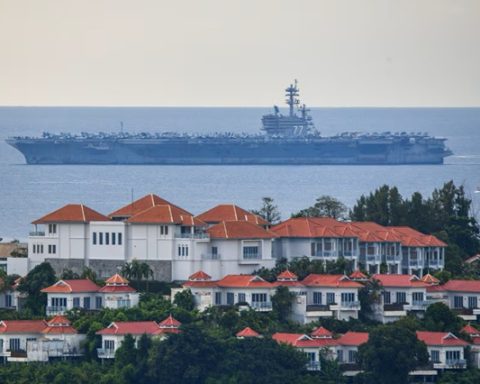
As the war in Iran entered its fifth week, an unexpected front began to take shape—not on the battlefield, but across social media platforms. Viral posts, shared widely across both Western and Chinese networks, appeared to offer strikingly detailed insights into U.S. military activity. From the positioning of aircraft carriers to the buildup of warplanes at strategic air bases, the level of precision stunned observers and sparked urgent questions within defense circles.
According to reporting by the Washington Post, much of this intelligence appears to originate from a rapidly expanding sector: Chinese private technology firms specializing in artificial intelligence-driven analysis of open-source data. These companies, some of which maintain links to China’s military-industrial ecosystem, are marketing tools that claim to “expose” the movements and strategies of U.S. forces in near real time.
The emergence of this capability reflects a broader shift in modern warfare, where publicly available data—such as satellite imagery, flight tracking information, and maritime shipping records—is increasingly being weaponized. While such data has long been accessible, advances in artificial intelligence have dramatically enhanced the ability to process, analyze, and interpret it at scale. The result is a new kind of intelligence market, one that operates in the gray zone between civilian enterprise and military application.
Beijing has officially sought to distance itself from direct involvement in the Iran conflict, maintaining its posture as a neutral actor advocating for peace. Yet the rise of these firms aligns closely with China’s long-standing strategy of civil-military integration, which encourages private sector innovation in support of national defense objectives. In recent years, the Chinese government has invested heavily in artificial intelligence development, with a particular emphasis on applications that could enhance military capabilities.
One company at the center of attention is MizarVision, a Hangzhou-based firm founded in 2021. Using a combination of Western and Chinese data sources filtered through advanced AI systems, the company has reportedly tracked U.S. naval movements, identified aircraft deployments, and cataloged activity at military bases across the Middle East. Images attributed to the firm have circulated online, showing detailed breakdowns of U.S. force concentrations ahead of key operations, including the buildup preceding Operation Epic Fury.
MizarVision claims its technology can reveal patterns such as refueling operations of carrier groups and the transport of missile systems. It has also asserted that it can monitor military escalation in various regions, including the Asia-Pacific and Latin America, though such claims remain difficult to independently verify. The company does not disclose its clients or the full extent of its data sources, adding to the opacity surrounding its operations.
Another firm, Jing’an Technology, has drawn attention for even more provocative claims. It released what it described as intercepted communications between U.S. stealth bombers during the early stages of the Iran conflict, suggesting that artificial intelligence could overcome traditional notions of military invisibility. Although the recording was later deleted, the episode highlighted the boldness of these companies’ assertions and the potential psychological impact of their messaging.
U.S. officials and intelligence experts remain divided on the actual capabilities of these firms. Some argue that their claims may be exaggerated, pointing to gaps in China’s own intelligence performance, such as being caught off guard by certain U.S. operations. Others warn that even if current capabilities are limited, the trajectory is clear and concerning. The ability to aggregate and analyze open-source data at scale represents a significant evolution in intelligence gathering, one that could erode traditional advantages held by advanced militaries.
The implications extend beyond the immediate conflict. Analysts suggest that these private firms provide China with a form of plausible deniability, allowing it to benefit from intelligence insights without direct state involvement. By outsourcing certain capabilities to nominally independent companies, Beijing can maintain its diplomatic stance while still gaining strategic advantages.
This dynamic has not gone unnoticed in Washington. Lawmakers and defense officials have expressed growing alarm over the potential for commercial technology to be used against U.S. forces. The concern is not only about the current conflict but also about the broader trend of militarizing artificial intelligence in the private sector. As one U.S. official noted, the issue is as much about intent as it is about capability.
The role of data providers has also come under scrutiny. Some of the imagery used by these firms appears to originate from commercially available satellite services, raising questions about how such data is accessed and whether existing safeguards are sufficient. While major providers have policies restricting the use of their data in conflict zones, enforcement remains a complex challenge in a globalized information ecosystem.
Meanwhile, the geopolitical context continues to evolve. China has maintained its diplomatic ties with Iran while calling for a ceasefire and peace negotiations. At the same time, reports have emerged—also highlighted by the Washington Post—that other U.S. adversaries may be more directly involved, including allegations of intelligence sharing to support Iranian military actions.
As warfare becomes increasingly data-driven, the line between civilian and military domains is blurring. The activities of Chinese AI firms in the Iran conflict underscore a fundamental shift: intelligence is no longer the exclusive domain of governments and spy agencies. Instead, it is becoming a commodity, shaped by algorithms and sold in a competitive marketplace.
This transformation presents both opportunities and risks. On one hand, it democratizes access to information, enabling greater transparency and accountability. On the other, it introduces new vulnerabilities, as adversaries exploit the same tools to gain strategic insights. For the United States and its allies, adapting to this new reality will require not only technological innovation but also a rethinking of how military operations are conducted in an age of pervasive surveillance.