by Our Diplomatic Affairs Editor
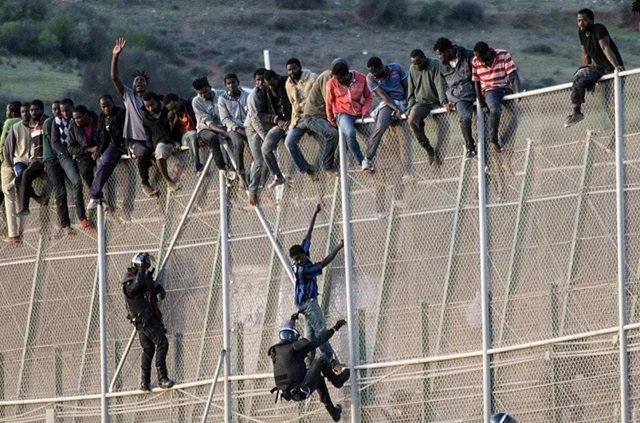
The Spanish Government’s decision to declassify 40 reports and communications relating to the migration crisis in Ceuta offers an unusually detailed reconstruction of the days before, during and immediately after the mass irregular entry of between 70,000 and 80,000 people into the Spanish city. The documents show a security system receiving increasingly urgent information about maritime arrivals, social-media mobilisation and the possibility of an attempt to cross the border. They also expose a central tension: warnings existed, but the scale of the event that followed was not foreseen.
Among the most consequential documents is a note sent by the National Intelligence Centre (CNI) to Moroccan intelligence services on 29 July, one day before the mass entry. “Information had been received concerning the planning of several calls to enter Ceuta, both by swimming and across the fence,” it stated. The communication was addressed to Morocco’s General Directorate for Territorial Surveillance (DGST), its domestic intelligence service, and the General Directorate for Studies and Documentation (DGED), its foreign intelligence service.
The CNI had been monitoring calls circulating in a WhatsApp group named “Assault on the Ceuta Fence” and two Facebook groups with approximately 180,000 members between them. The material included explicit encouragement to cross the border during the Throne Day celebrations, when, according to one message transcribed by the CNI, “Anyone who wants to cross has one last opportunity on Throne Day at 8.00. The authorities will be distracted by the celebrations and parades.”
The warnings were not confined to a formal intelligence note. On 29 July at 13.52, a CNI officer in Ceuta contacted the chief of staff of the Government Delegate in Ceuta through WhatsApp. “On social media there is a call for an assault across the fence and by sea tomorrow at 20.00, taking advantage of Throne Day and the fact that their security forces will be busy. There are two different groups with a total of 180,000 followers. So that you can understand the reach of the dissemination,” the officer wrote. The chief of staff responded, “Good grief”, a Ceuta expression. The two subsequently spoke for 11 minutes, although the contents of that conversation are not known.
The same CNI officer also contacted a commander in the Information Division of the Guardia Civil. After an unanswered call, the officer sent a message: “We have information about an attempt to enter by swimming and jumping the fence tomorrow, on Throne Day.” The Guardia Civil commander, who was outside the territory at the time, returned the call, and the two spoke for seven minutes.
The directness of those exchanges is itself significant within the chronology established by the documents. The published material records the CNI communicating through an intelligence note to Morocco while simultaneously passing information directly to Spanish authorities in Ceuta and the Guardia Civil. The Government has nevertheless maintained that formal communication of this kind should not have remained at the level of “instant messaging” and should have been elevated through the appropriate channels.
The CNI communications began before the final warning. On 27 July, the chief of staff of the Government Delegate contacted a CNI officer concerning the growing number of people already arriving in Ceuta. The exchange referred to an “urgent” meeting involving the Government Delegation, Police, Guardia Civil and the regional government. “Regarding the swimmers. Whenever you want, I can brief you,” the chief of staff wrote to the CNI officer. Two days later, the intelligence service would send its explicit warnings about the planned crossing.
The wider documentary record shows that the change in the migration pattern had been identified well before the CNI’s 29 July alert. On 8 July, a “dispatch note” from the Guardia Civil’s maritime border command proposed reinforcing personnel following the Supreme Court judgment issued in June that prohibited immediate returns of migrants attempting to enter Ceuta and Melilla by swimming. The Guardia Civil warned that the judgment could encourage a shift towards maritime crossings and asked for increased personnel, stronger technological systems for early detection and coastal surveillance in both autonomous cities, and a legislative amendment.
The concern became more pronounced during the third week of July. On 22 July, the Guardia Civil reported an increase in swimming entries into both autonomous cities between 13 and 19 July compared with the previous week, recording 48 and 35 entries respectively. It also reported that the Moroccan Royal Navy had intercepted 773 attempts, 146 more than during the preceding week.
By 29 July, the same authority responsible for coordinating the response to irregular migration was reporting a further increase in cooperation by the Moroccan Navy, which had intercepted 1,429 attempted swimming entries, 482 more than the previous week. The figures demonstrated that the phenomenon was already expanding rapidly on both sides of the border.
The situation was also visible beyond the security apparatus. On 27 July, the local newspaper Faro de Ceuta placed “Ceuta Calls for Immigration Law Reform Amid Migration Pressure” on its front page. The following day it described the situation as “An Unstoppable Pressure”. On the same 27 July, an urgent meeting was held between members of the Government Delegation in Ceuta, the Police, Guardia Civil and the regional government.
By the night of 29 July, concern had become acute. Local reporting warned that without additional resources the situation could become critical within weeks and that there could be “more than 5,000 people in the streets”. The city was also living with the memory of May 2021, when approximately 8,000 people entered Ceuta through the border in a single day, creating what had previously been a record.
The following morning, before the mass entry had begun, Ceuta’s president, Juan Jesús Vivas, described the situation publicly as “one of absolute humanitarian and social emergency” in an interview with Cadena SER shortly after eight in the morning. From around 11.00, according to a subsequent CNI report, the human flow crossed the border and continued for more than a day.
The military system was also receiving information. At 12.00 on 30 July, the 32nd Electronic Warfare Regiment (REW32), part of the Spanish Army, informed the Armed Forces Intelligence Centre (CIFAS) that a “very likely” “mass entry” was expected. The warning arrived as the crisis was already unfolding.
The CENIF subsequently raised its assessment to “Extreme”, warning of an immediate risk of collapse from irregular entries. At 14.37, the CENIF’s Frontex Group warned that migrants arriving in Ceuta might attempt to reach mainland Spain concealed in vehicles belonging to acquaintances. On 31 July, the CENIF maintained the “Extreme” assessment and reported a significant increase in messages and publications.
The documents therefore reveal an accumulation of warnings rather than a single intelligence alert. CECORVIGMAR, the Guardia Civil centre responsible for maritime surveillance, had already been sending regular information to the Secretary of State for Security. The CENIF had been monitoring the developing situation. The Information Division of the Guardia Civil was producing assessments. The CNI was monitoring social-media groups and communicating directly with authorities. The military intelligence system was also receiving urgent information.
Yet the distinction between warning of an event and predicting its magnitude remains central to the documentary record. Interior Ministry sources have insisted that the earlier alerts did not express with sufficient clarity the scale of what subsequently occurred. Before 30 July, the Government had also reinforced the border with 70 Guardia Civil officers: 10 assigned to border control and 60 to public-security duties.
The declassified material also sheds light on the increasingly difficult question of Morocco’s role. Before the crisis, the security agencies repeatedly highlighted Moroccan cooperation. After the border was overwhelmed, however, Spanish authorities began considering different explanations for what appeared to be a dramatic change.
One Guardia Civil assessment listed several hypotheses, ranging from the “inability” of Moroccan authorities to contain the arrival of thousands of migrants to the possibility of “collusion by the Moroccan authorities as a reaction to recent political events”, including a meeting between the Spanish Prime Minister and Algeria and the Supreme Court judgment.
The CNI’s own assessment, sent to the Government at 21.20 on 30 July, stated that it had not detected a “proactive response by the Moroccan authorities to the loss of control of the situation”, apart from the deployment of some riot-control units at the Sab Sebta border three hours after the breakwater had been overwhelmed.
The Armed Forces Intelligence Centre offered a more cautious interpretation. It described the Moroccan authorities’ conduct as “passivity” but assessed that “It is highly likely that the Moroccan authorities are not actively facilitating the migration wave, but have acted negligently or passively.”
That distinction matters. The documents do not present a single agreed explanation for Morocco’s conduct. Rather, they record competing hypotheses developed as Spanish authorities attempted to understand why a border system that had previously relied on Moroccan cooperation appeared, during the crisis, to lose control. The CENIF later sent a report to National Court judge María Tardón concerning the possible “passivity” or “guiding” of migrants by Moroccan gendarmerie officers, based on images and interviews analysed on social media.
The numerical record makes clear how quickly the situation had changed. On 29 July, the day before the mass entry, 501 attempts to enter Ceuta by swimming were recorded and 468 people succeeded. The figures represented a dramatic escalation from earlier in the month.
Across the 40 documents, 30 different entities appear: 10 as issuers, 18 as recipients and two in both categories. CECORVIGMAR produced nine documents, the largest number, while the CENIF and CNI each produced seven. Twenty-three of the communications were sent by email or WhatsApp, seven were internal communications, three were CNI notes and two were classified messages or reports.
The record is consequently less a story of an absence of information than of information accumulating across multiple institutions at different speeds and through different channels. There were warnings about increased maritime arrivals, requests for reinforcements, intelligence reports about social-media mobilisation, direct communications between the CNI and officials in Ceuta, a formal warning to Moroccan intelligence and increasingly urgent border assessments.
But the most striking feature of the documents is the gap between the warning that an attempt was coming and the extraordinary scale of what actually happened. The CNI knew of calls involving groups with 180,000 members. The Guardia Civil had recorded a rapidly rising number of swimming attempts. Moroccan authorities had intercepted increasing numbers before the crisis. Officials in Ceuta were already describing an emergency. The CENIF eventually assessed the danger as “Extreme”.
What the documents do not show is a warning that accurately anticipated the scale of the mass entry. Instead, they reveal a system watching the indicators intensify, issuing alerts, requesting resources and communicating across institutions as the situation deteriorated.
The declassification therefore leaves a complex record rather than a single explanation. It shows that information existed, that warnings were communicated and that several agencies recognised a rapidly changing migration pattern. It also shows that assessments of the Moroccan response evolved sharply once the border was overwhelmed. At the centre of the record remains the same unresolved tension: the authorities were warned that people were preparing to cross Ceuta’s border, but the available warnings did not foresee the extraordinary magnitude of the event that followed.