Friedrich Merz’s Germany struggle to hold together his government in Berlin is only one small part of a much larger problem unfolding this week in New York. Inside the headquarters of the United Nations, the challenge is not simply whether Germany can restore its international standing or whether the UN can overcome another procedural crisis. The deeper question is whether the political principles on which the post-war international order was built can survive an era in which increasingly powerful leaders are willing to put national interest, personal authority and political calculation ahead of collective rules.
The United Nations was never a perfect institution. Its founding idea was fragile from the beginning: states with radically different interests were expected to accept common principles and resolve disputes through an international system that gave disproportionate power to the permanent members of the Security Council. Its procedures can be opaque, its negotiations painfully slow and its results disappointing. The description of the UN as a “toothless tiger” has therefore become familiar.
But the problem facing the organisation is now larger than institutional inefficiency. It concerns the weakening of the political assumptions that made multilateralism possible in the first place.
Germany provides one illustration. Foreign Minister Johann Wadephul has acknowledged that defending the UN is currently difficult. Germany’s international credibility has also suffered after its defeat in June in the election for a non-permanent Security Council seat. Questions in New York focused on the gap between Germany’s foreign-policy ambitions and its conduct. Wadephul now argues that Germany must demonstrate that it is governed by a stable coalition capable of taking its responsibilities seriously.
Yet the German question is ultimately secondary to the larger one. Germany is being asked to demonstrate stability at precisely the moment when the wider international system is becoming less stable. Its approach to the Middle East and its position towards Donald Trump’s foreign policy are being watched by other UN members. Berlin is therefore confronting not simply a problem of diplomatic reputation, but the consequences of a broader transformation in international politics.
The United States remains central to that transformation. Trump’s second presidency has placed additional pressure on institutions and alliances that depended for decades on American political support. The source text describes a president who seeks the Nobel Peace Prize while pursuing a politics of strength, initiating wars and disregarding the UN and international law. Whether one agrees with that characterisation or not, the underlying institutional problem is clear: the organisation is most vulnerable when one of the world’s most powerful states is unwilling to operate within the assumptions on which the system was constructed.
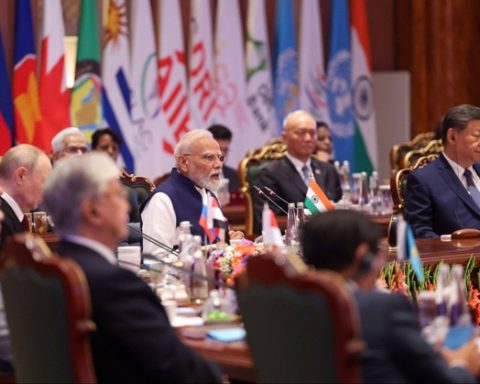
That challenge extends beyond Washington. Trump, Xi Jinping and Vladimir Putin are presented as leaders operating in an international environment increasingly shaped by competing centres of power. While Western organisations such as the G7 and NATO face internal strain, China, Russia and others gather in formats including Brics and the Shanghai Cooperation Organization. These groupings offer alternative forms of international cooperation and demonstrate that the world is no longer organised around a single political model.
The consequence is not simply a contest between individual countries. It is a contest over the meaning and usefulness of the rules themselves.
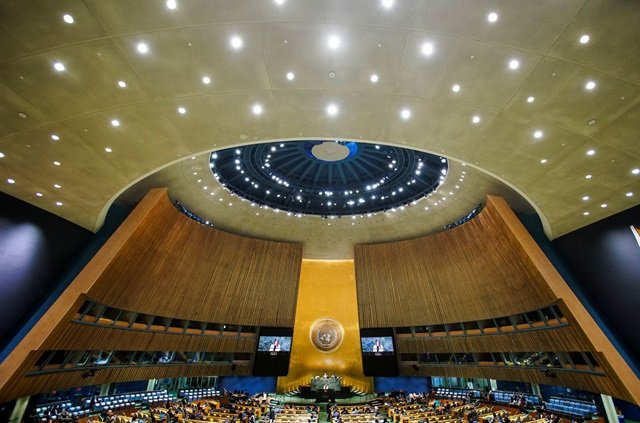
The principle articulated by former US President Harry Truman after the Second World War was straightforward: “If we do not want to die together in war, we must learn to live together in peace.” Eight decades later, the UN is confronting wars in Ukraine, the unresolved conflict between the United States and Iran, the continuing devastation in Gaza, and crises in Sudan, Yemen and Libya. More than 140 heads of state and government will gather in New York, deliver speeches and hold private meetings, yet the organisation remains unable to bring many of these conflicts decisively closer to resolution.
This is where the crisis of democratic leadership intersects with the crisis of the UN. The organisation depends on states accepting that international rules matter even when those rules constrain their own freedom of action. When powerful governments instead treat international institutions as obstacles, the authority of those institutions inevitably weakens.
The decline is also visible in the uncertainty surrounding the UN’s next secretary-general. António Guterres will leave office at the end of the year after two five-year terms. The organisation therefore needs a successor capable of defending its relevance while navigating the competing interests of the Security Council’s permanent members. Yet the selection process itself remains opaque and heavily influenced by the same powers whose interests can conflict with the independence expected of the secretary-general.
Seven candidates remain after Michelle Bachelet withdrew her candidacy. Most come from Latin America, reflecting the informal rotational expectation that the region should now have the opportunity to provide the next secretary-general. Rebeca Grynspan of Costa Rica is among those regarded as having strong prospects and could become the first woman to hold the position.
The significance of the appointment goes beyond the personality of one official. Whoever succeeds Guterres will inherit an organisation expected simultaneously to reform itself, reduce costs, retain international legitimacy and withstand pressure from governments seeking to reduce its resources and influence.
That pressure comes at a moment when traditional Western confidence in its own political model is also under strain. For decades, the democratic states of Europe and North America presented the post-war international system as a framework through which political disputes could be contained, alliances maintained and international law defended. Now those same states are increasingly preoccupied with protecting themselves from the consequences of divisions within their own alliances.
Canada’s Mark Carney has addressed the European Parliament and called for closer Canadian-European cooperation. Wadephul is travelling to Ottawa as Germany seeks to strengthen its relationship with Canada. Such efforts reflect a wider search for reliable partnerships at a time when confidence in the traditional transatlantic relationship has become less certain.
Yet the UN remains different from every alliance or regional grouping. It is still the place where 193 states can appear in the same institution, speak publicly and meet privately. Middle powers can negotiate with one another. Leaders who disagree profoundly can still sit in the same building. Bilateral conversations can take place alongside formal debates. Even when the institution fails to settle conflicts, it remains the principal setting in which those conflicts are argued before the international community. That may be the UN’s greatest remaining asset.
The question now is whether the organisation can turn that asset into renewed authority before the political foundations beneath it weaken further. Reform, cost reductions and a strong new secretary-general are presented in the source text as necessary steps. But institutional reform alone cannot resolve a deeper problem: international organisations ultimately depend on governments that are willing to accept limits on their own power.
Trump’s expected appearance immediately after Brazilian President Luiz Inácio Lula da Silva offers a revealing symbol. His position in the programme could be read as evidence that the UN still matters to the American president, or simply as another platform for political performance. Either way, the world will be listening.
The real issue confronting New York this week is therefore larger than Germany, larger than Trump and even larger than the UN itself. It is whether the world’s major powers still believe that rules, institutions, democratic principles and international cooperation are constraints worth preserving — or merely instruments to be used when convenient. The answer will shape not only the future of the United Nations, but the kind of international order that follows it.