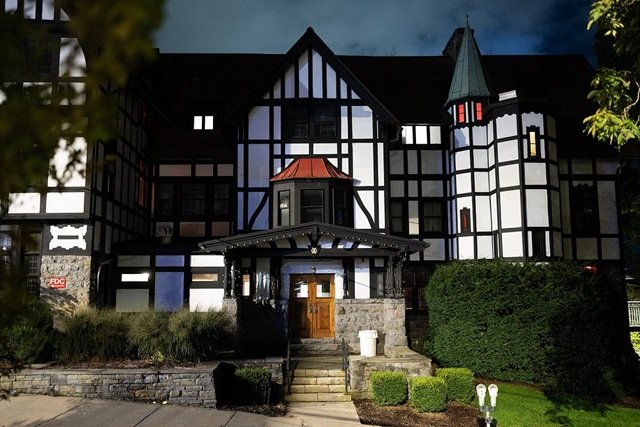
I had a brief experience with a fraternity at Cornell University. I was a senior in high school. I stayed in a frat for a weekend with a former high school classmate. His “brothers” dragged me off a couch where I was sleeping and pinned me to the floor. They yanked up my shirt and dumped dog food on my stomach. They called in the fraternity mastiff and goaded the dog to “eat me.”
The former classmate, Don Chartier, decided he would rather remain in the good graces of his “brothers” than intervene. The experience dissuaded me from applying to the university, destroyed a high school friendship — we had run cross country and track together — and left me with deep loathing for fraternities.
Of course, that prank pales in comparison to the reported gang rape of a female student. But it is part of the same culture of sadism and abuse that runs like an electric current through all fraternities.
You are admitted to these male enclaves by allowing yourself to be hazed, humiliated and stripped of your dignity. Hazing rituals weed out those with enough self-esteem and independence to stand up to the hierarchy. They ensure conformity and obedience. It is a filter. Fraternity “brothers” are self-selected. Those who have the strength to oppose public humiliation and that perpetuated on each new cycle of recruits, leave.
Fraternities across the country are plagued by allegations of rape and sexual assault. Men in fraternities are three times more likely to commit rape than those who do not belong to fraternities. These crimes, well known to fraternity members and university administrators, are masked by a culture of silence.
The president of Cornell, Michael I. Kotlikoff, whose university expels students who protest genocide and shields students who commit rape from criminal prosecution, issued the usual hour-of-reckoning statement that comes accompanied with a lot of vague promises of reform. He is no doubt busy doing damage control with his big donors, not a few of whom come out of the fraternity system.
Kotlikoff and all administrators involved should be fired. Those accused of rape should be criminally charged. The disciplinary investigations of fraternities — which universities keep secret — should be made public. Fraternities found to have engaged in sexual assault — which will be most of them — should be closed. Those fraternity members who carried out sexual assaults — no matter how many years ago — should face trial. This is the minimum. But it is a minimum I am certain Cornell will never achieve.
Universities in the United States have turned education upside down. They make war on scholarship, inquiry, self-criticism, moral autonomy and the search for artistic and esoteric forms of expression — in short, the world of ethics, creativity and ideas. They cater to the demands of rich alumni, who censor curriculum and purge professors and programs. They perpetuate the elitism, racism and rigid definition of gender roles in male fraternities. It is a culture of conformity and intolerance.
Education in the U.S. is a mindless quest for collective euphoria. Students are taught that self-worth and self-fulfillment are found in crowds, in mass emotions, in status, rather than individual transcendence. Those who do not pay deference to the celebration of wealth, privilege and power are cast out as freaks.
It is a war on knowledge in the name of knowledge.
“Knowledge,” as C. Wright Mills and Alan Wolfe wrote in “The Power Elite,” is “no longer widely felt as an ideal; it is seen as an instrument. In a society of power and wealth, knowledge is valued as an instrument of power and wealth, and also, of course, as an ornament in conversation.”
James O. Freedman — the former president of Dartmouth College — fought the school’s entrenched culture of elitism, white male entitlement, fraternities and football. The Dartmouth Review published a cover article that depicted Freedman — who was Jewish — as Hitler and wrote that he was orchestrating the “Final Solution” to traditional conservatism at Dartmouth.
Freedman told the college in his inaugural address:
We must strengthen our attraction for those singular students whose greatest pleasures may come not from the camaraderie of classmates but from the lonely acts of writing poetry or mastering the cello or solving mathematical riddles or translating Catullus. We must make Dartmouth a hospitable environment for students who march “to a different drummer” — for those creative loners and daring dreamers whose commitment to the intellectual and artistic life is so compelling that they appreciate, as Prospero reminded Shakespeare’s audiences, that for certain persons a library is “dukedom large enough.”
It was a forlorn and lonely battle. Dartmouth proved impervious to change.
Andrew Lohse, a former Dartmouth fraternity member, was profiled in an article in Rolling Stone magazine. He was ostracized, not only by students, but the university administration, for his public exposure of the hazing and abuse he experienced.
“I was a member of a fraternity that asked pledges, in order to become a brother, to: swim in a kiddie pool of vomit, urine, fecal matter, semen and rotten food products; eat omelets made of vomit; chug cups of vinegar, which in one case caused a pledge to vomit blood; drink beer poured down fellow pledges’ ass cracks… among other abuses,” he wrote.
He accused Dartmouth’s 17 fraternities, 11 sororities and three co-ed houses — to which roughly half of the student body belonged — of perpetuating a culture of “pervasive hazing, substance abuse and sexual assault,” as well as an “intoxicating nihilism” that dominates campus social life.
“One of the things I’ve learned at Dartmouth — one thing that sets a psychological precedent for many Dartmouth men — is that good people can do awful things to one another for absolutely no reason,” he wrote. “Fraternity life is at the core of the college’s human and cultural dysfunctions.”
Any effort to hold football programs or Greek organizations to account becomes an attack against the collective identity that gives universities their sense of prestige and empowerment. All those who question or criticize these organizations are treated as the enemy.
Bernard Lefkowitz captured the sickness of this culture in his book “Our Guys: The Glen Ridge Rape and the Secret Life of the Perfect Suburb.” Lefkowitz wrote about a group of high school athletes in Glen Ridge, New Jersey, who in 1989 lured a 17-year-old developmentally disabled girl to a basement. The boys sexually abused her with a broomstick and a baseball bat. When the assault became public, the town rallied not around the victim, but “our guys.”
The woman who said she was drugged and raped by the Cornell fraternity members has received “multiple threats” to withdraw her civil lawsuit, according to her lawyer Thomas Giuffra.
The corporate world sees football players, fraternity brothers and sorority sisters as prime recruits. Students are conditioned to join the team, to surrender moral autonomy, to accept and carry out acts of personal humiliation, to treat with contempt those who oppose them or who are different, to define their life by an infantile narcissism centered on greed and self-promotion and to remain silent about crimes they witness or take part in.
It is the very ethic of corporations.
The ruling elite sees in Greek organizations and college sports programs the training ground for an amoral class of speculators, bankers and corporatists who pillage the country. The goal is to train people to subsume themselves into the herd, to unquestioningly use technical and vocational skills to serve the system.
These forces of conformity are hostile to the humanities, where students are taught to question assumptions and structures. The humanities prod students to seek a life of meaning and an ethical code that challenges the blind, utilitarian obedience to power and profit that corporations and the military instill.
The goal of education is not to tell students what to think, but to teach them how to think. It is to instill the capacity for moral choice and moral action.
The latest sexual assault case is a savage indictment of Cornell University and a savage indictment of us.