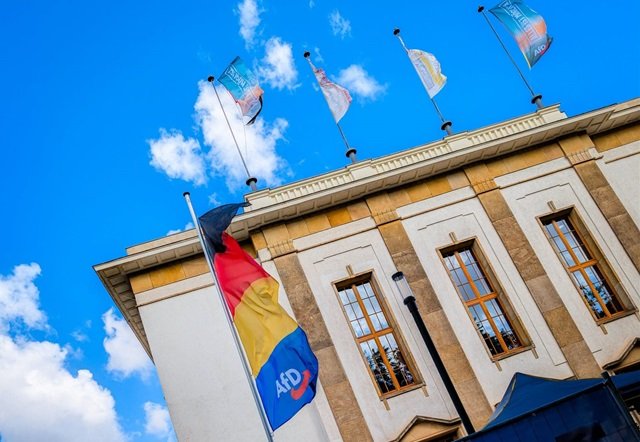
I’ve been traveling through Germany for the past week talking about my memoir In the Realm of the Last Man (Der Letzte Mensch in German), starting in Berlin and continuing through Hamburg, Stuttgart, and Munich. As readers of Frankly Fukuyama should be aware, there has been a political earthquake in recent weeks as the AfD—the right-wing Alternative for Germany—has come out on top in the eastern state of Saxony-Anhalt, winning 44% of the vote. Then in Mecklenburg-Vorpommern, a surging AfD wiped out the formerly dominant Christian Democratic Union (CDU), which failed to reach the 5% vote share necessary to receive representation in the state parliament. The CDU and other mainstream parties had up to now been following a “firewall” strategy of refusing to consider cooperation with the AfD, a policy of marginalization that has obviously failed to work.
In my memoir, I had argued that one explanation for the rise of populist-nationalist parties like the AfD in Germany and Trump’s MAGA movement in the U.S. was less the failure to distribute material goods than the distribution of equal respect, which led to a backlash of anger on the part of populations who felt disregarded and socially marginalized. It seems to me that this explanation applies in spades to Germany.
The AfD’s political base is in the states of the former East Germany, what used to be the Communist German Democratic Republic (GDR). After unification in the early 1990s, the former West Germany made impressive efforts to incorporate the GDR into its own thriving economy, transferring wealth and welfare state benefits to the East, as well as a rule of law that granted equal rights to the former Communist society.
This formal equality was not matched, however, on a social level. Germany, like the United States, United Kingdom, and other rich democracies was undergoing a social transformation in this period. A new elite was forming: parties of the left like the American Democrats, British Labour, and the German Social Democrats were increasingly dominated not by the working class they claimed to serve, but by educated professionals living in cosmopolitan urban centers. These elites may have espoused egalitarian policy views, but they did not perceive the huge social gap that had opened up between themselves and their less-educated peers living outside of big cities. The de-industrialization brought on by a globalizing economy and neo-liberal policies exacerbated this cleavage, with heartland jobs being outsourced or replaced by a service sector requiring a different type of education and skills.
It is against this backdrop that the rise of the AfD must be understood. Roughly 2 million people left East Germany for the West since 1990, out of a 1989 population of only 16 million. While early leavers were largely young men, after 1991 they skewed female. The GDR’s inefficient industrial base was largely dismantled; while there was new investment in the East, many workers found their livelihoods disrupted. The remaining population was therefore more male, elderly, and less educated.
These economic changes do not fully account for the social gap that opened up between East and West, however. Many Easterners felt that they were being looked down upon by their Western compatriots. They bore a subtle social stigma that showed up in phenomena like regional accents and the Easterners’ inability to speak English well. While the latter were receiving social benefits from the West, politics remained dominated by that region’s mainstream parties. Prior to 1989, there had been virtually no non-European immigration into the GDR, and therefore no experience of living in a culturally diverse society. West Germans did a lot after 1945 to educate their young people about the Holocaust and the militarism of the Hitler era, something that did not happen in the East. This omission fed the AfD narrative that Germans needed to stop feeling guilty for the Nazi era and to be proud of their history. Younger, less educated men in particular saw their social status decline in the liberal culture brought on after unification.
This then constitutes the social and economic backdrop to the rise of the AfD. It is very similar to that of Donald Trump’s MAGA base, which is also composed of less educated and more rural voters. In both countries, young men have joined hands with the elderly nostalgic for the past in opposing mainstream parties that they feel have ignored and disrespected them.
As I said at the end of In the Realm of the Last Man, “We have means of distributing resources a bit more evenly, and should undertake to do that. What we lack is a way of distributing respect.”