A bulletin published in October by Sri Lanka’s Department of Census and Statistics (DCS) shows a profound erosion of living standards under successive governments. It revealed that the country’s poverty rate climbed to 16 percent in the first quarter of 2025, from 14.3 percent in 2019, and real incomes declined for most households.
The figures expose the fraudulent claims made by the Janatha Vimukthi Peramuna-led National People’s Power (JVP/NPP) government, which came to power in 2024 promising to improve living conditions for ordinary people. In fact, it has continued and deepened the IMF-dictated austerity measures imposed by successive governments.
Despite a rise in nominal household incomes between 2019 and 2025, inflation has eroded workers’ purchasing power: real mean household income fell by 7.8 percent, while real median income plunged by 11.1 percent.
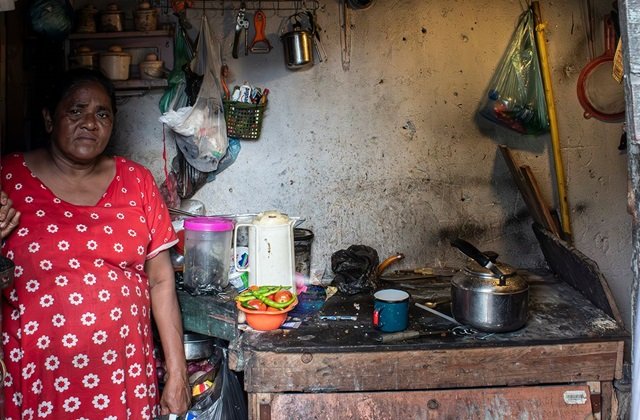
The burden falls most heavily on those who are already most exploited and oppressed. In the plantation estates, the poverty rate was 23 percent in 2025. Estate workers—largely Tamil-speaking workers descended from those brought from southern India under British colonial rule to work on plantations—remain the most oppressed section of the Sri Lankan working class.
The poverty rate was 17.3 percent in rural areas, where the majority of the population lives, and 7.8 percent in urban areas.
The cost of bare survival has soared. The data places 3.4 million people below the poverty line. The official monthly poverty line stood at 6,966 rupees per person in 2019; it rose to 16,417 rupees in 2025 and further to 17,742 rupees by October 2026.
This sharp increase reflects the relentless escalation in the prices of food, fuel, transport, medicines, housing and basic utilities. For a family of four, even an income substantially above the official poverty threshold is increasingly inadequate to secure a minimally decent standard of living.
The situation has undoubtedly become even worse in the last year-and-a-half, not covered by the DCS report. Prices for fuel, fertilizer and other essentials have soared due to the criminal US-led war against Iran.
While living conditions among working people continue to deteriorate, the wealth of the richest sections of society has expanded. The DCS’s most damning finding is the extreme concentration of income at the top. In early 2025 the richest 20 percent of households received an average monthly income of 335,679 rupees, compared with just 22,612 rupees for the poorest 20 percent—a staggering disparity of nearly 15 to one.
Between 2019 and 2025, the real income of the poorest quintile of households fell by approximately 19.6 percent, while that of the richest quintile rose by about 6.8 percent. Consequently, the income ratio between the richest and poorest quintiles widened from 10.6 in 2016 to 14.8 in early 2025.
Meanwhile, major banks and corporations are reporting soaring profits. According to financial press reports, Hayleys PLC—which owns hotels, shipping, manufacturing, and retail businesses—increased its pre-tax profit by 49 percent to Rs. 21.31 billion during the first half of 2026. Aitken Spence, with interests in tourism, maritime and logistics, recorded a 71.4 percent increase to Rs. 2.8 billion over the same period.
John Keells Holdings, Sri Lanka’s largest diversified conglomerate, lifted its attributable profit by 213 percent to Rs. 5.17 billion in the second quarter of 2026/27, up from Rs. 1.65 billion a year earlier. LOLC Finance reported an annual after-tax profit of Rs. 27 billion and underlying profit growth of nearly 30 percent.
Deepening inequality is not an accidental byproduct of the economic crisis. It is the outcome of a class strategy that shifts the burden of debt repayment, fiscal adjustment and the defence of capitalist profitability onto the backs of workers and the poor.
The government presents falling unemployment as proof that the economy has turned the corner. But the unemployment rate conceals more than it reveals. In the first quarter of 2026 unemployment was 3.7 percent, down from 3.8 percent a year earlier. However, total employment fell by 36,737, from 8.14 million to 8.10 million.
According to a report released last month by the Institute of Policy Studies (IPS), between 2019 and 2024 labour-force participation fell by 5 percentage points and the employment-to-population ratio by 4.5 points. Real earnings for salaried workers also fell. Around 300,000 workers left Sri Lanka in 2022 because of the lack of viable employment at home.
Alongside the decline in labour-force participation, informal employment accounts for roughly two-thirds of those in work. According to the IPS, in 2024 informality covered 66.5 percent of the employed—about 5.3 million workers. Informal wage employees in that year earned an average of 35,000 rupees a month, compared with 63,000 for formal wage employees. Female labour-force participation fell from 34.5 percent in 2019 to 29.8 percent in 2024.
Youth unemployment (for workers aged 15 to 24) stood at 17.8 percent in the second half of 2026, rising to 22.4 percent for young women.
Limited welfare assistance under the Aswesuma program is failing to reach many of those most in need. The IPS found that among the poorest 20 percent of households facing high exposure to economic shocks, only 55 percent receive social protection, leaving nearly half without assistance.
The deteriorating social conditions confronting workers and the oppressed are bound up with austerity measures dictated by the IMF and imposed by successive governments. These attacks have intensified since 2022, when the government of President Gotabaya Rajapakse defaulted on its loan repayments amid a severe economic crisis. Soaring prices triggered a mass uprising of workers and the rural poor, which toppled the government and forced Rajapakse to flee the country.
In March 2023, Rajapakse’s replacement, President Ranil Wikremasinghe, signed a new $3 billion bailout loan agreement with the IMF. This included cuts to public-sector wages, the restructuring and privatization of state-owned enterprises, increased taxes on workers and higher fuel and electricity prices.
The JVP/NPP government came to power pledging to bring change and renegotiate the deal with the IMF. However, it rapidly abandoned its election promises and began implementing the IMF austerity program to the letter, acting as the local representative of international finance capital. These attacks are escalating, with the backing of the trade union bureaucracy, which is seeking to suppress growing resistance from the working class.
Sri Lanka is a stark example of the global offensive by capitalist governments, aimed at shifting the burden of debt repayment and military expenditure onto the backs of working people. To enforce its attacks, President Anura Kumara Dissanayake’s government is advancing repressive legislation, including the Protection of the State from Terrorism Act (PSTA) and the Prevention of Organised Crimes Bill (POCB), which are both aimed at criminalising workers’ resistance.
The working class must draw the necessary conclusion: no section of the capitalist establishment, whatever its “left” or “progressive” coloration, will defend the interests of workers. The fight against repression cannot be separated from the fight against the social conditions that make repression necessary. Only the independent political mobilisation of the working class, based on a socialist program and in international unity with workers everywhere, can defeat both the austerity that immiserates millions and the police-state measures designed to silence the resistance to it.