by Our Foreign Affairs Editor
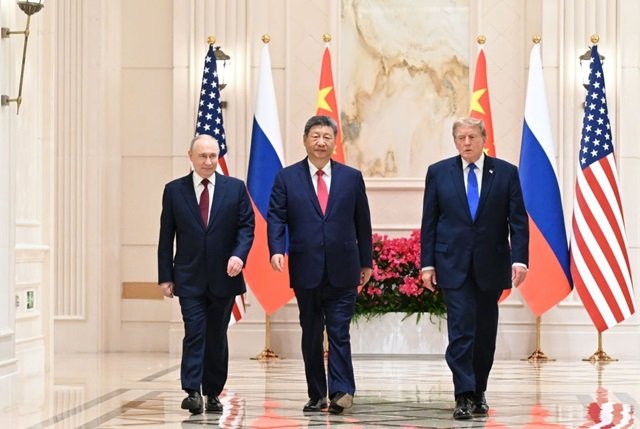
The leaders of the world’s three largest nuclear powers have called for cooperation, mutual respect and a renewed commitment to international peace at an unprecedented trilateral meeting in China. Yet, as Vladimir Putin, Xi Jinping and Donald Trump exchanged assurances about their shared responsibility for global stability in Shenzhen on Thursday, Ukraine’s repeated attacks on a strategically important Russian bridge offered a reminder of the distance between diplomatic ambitions and the realities of international conflict.
The meeting, held on the sidelines of the Asia-Pacific Economic Cooperation (APEC) summit, brought together the Russian, Chinese and American presidents in a format that reflects the changing dynamics of international diplomacy. Its significance extends beyond the three countries themselves. Together, they possess the world’s largest nuclear arsenals and exercise considerable influence over international security, economic relations and the direction of major geopolitical disputes. Their willingness to engage collectively therefore carries implications for a wider international order increasingly affected by military confrontation, trade tensions and competing political interests.
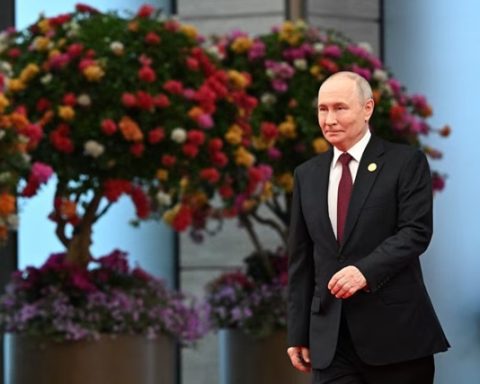
Opening the discussions, Putin argued that Russia, China and the United States could make a substantial contribution to international security if they worked together as equal partners. He emphasised mutual respect, equality and a balance of interests as the foundations for constructive cooperation, placing particular responsibility on the three governments to strengthen world peace and stability. He also identified overlapping interests in addressing regional conflicts, including the war between Russia and Ukraine, and proposed that the discussions examine global and regional relations as well as energy security.
Xi, who hosted the gathering, presented four principles for relations among major powers: mutual respect, peaceful coexistence, mutually beneficial cooperation, and dialogue and consultation. He argued that international peace depended on major countries maintaining harmonious relations, adding that sound interactions between powerful states were not simply desirable but essential. His remarks placed particular emphasis on respect for national sovereignty and territorial integrity, as well as each country’s right to determine its own political and development path.
The Chinese president also called on governments to respect one another’s core interests and principal concerns and refrain from interfering in domestic affairs. His position reflects a diplomatic approach that places sovereignty and non-interference at the centre of relations between major powers. Whether these principles can be reconciled with the competing security and political interests of the three countries remains a central question for any sustained cooperation.
Nuclear security emerged as one of the most consequential subjects. Trump acknowledged that the three countries possess nuclear arsenals substantially larger than those of other states, arguing that their position gives them a particular responsibility to discuss reducing nuclear weapons and preventing their use. He urged Russia and China to cooperate with Washington in preventing nuclear proliferation, warning that acquiring nuclear weapons can create conditions in which relinquishing them becomes difficult.
Xi went further in calling for the comprehensive prohibition and destruction of nuclear weapons, advocating the creation of a nuclear-free world. He reiterated that nuclear war could not be won and must never be fought, insisting that every effort should be directed towards preventing such a conflict. The statements established an area of apparent common ground among the three leaders, although the meeting’s opening remarks did not identify specific disarmament commitments, timetables or mechanisms through which their proposals might be implemented.
The Ukraine conflict nevertheless remained an unavoidable issue. Trump expressed optimism that a peaceful settlement might be approaching, saying that developments were under way and that he hoped both Putin and the Ukrainian leadership would want to end the war. He called for further efforts to reach an agreement. Putin, meanwhile, confirmed that the conflict had received considerable attention during his earlier bilateral meeting with Trump, which took place at the American president’s initiative.
The diplomatic discussions unfolded against a particularly sensitive military development. Hours before the trilateral meeting, Ukrainian forces struck the bridge connecting Russia with Crimea for the third time in a week, according to Russian authorities. The latest attack forced the suspension of railway services, although Russia’s transport ministry reported that nobody had been injured and that specialists were assessing the damage.
The 19-kilometre bridge across the Kerch Strait is both a major transport connection and a politically significant infrastructure project for Moscow. Inaugurated by Putin in 2018, it represents Russia’s attachment to Crimea, which Moscow annexed from Ukraine in 2014. The peninsula is also home to Russia’s Black Sea Fleet and has substantial importance for Russian military logistics.
The latest incident followed a more damaging Ukrainian attack on Tuesday, when drones and missiles struck the bridge’s central road section. Videos and images verified by Reuters showed the main road arch collapsing into the sea, leaving a substantial gap. The damage could complicate Russian supply routes to Crimea, which has a population of nearly 2.5 million, while placing additional pressure on military logistics supporting Russian forces in parts of southern Ukraine. An earlier attack on Monday had caused less extensive damage.
The timing presents an awkward backdrop for Putin’s participation in a summit that Moscow has portrayed as evidence of its place in an emerging multipolar international order. Russia hopes the gathering will demonstrate that its international diplomatic position cannot be marginalised and that major global decisions should not be shaped exclusively by Western governments.
The Shenzhen meeting also took place within the broader framework of the 33rd APEC Economic Leaders’ Meeting, which opened on Wednesday. The gathering brings together 21 Asia-Pacific economies representing more than 60 per cent of global gross domestic product and approximately half of world trade. Its agenda includes innovation, digital technologies, economic cooperation and regional integration. Putin used his address to the APEC CEO Summit to advocate greater economic cooperation and a fairer international order, while criticising Western sanctions and trade restrictions against Russia.
The three presidents’ discussions lasted approximately one and a half hours. Their meeting followed separate bilateral engagements, including more than two hours of talks between Putin and Xi. Trump had also met Putin, while Xi’s personal welcome of the American president at the airport provided a visible demonstration of diplomatic courtesy despite continuing disagreements between Washington and Beijing over trade and restrictions on Chinese access to advanced artificial intelligence chips.
The Shenzhen gathering has established a significant diplomatic moment: the leaders of three nuclear powers have publicly recognised their collective responsibility for international stability. But declarations of mutual respect and cooperation are only an initial step. The more consequential test will be whether those principles can produce practical progress on nuclear security, the Ukraine conflict and the wider disputes shaping international relations. For a world facing several overlapping crises, the value of the summit will depend less on the language exchanged behind closed doors than on what its participants are prepared to do afterwards.