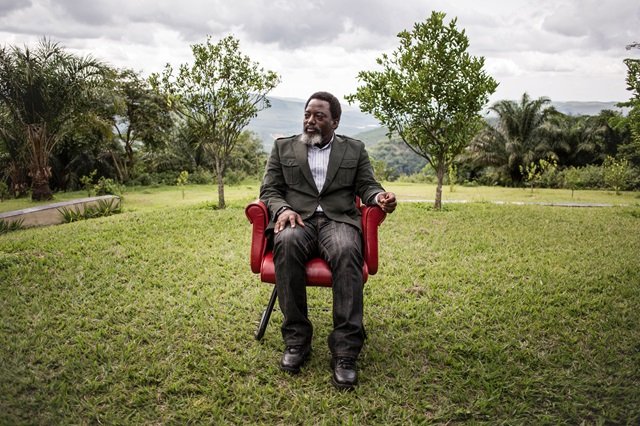
Seven years after leaving office, former Democratic Republic of the Congo president Joseph Kabila has emerged at the centre of an armed rebellion aimed at destabilising the government of his successor, Félix Tshisekedi. Kabila, who governed the country from 2001 to 2019 and was sentenced to death by a military court in 2025, is now leading the principal rebel movement in the country while seeking political alliances capable of challenging the government from within. His immediate objective is to prevent Tshisekedi from securing a third presidential term, but his strategy extends beyond opposition politics to the expansion of an insurgency already controlling important territory in the country’s northeast.
Kabila’s assumption of leadership of the Congo River Alliance-M23, subsequently renamed the Front for the Refoundation of the Nation (FRN), has reinforced suspicions that he maintained close connections with the insurgency. The movement is backed by Rwanda, whose support has been a significant factor in the conflict. Kabila now occupies an unusual position, directing the rebel movement’s military operations in the northeast while also taking part in negotiations between the insurgents and the Congolese government in Doha. Fighting has intensified in recent weeks in South Kivu, one of the principal areas affected by the rebellion.
The military campaign is only one dimension of Kabila’s strategy. From Goma, a major stronghold of the insurgency, he has issued threats against the government in Kinshasa and sought to present himself as an alternative to Tshisekedi’s leadership. In a recent interview with Conspiracy Tracker Great Lakes, a research group sympathetic to the rebellion, Kabila accused the president of acting as a dictator and disregarding the country’s Constitution. He argued that the Democratic Republic of the Congo needed either elections or a revolution.
The immediate political confrontation centres on Tshisekedi’s efforts to change the constitutional framework governing presidential terms. On 10 November, the government announced through national television that legislation had been approved establishing the basis for a referendum on constitutional reform. The current Constitution limits presidents to two terms, a restriction that would prevent Tshisekedi from seeking another mandate in 2028. The proposed referendum offers a potential route around that limitation.
Tshisekedi has been in power for eight years, and the prospect of constitutional reform has prompted a strong reaction from opposition groups. The C64 opposition platform has described the initiative as a constitutional coup and is preparing to mobilise against it through street demonstrations. The dispute has consequently created an opportunity for Kabila to broaden his political influence by aligning his movement with opponents of a third presidential term.
However, bringing the opposition into an alliance with an armed insurgency presents considerable difficulties. Kabila’s military-court conviction, his alleged connections with Rwanda and his leadership of a movement involved in armed conflict make him a controversial potential partner for political figures seeking to challenge Tshisekedi. The government has warned opposition leaders against maintaining contact with him, placing additional pressure on an already divided opposition.
Prominent C64 figures, including Moïse Katumbi, Martin Fayulu, Delly Sesanga and Jean-Marc Kabund, have so far rejected the military approach and attempted to maintain a degree of distance from both Tshisekedi and Kabila. Nevertheless, Katumbi, who lives in exile, recently announced plans to travel to the northeast to meet the former president. Speaking to Jeune Afrique in early November, he argued that Goma remained part of the Democratic Republic of the Congo and that Kabila was a Congolese citizen. He also pointed out that the government itself continued negotiating with the FRN in Doha.
The possibility of cooperation between Kabila and sections of the opposition could alter the political character of the conflict. At present, his movement derives much of its influence from its armed presence in the northeast and its relationship with Rwanda. To become a credible national political force, however, it would need to attract Congolese opponents of Tshisekedi who may have little interest in supporting an insurgency. The distinction between opposition to the president and support for an armed movement remains central to Kabila’s attempt to expand his political base.
Tshisekedi has also taken steps that appear designed to diminish Kabila’s political legacy. On 11 November, the government formally requested that regional governors submit inventories of bridges, streets, roundabouts and monuments bearing the former president’s name, with the intention of renaming them. The initiative came after Tshisekedi’s government had pursued the military-court proceedings that resulted in Kabila’s death sentence. The campaign to remove his name from public infrastructure adds a symbolic dimension to a confrontation already being fought through military operations, legal proceedings and political manoeuvring.
The struggle is increasingly extending beyond Congo’s borders. Kabila has undertaken repeated visits to neighbouring countries in recent months, attempting to persuade regional leaders that Tshisekedi cannot defeat the rebellion and therefore cannot guarantee internal stability. Angola is a particular target of his diplomatic efforts. Its government has shown a willingness to intervene when developments in neighbouring countries are perceived as threatening its own security, making its position potentially important to the conflict’s regional balance.
Tshisekedi, meanwhile, retains significant international backing. The United States has explicitly supported his government, and Kinshasa has recently concluded an agreement granting Washington preferential access to Congolese mineral resources in exchange for defence support. Russia and China have also maintained their formal support for the government rather than extending political credibility to Kabila. These relationships complicate the former president’s efforts to present himself internationally as an alternative capable of restoring stability.
Rwanda’s position may prove decisive in determining whether Kabila can transform his insurgency into a broader political movement. President Paul Kagame’s government has provided substantial support to the rebellion, but that relationship could become an obstacle if Kabila seeks to attract Congolese nationalists who oppose Tshisekedi without necessarily supporting foreign involvement in their country’s conflict. He may therefore need to establish some formal distance from Kigali while continuing to depend on a movement whose military position has benefited from Rwandan backing.
During a recent meeting with James Swan, head of the United Nations Organisation Stabilisation Mission in the Democratic Republic of the Congo (MONUSCO), Kabila declared that he intended to prevent Tshisekedi from obtaining a third term by all necessary means. He also accused the Congolese army of violating the ceasefire agreed in Doha. Bertrand Bisimwa, Kabila’s spokesperson, similarly accused government forces of continuing to kill members of the rebel movement.
The confrontation now involves three interconnected struggles: an armed insurgency in the east, a constitutional dispute over presidential term limits and a contest for regional and international support. Kabila’s ability to unite opposition politicians around his campaign remains uncertain, particularly given their reluctance to endorse military action. Yet his emergence as the formal leader of the rebellion has transformed the political stakes. What began as a struggle over the future of Tshisekedi’s presidency is increasingly becoming a wider contest over who can claim political authority, territorial influence and the right to determine Congo’s future.