Ai Weiwei has reignited the global debate on artistic freedom after criticising the decision-making practices of major international art institutions, including the Venice Biennale. Speaking during the inauguration of his retrospective Aftershock at the MAXXI museum in L’Aquila, Italy, the Chinese artist argued that cultural platforms should not act as arbiters of political legitimacy by excluding countries or artists on the basis of geopolitical positions. For Ai Weiwei, such decisions amount not to ethical clarity but to a form of censorship that undermines the very principle of free expression.
His remarks, published in coverage by El País, come at a moment of heightened tension in the cultural world, where institutions are increasingly pressured to take political stances on global conflicts. Ai Weiwei, who has spent decades confronting state control and censorship, insisted that the problem is not confined to authoritarian systems. Instead, he warned that democratic societies are equally vulnerable to forms of exclusion and suppression, particularly when cultural institutions begin to filter participation based on political criteria rather than artistic merit.
The artist’s position is rooted in a long and turbulent personal history with censorship and exile. Now 68, Ai Weiwei currently lives in Portugal after years spent in China, the United States, Germany and the United Kingdom. His trajectory has been marked by repeated clashes with authorities, including his 2011 detention in China following his criticism of the government’s handling of the 2008 Sichuan earthquake, in which tens of thousands of people died. During that period, he led citizen-led investigations documenting victims whose names were initially suppressed, turning his artistic practice into an act of public accountability.
Ai Weiwei’s experience of censorship has not been limited to authoritarian contexts. He also recalled the cancellation of an exhibition in London in 2023 at the Lisson Gallery after controversial statements he made on social media regarding Israel’s military actions in Gaza. For him, the episode demonstrated that democratic societies are not exempt from pressure, backlash or institutional self-censorship. “Censorship has no borders,” he argues, insisting that both Western democracies and non-democratic states ultimately converge in their tendency to protect political or economic interests when faced with dissenting voices.
At the centre of his current intervention is the controversy surrounding the Venice Biennale’s decision to exclude Russia and Israel from certain award processes. Ai Weiwei argues that such exclusions transform cultural institutions into political actors, compromising their responsibility to ensure equal representation. In his view, the role of events such as the Venice Biennale is not to evaluate moral or political positions but to preserve open access to artistic expression. When institutions begin to “select” based on political alignment, he warns, they cross a line into censorship disguised as ethical judgment.
His argument is not merely abstract but grounded in a broader critique of how contemporary societies manage disagreement. As reported by El País, Ai Weiwei links these institutional decisions to a wider cultural climate in which freedom of expression is increasingly conditional. He warns that when societies accept selective visibility—deciding which voices are acceptable and which are not—they risk weakening the foundations of democratic culture itself. In his words, restricting expression does not resolve conflict but impoverishes society, making it “less intelligent” and less capable of critical thought.
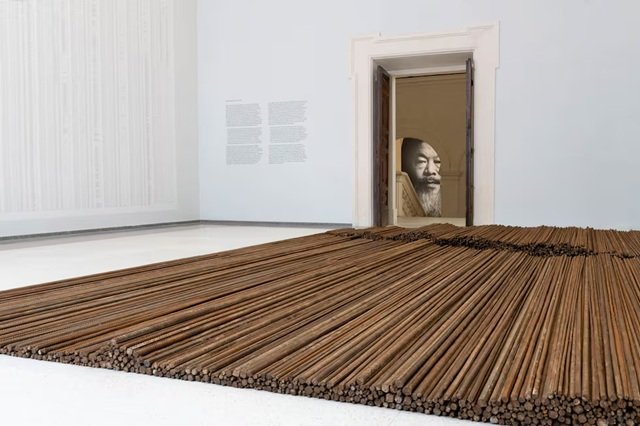
The exhibition Aftershock at the MAXXI National Museum of 21st Century Arts, L’Aquila presents a concentrated overview of Ai Weiwei’s career, combining early photographic works from his time in New York with large-scale installations addressing war, displacement and political violence. The show also engages directly with the history of L’Aquila, a city still marked by the devastating earthquake of 2009. Ai draws parallels between L’Aquila and Sichuan, where he documented the consequences of structural failures in public buildings that led to mass casualties, especially among schoolchildren. His work Straight, composed of steel reinforcement bars recovered from collapsed structures, stands as a memorial to those deaths and reflects his ongoing engagement with memory, accountability and state responsibility.
Throughout the exhibition, Ai Weiwei revisits themes that have defined his artistic practice: migration, war, historical trauma and the fragility of truth in the digital age. Works referencing the refugee crisis in Europe, including reinterpretations of iconic images of suffering, highlight his insistence on confronting uncomfortable realities. While some of these works have generated controversy, including accusations of exploiting tragedy, Ai defends them as necessary acts of witnessing. He argues that the role of the artist is not to comfort audiences but to expose contradictions and challenge selective empathy.
His reflections extend beyond art institutions to global politics and the changing nature of authority. Ai Weiwei expresses concern about the increasing instability of international alliances and the erosion of consistent democratic principles across regions. He suggests that contemporary geopolitics is marked by shifting positions and pragmatic alliances rather than coherent ethical frameworks, a condition he views as destabilising for both governance and cultural production. In this context, he reiterates that censorship—whether overt or subtle—serves as a tool for managing uncertainty by limiting the space of public debate.
A recurring concern in his recent writings, including his book On Censorship, is the impact of artificial intelligence on personal freedom and collective agency. While he does not reject technology itself, he warns that AI systems can easily become instruments of surveillance and behavioural control when placed in the service of political or economic power. The risk, he argues, is not the machine itself but the structures that deploy it. As such, he frames digital technologies as part of a broader continuum of tools that can either expand or restrict freedom depending on how they are governed.
Despite his critical stance, Ai Weiwei remains focused on individual responsibility. He argues that safeguarding dignity and freedom begins at the level of the individual, who must remain vigilant against systems that erode privacy and autonomy. His refusal to compromise on this principle is reflected in both his artistic practice and his public interventions, which continue to challenge institutions across political systems.
In conversation with El País, Ai Weiwei ultimately rejects the idea that censorship belongs exclusively to authoritarian regimes. Instead, he presents it as a structural risk embedded within all societies, including those that define themselves as democratic. His warning is clear: without constant defence of open expression, even cultural spaces dedicated to freedom can become sites of exclusion. His work, spanning decades and continents, insists that the struggle over speech is not a peripheral issue in contemporary politics but one of its defining battlegrounds.