Editorial
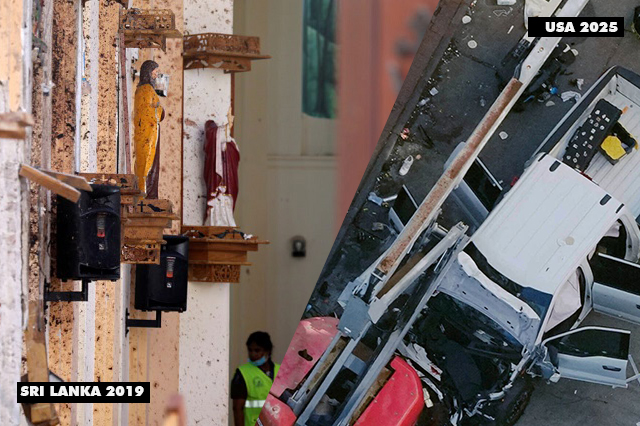
The beginning of the new year is far from a celebration for the United States. ISIS-inspired lunatics unleashed their savage barbarism against unarmed Americans. We must seize this moment to condemn this horrific attack in the most forceful and unyielding terms possible. What is fascinating is that three days after the horrendous car-ramming attack in New Orleans that claimed at least 14 lives, there was an eerie but remarkable response from U.S. authorities: they swiftly ruled out any involvement from accomplices or wider terrorist cells. The FBI confirmed the attacker’s sole responsibility for the carnage, identifying him as a former soldier who was 100% inspired by ISIS ideology. Despite his chilling allegiance to a jihadist group, no political leaders, no religious institutions, and no factions in substantive numbers came forward with inflammatory conspiracies. The law enforcement agencies, despite the initial tension, operated in relative calm, carefully uncovering the motivations behind the attack. In fact, they acted decisively and took every precaution to prevent any further escalation. The immediate response was one of control, not hysteria. The U.S. law enforcement agencies understood one critical truth: it is not the narrative that matters most in the wake of tragedy, but the cold, sober pursuit of justice.
Contrast this measured approach with the explosive political chaos that followed the 2019 Easter Sunday attacks in Sri Lanka. The bombing of multiple Christian churches, which claimed over 250 lives, was linked to local extremists who had pledged allegiance to ISIS. These were not faceless, shadowy figures but homegrown, radicalised individuals, driven by a powerful ideology—yet what followed was a deeply troubling narrative driven by opportunistic political manipulation. Instead of tackling the reality of the threat, Sri Lanka’s political establishment, aided by the Catholic Church and opposition parties, descended into a quagmire of fake propaganda. These entities, led by leaders eager to exploit the situation, did not seek the truth but rather crafted narratives that served their interests. They distracted from the core issue—the rise of Islamist radicalisation—and instead pursued an agenda of political vengeance.
The narrative that the Catholic Church, particularly Cardinal Malcolm Ranjith, sought to weave around the bombings painted a picture of deep state conspiracies and foreign involvement, playing into the hands of both internal political rivals and foreign actors with vested interests. The Church became a central figure in a story that failed to acknowledge the self-radicalised local bombers who were inspired by ISIS. Instead, it adopted a populist, emotionally charged rhetoric aimed at placing the blame on the state machinery—a narrative that remains to this day largely unchecked by empirical analysis.
This response was not just an irresponsible oversimplification of a complex issue, but also an utter failure of leadership. It represented a moral and intellectual bankruptcy among the very people who should have understood the nature of the attack in the first place. For those who bore the sacred responsibility of guiding Sri Lanka through its complex social and political fabric, it was a catastrophic misstep, driven not by the quest for truth, but by self-serving opportunism.
The issue is not merely one of religious manipulation; it is far more profound. The Catholic Church’s post-Easter Sunday actions cannot be examined in isolation. The fact that it wielded so much influence over the political process in Sri Lanka’s governance structures post-attack speaks volumes. As our political columnist Luxman Aravind has astutely pointed out, it was the Catholic Church that became the ultimate beneficiary of the crisis, successfully orchestrating the downfall of not one, but three subsequent governments. In doing so, it not only changed the course of the country’s political trajectory but also systematically overhauled the state apparatus to meet its needs. State officers, who once served the principles of the Constitution, were replaced with individuals who were more attuned to the political whims of powerful religious institutions. This overhaul, motivated by short-term gains, profoundly weakened Sri Lanka’s governance structure and laid the groundwork for future instability.
This becomes all the more worrying when we remember that the attackers themselves were radicalised through global jihadist ideologies. These were not isolated individuals but rather products of a global network of radicalisation, inspired by ISIS. By choosing to sidestep this reality in favour of manufactured conspiracies, Sri Lanka missed a golden opportunity to address the real dangers of homegrown extremism. A healthy, functioning democratic society must reject ideologically-driven narratives that do not acknowledge the full extent of the threat—especially when it comes to the global reach of Islamist terror. Yet, tragically, Sri Lanka failed in this regard.
What is truly disturbing is the failure of Sri Lanka’s leadership, particularly from the political class, to separate legitimate security concerns from their personal political agendas. This profound lapse, demonstrated through the rushed politicisation of the Easter attacks, not only undermined the national security response but also exposed the complete absence of a long-term strategy to combat extremism. With the Catholic Church acting as a kingmaker in the corridors of power, the state’s resources and focus were diverted from the critical task of strengthening its counter-terrorism efforts and addressing the growing influence of radical groups.
The consequences of this failure were immediately visible in the aftermath. The intelligence and security agencies, already under pressure from a lack of coordination and systemic inefficiency, were not allowed the autonomy they needed to tackle these issues head-on. Political interference in security matters stifled the necessary reforms, and a vacuum of leadership left the state increasingly vulnerable to the spread of extremist ideologies. In contrast to the swift response in New Orleans, where law enforcement agencies rallied together to stitch together the facts, Sri Lanka’s agencies were dragged into a political storm where their work was undermined by political scapegoating and false narratives.
The Catholic Church’s relentless pursuit of this conspiracy theory was a self-inflicted wound on the country’s ability to counter extremism effectively. By focusing on peripheral theories, it distracted from the hard, uncomfortable truths that needed to be faced. The self-radicalisation of Sri Lankan youth, driven by external jihadist influences, demanded a strategic response rooted in intelligence, social reform, and religious moderation. But instead of building a foundation of resilience, Sri Lanka fell victim to short-term political appeasement—a dangerous game played by those who had more to gain from shifting the narrative than from confronting the uncomfortable realities of global jihadist radicalisation.

We must ask ourselves: What are we so afraid of? Why is it that we continue to sidestep the real issues in the name of political survival and religious convenience? Why do we allow ideologically driven narratives to dominate our discourse at the expense of public safety and truth? Sri Lanka must reflect on these questions if it is to avoid another disaster of this magnitude. If we are to prevent a repeat of such tragedies, then we must recognise the failings of the past—the manipulation of the truth, the undermining of security agencies, and the undue political influence that permeates every aspect of governance.
There is also a deeper, more ominous question that looms: If the Catholic Church and other powerful religious institutions continue to wield such unchecked influence, what does this mean for the future of Sri Lanka’s state structure? What happens when political ambition and religious interests merge to control national security and governance? The consequences of such unchecked power could very well tear the fabric of the nation apart, just as it did during the bloody civil war that raged for nearly three decades. We cannot afford another rupture; the scars of the past are still too fresh.
It is not too late to recalibrate and focus on substance over narrative, facts over propaganda, and security over political expediency. Sri Lanka needs a new generation of leaders who can build bridges, unite the country, and address radicalisation with the seriousness it demands. The state must reclaim its independence from the influence of political opportunism, and most importantly, it must refocus its counter-terrorism policies in a manner that transcends the politics of the moment. The world has changed, and so must Sri Lanka. For the sake of the future, let us not be led astray by the false promises of power—we must act with clarity, conviction, and foresight. The time to rise above this crisis is now.