Less than a month after Türkiye, Saudi Arabia and Pakistan created the Mecca Joint Defence Agreement (MJDA), the pact is already confronting a question that could prove more important than its founding declaration: can it expand?
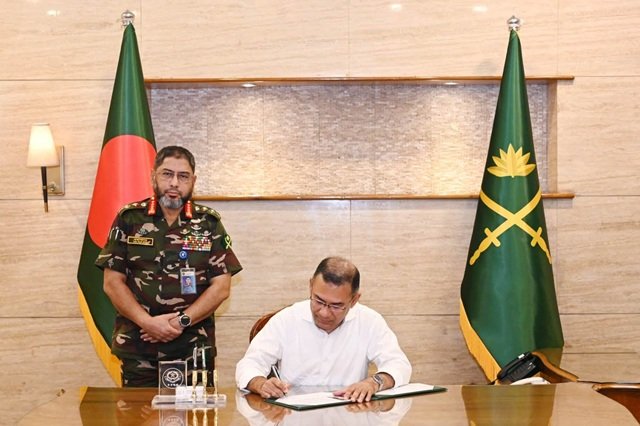
Bangladesh has expressed interest in the arrangement, although Dhaka has not made a policy-level decision on membership. Pakistan, meanwhile, has described the MJDA as an evolving security architecture potentially open to countries willing to share its collective obligations.
Bangladesh’s possible entry matters because admitting a fourth member would do more than enlarge the pact. It would test what kind of security institution the MJDA is becoming.
The original agreement connects three powers with substantial but different strategic interests. Bangladesh would introduce another layer of complexity. Dhaka maintains important relationships with China, India, the United States, Japan, Europe and the Gulf states. It has little interest in exchanging those relationships for membership in a rigid geopolitical camp. That makes Bangladesh an unusually revealing test case.
The Fourth-Member Problem
Collective defence is straightforward on paper: an attack on one member is treated as an attack on all. In practice, such commitments immediately raise harder questions.
What constitutes an attack? What assistance is required from other members? Would every new member assume identical obligations despite facing fundamentally different security environments? How would governments respond when one member’s adversary remains an important economic or diplomatic partner of another?
These questions already exist within the MJDA. Expansion would make them harder to postpone.
Türkiye, Saudi Arabia and Pakistan have different relationships with Washington, Beijing, Tehran, Moscow and New Delhi. Bangladesh would add another state whose foreign policy depends heavily on avoiding exclusive alignment.
Dhaka’s economic relationship with China is substantial. Geography makes a functioning relationship with India unavoidable. Western markets remain critical to Bangladesh’s export economy, Japan is a major development partner, and the Gulf is important for energy, employment and remittances.
Joining a defence framework that required Bangladesh to choose among those relationships would therefore carry significant costs. The attraction of the MJDA lies precisely in the possibility that it might not require such a choice.
The three founding governments have presented the agreement as defensive rather than directed against a predetermined adversary. If that principle survives expansion, the MJDA could offer something increasingly attractive to middle powers: additional security cooperation without the political discipline traditionally associated with bloc membership.
If it does not, its potential membership will narrow considerably.
Why Bangladesh Is Looking Beyond Its Existing Partnerships
Bangladesh’s interest should not be reduced to religious solidarity among Muslim-majority countries. There are concrete strategic calculations involved.
Dhaka has been diversifying its defence relationships, including through growing military cooperation with Türkiye. Turkish defence equipment and discussions over broader industrial cooperation indicate a relationship moving beyond simple procurement.
For Bangladesh, diversification reduces dependence. For Türkiye, defence-industrial ties provide an avenue for expanding strategic influence without requiring formal alliance structures.
The Gulf dimension is equally important. Bangladesh’s economic exposure to the region includes energy, investment, employment and remittance flows. Maritime routes stretching from the Gulf through the Arabian Sea into the Indian Ocean consequently have direct implications for Bangladeshi economic security.
Membership in the MJDA could potentially deepen training, technology exchange, military consultation and defence-industrial cooperation with three increasingly important partners.
But those benefits would have to be weighed against the diplomatic consequences of joining a collective-defence arrangement.
India will inevitably examine the possibility closely. A formal security relationship connecting Dhaka more closely with Islamabad would attract attention in New Delhi regardless of assurances that the pact is defensive.
Yet viewing Bangladesh’s calculations exclusively through India-Pakistan rivalry misses the broader shift underway.
Like many middle powers, Bangladesh is attempting to increase the number of strategic relationships available to it. The objective is not necessarily to replace one patron with another but to avoid excessive dependence on any of them.
The relevant question is therefore not whether Bangladesh is moving into somebody else’s camp. It is whether joining the MJDA would expand Dhaka’s room for manoeuvre or reduce it.
Security Without Bloc Politics?
That question extends well beyond Bangladesh.
The MJDA itself reflects an international system increasingly characterised by overlapping rather than exclusive partnerships. Bangladesh would test whether that flexibility can survive formal enlargement.
This creates an opportunity for the MJDA, but also a contradiction.
Collective defence requires credible obligations. Strategic autonomy requires flexibility. Too much flexibility and the pact risks becoming politically impressive but militarily ambiguous. Too much obligation and prospective members may conclude that membership restricts the diplomatic freedom they were trying to preserve.
Bangladesh therefore presents the MJDA with its first serious enlargement dilemma.
The real test is not whether the founding governments can persuade another country to sign. It is whether they can construct rules for consultation, crisis management and military cooperation strong enough to make collective defence credible while remaining flexible enough to accommodate members with divergent external relationships.
That balance will become harder with every additional member.
If Bangladesh eventually joins, its accession would signify more than the geographical expansion of a defence agreement from the Gulf deeper into South Asia. It would provide the first evidence that the MJDA can function beyond the strategic understandings of its three founders.
If Bangladesh remains interested but ultimately stays outside, that outcome may be equally revealing.
The future of the Mecca pact will not be determined by the number of countries attracted to it. It will depend on whether collective security and strategic autonomy-two objectives that often pull states in opposite directions can actually coexist within the same institution.