Police and paramilitary forces were deployed across Dhaka and several other cities on Friday following violent overnight protests triggered by the death of a prominent youth leader, raising concerns of further unrest ahead of Bangladesh’s national elections scheduled for February 12.
Streets in the capital were largely calm on Friday morning, but residents expressed fears that violence could resume later in the day, particularly after Friday prayers.
The unrest followed the death of Sharif Osman Hadi, 32, a spokesperson for Inquilab Mancha (Platform for Revolution), who was shot in the head by masked assailants in Dhaka last Friday while launching his campaign for the upcoming elections. Hadi had been actively involved in the student-led protests that toppled former prime minister Sheikh Hasina’s government last year.
After initially receiving treatment at a local hospital, Hadi was flown to Singapore for advanced medical care. He died after spending six days on life support.
Hadi was known for his outspoken criticism of India, and Inquilab Mancha describes itself as a “revolutionary cultural platform inspired by the spirit of uprising.”
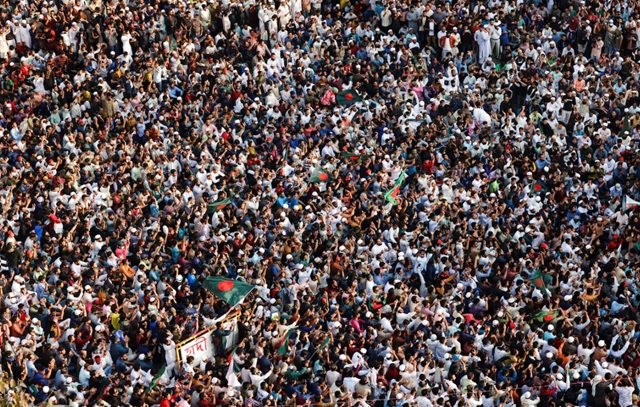
On Thursday night, protests escalated into violence in several parts of Dhaka. Videos circulating on social media showed mobs vandalising the offices of the country’s largest daily newspaper, Prothom Alo, as well as The Daily Star. A fire broke out at The Daily Star building, though the fire service later said the blaze was under control. Troops were deployed to the scene, and firefighters rescued journalists trapped inside.
Demonstrators chanted emotionally charged slogans invoking Hadi’s name, vowing to continue their movement and demanding swift justice. Authorities reinforced security in several areas to prevent further violence.
The home of Bangladesh’s first president, Sheikh Mujibur Rahman — the father of Sheikh Hasina — was vandalised and set on fire again, following similar attacks in February and August last year.
New Age editor Nurul Kabir, who also heads the country’s Editors’ Council, was harassed outside The Daily Star premises during the violence. Videos showed him being pushed into a crowd, verbally abused as an “Awami League collaborator,” and having his hair pulled.
Elsewhere, the premises of the prominent cultural organisation Chhayanaut were vandalised and torched in Dhaka. In the northwestern district of Rajshahi, protesters demolished an Awami League party office using a bulldozer, while demonstrators blocked major highways in several other districts.
Violence was also reported in cities including the port city of Chittagong, where protesters attacked the Indian Assistant High Commission and set fire to a house belonging to a former Awami League education minister.
Pressure on Interim Government
Bangladesh has been governed by an interim administration led by Nobel laureate Muhammad Yunus since August 2024, after Sheikh Hasina fled to India following a mass student-led uprising. The interim government has faced mounting pressure over delayed reforms, while the Awami League has warned of unrest after being barred from contesting the elections.
In a televised address following Hadi’s death, Yunus described the killing as “an irreplaceable loss to the nation’s political and democratic sphere.” He urged citizens to remain calm and pledged a transparent investigation to bring those responsible to justice, warning that continued violence could undermine the credibility of the upcoming election.
The interim administration has declared Saturday a day of state mourning in honour of Hadi, with national flags to be flown at half-mast and special prayers planned nationwide.
The unrest comes amid a deterioration in Bangladesh–India relations since Hasina fled to New Delhi. Earlier this week, hundreds of protesters under the banner “July Oikya” (July Unity) marched toward the Indian High Commission in Dhaka, chanting anti-India slogans and demanding Hasina’s return.