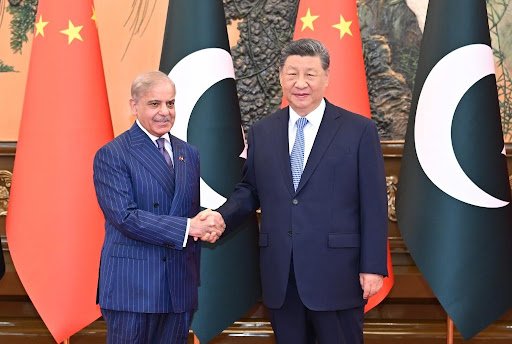
The joint statement issued after Prime Minister Shehbaz Sharif’s May 23-26 visit to China was not merely another ceremonial reaffirmation of friendship between Islamabad and Beijing. It reflected something deeper: the steady evolution of China-Pakistan relations into a long-term strategic framework shaped for an increasingly fragmented international order.
At a time when many alliances across the world are becoming transactional, unstable and vulnerable to domestic political shifts, China and Pakistan are projecting continuity, institutional trust and strategic patience. The language used in the statement was particularly significant. Both countries pledged to accelerate efforts toward building an “even closer China-Pakistan Community with a Shared Future in the New Era”- terminology that suggests Beijing increasingly sees Pakistan not simply as a bilateral partner, but as an important geopolitical anchor within its wider regional and Eurasian vision.
That shift is unfolding amid profound international transformation. Global politics is entering a period marked by technological rivalry, economic fragmentation, strategic competition and weakening confidence in traditional Western-led structures. Supply chains are increasingly politicized. Competition is expanding into artificial intelligence, digital governance, maritime access, cyber infrastructure and space technology. Against this backdrop, the China-Pakistan relationship is no longer confined to conventional diplomacy or traditional military cooperation.
From Strategic Friendship to Geopolitical Alignment
The breadth of cooperation itself reflects how extensively China-Pakistan relations have evolved. Few bilateral partnerships today simultaneously span defense cooperation, industrialization, artificial intelligence, regional diplomacy, digital economy integration, counterterrorism coordination, connectivity infrastructure and space collaboration.
More importantly, the relationship is increasingly oriented toward future power domains rather than legacy geopolitics alone.
Artificial intelligence governance, scientific innovation and digital integration are emerging as central pillars of the partnership’s next phase. Cooperation linked to Huawei-backed digital infrastructure projects, BeiDou satellite navigation integration and expanding cloud and telecommunications ecosystems indicates that the relationship is gradually extending into strategic technology architecture rather than remaining confined to conventional economic cooperation.
Pakistan’s support for China’s proposed global AI governance framework also reflects Islamabad’s effort to position itself within emerging technological rule-making structures rather than outside them. This matters strategically because technological governance is rapidly becoming one of the defining arenas of global competition.
For years, Pakistan’s international image has remained heavily securitized-associated largely with counterterrorism, instability or economic crisis management. The latest statement projects a different trajectory. Islamabad increasingly appears to be positioning itself within emerging technological and geoeconomic structures rather than remaining confined to reactive regional politics.
The symbolism of space cooperation was particularly striking. China’s announcement that two Pakistani astronauts will receive training, potentially paving the way for the first foreign astronaut to enter the Chinese Space Station, reflects a level of political and scientific trust rarely extended by major powers.
Space collaboration remains among the most strategically sensitive areas of technological cooperation globally. The expanding cooperation in space and scientific research also reflects China’s broader effort to internationalize parts of its technological ecosystem. Discussions surrounding lunar research cooperation and long-term peaceful space collaboration indicate that the partnership is beginning to extend beyond terrestrial infrastructure into future scientific domains with strategic implications.
Beijing’s willingness to integrate Pakistan into that domain sends a broader geopolitical signal about the depth of the relationship.
CPEC 2.0 and the Expansion of Strategic Connectivity
Equally important is the quiet transformation taking place within the China-Pakistan Economic Corridor itself.
The original phase of CPEC focused primarily on transport infrastructure and energy stabilization. The emerging second-generation framework is noticeably different.
Projects connected to the ML-1 railway upgrade, Gwadar Free Zone expansion, mineral development agreements and industrial relocation increasingly indicate that CPEC is evolving from a connectivity corridor into a broader geo-economic integration framework. The emphasis is shifting toward supply chains, logistics depth, industrial capacity and technological connectivity capable of linking Pakistan more deeply with wider regional economic networks.
The broader emphasis is increasingly shifting toward industrial cooperation, minerals, logistics, digital connectivity, supply chains, artificial intelligence applications and high-value manufacturing sectors.
This reflects strategic adaptation rather than stagnation.
For years, critics portrayed CPEC as economically unsustainable or strategically vulnerable. Yet Beijing’s latest commitments suggest that Chinese confidence in Pakistan’s long-term connectivity potential remains intact despite regional instability, sabotage attempts and persistent hostile narratives surrounding the project.
Gwadar Port continues to occupy a central position in China’s regional calculations. For Beijing, Gwadar is not merely an infrastructure investment. It represents a long-term access point linking South Asia, Central Asia, the Gulf and wider Eurasian trade corridors. China’s sustained emphasis on Gwadar reflects strategic patience and long-range geopolitical thinking rather than short-term economic expectations alone.
The joint statement also demonstrated growing convergence in regional diplomatic and security outlooks.
China publicly appreciated Pakistan’s role in facilitating de-escalation efforts during the recent US-Iran crisis and acknowledged the Islamabad talks. That acknowledgment was diplomatically important because it projected Pakistan not merely as a security actor, but increasingly as a state capable of diplomatic mediation during periods of regional volatility.
This is particularly relevant as the Middle East undergoes rapid geopolitical restructuring following the Gaza war, intensifying US-Iran tensions and broader uncertainty surrounding regional normalization frameworks.
On Afghanistan, both countries also revealed increasing alignment in threat perception. The statement emphasized the need to prevent militant groups from using Afghan territory to threaten regional security. Beijing’s public alignment with Pakistan’s concerns regarding cross-border militancy reflects the growing overlap between Chinese regional security interests and Pakistan’s own internal security calculations.
The proposed future “China-Pakistan Security Partnership” may ultimately emerge as one of the most consequential dimensions of the relationship’s evolution. It suggests movement toward deeper institutional coordination extending beyond traditional defense cooperation into intelligence-sharing, counterterrorism coordination and broader regional security architecture.
A Partnership Designed for a Multipolar World
The geopolitical signaling toward India was equally clear.
China once again reaffirmed support for Pakistan’s sovereignty and territorial integrity while reiterating that the Kashmir dispute remains an unresolved historical issue requiring peaceful resolution in accordance with United Nations resolutions and bilateral agreements. This remains strategically significant because it preserves the international and disputed character of Kashmir despite India’s sustained efforts to internalize the issue diplomatically after August 2019.
At the same time, Beijing continues attempting to stabilize its broader strategic competition with India, reflecting China’s preference for calibrated rivalry rather than uncontrolled escalation in South Asia. This balancing approach allows Beijing to preserve its strategic partnership with Pakistan while managing wider regional stability concerns.
More broadly, the statement reflected growing convergence between Beijing and Islamabad against coercive geopolitics, unilateralism and bloc confrontation.
Both countries increasingly present themselves as advocates of negotiated stability, sovereign equality and multipolarity. That narrative resonates across large parts of the Global South, where many states are seeking strategic flexibility rather than rigid alignment within competing geopolitical blocs.
For many developing countries, the China-Pakistan relationship increasingly represents a model of long-term strategic cooperation combining infrastructure investment, political coordination, technological collaboration and institutional continuity without overt political conditionalities.
At the same time, important challenges remain. Pakistan’s domestic economic constraints, security environment and governance capacity will continue to shape how effectively many of these ambitious projects are implemented. Regional instability surrounding Afghanistan and wider geopolitical competition in South Asia also ensure that the partnership will continue operating within a complex strategic environment.
Yet the broader direction of travel is unmistakable.
China and Pakistan are no longer simply managing a historical friendship. They are gradually constructing a long-term strategic ecosystem capable of adapting simultaneously to geopolitical turbulence, technological competition and shifting regional alignments.
The partnership is historic in trust, comprehensive in scope and increasingly future-oriented in ambition.
As global alignments become more fluid, fragmented and transactional, Beijing and Islamabad appear increasingly focused on institutionalizing one of the few long-term strategic partnerships still expanding simultaneously across diplomacy, technology, security and geoeconomic integration.